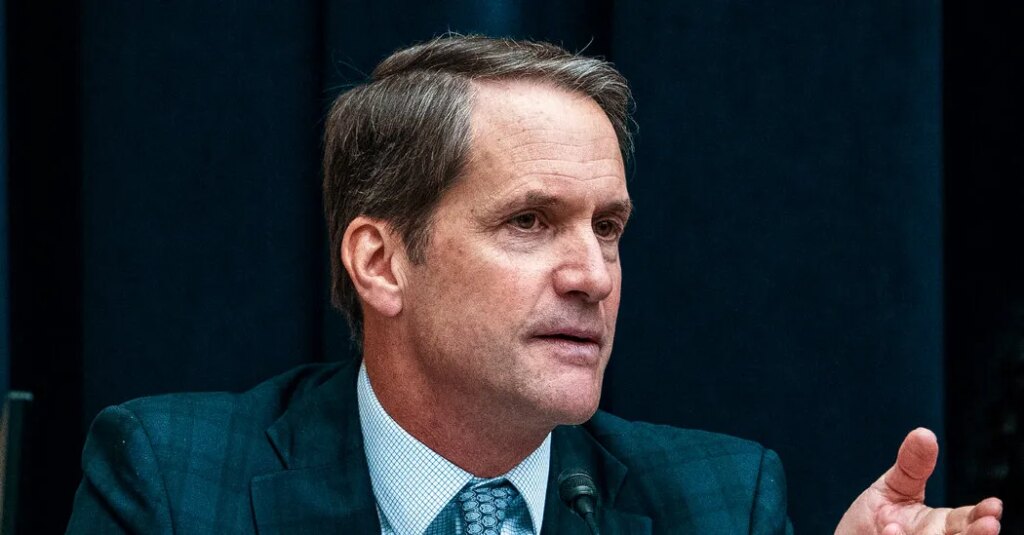
The incoming Democratic chairman of the House Intelligence Committee is promising to scrutinize the C.I.A.’s “extremely aggressive” use of covert actions since President Trump returned to office, part of a broader effort to conduct renewed oversight of American spy agencies next year.
In an interview with The New York Times, the lawmaker, Representative Jim Himes of Connecticut, outlined his priorities after the new Democratic Congress is sworn in. His committee, he added, will also examine donations to Mr. Trump’s various construction projects in Washington from defense and intelligence contractors, and investigate whether intelligence analysts have been pressured to write reports that align with the objectives of senior officials in the Trump administration.
Mr. Himes’s agenda underscores how Democrats hope to use their commanding majorities in the House and Senate to act as a check on executive power after the Republican-led Congress largely abdicated that role over the past two years. Democratic leaders have indicated that they intend to investigate a wide range of matters, like the president’s cryptocurrency windfall while in office or the activities of his eldest son, Donald Trump Jr.
Mr. Himes is likely to encounter resistance from the administration on all three of his priorities. Will Scharf, the White House counsel, has asserted that aggressive oversight by Democratic lawmakers “may cross the line into blatant criminality.”
But no matter may prove more difficult to scrutinize than the use of covert action — the secretive orders that require presidential authorization and allow for the sort of cloak-and-dagger operations that often capture the imagination of Hollywood studios and public fascination. They can include lethal missions or paramilitary deployments aimed at influencing conditions in a foreign country.
Mr. Himes said he considered it a core responsibility of his committee to review the expansion of covert actions under the C.I.A. director, John Ratcliffe.
Last year, Mr. Trump took the unusual step of publicly acknowledging that he had authorized covert action in Venezuela, allowing the C.I.A. to operate there clandestinely. The agency secretly installed a team in Venezuela to collect information months before the U.S. raid in January that captured Nicolás Maduro, and used a drone strike on a dock that American officials believed was being used by a gang to store narcotics in the days before the Maduro operation.
Mr. Himes said the expansion of the use of covert action was not limited to Venezuela.
“Covert action has become much more aggressive worldwide, and the committee would be massively failing at its job if it didn’t double down on oversight,” Mr. Himes said in the interview. “I don’t want the tone to be wrong here. I’ve spent a lot of time in weird places with the people who do covert action, and they absolutely want to do the right thing, and they have been very open to oversight. But it is nonetheless a very serious enterprise.”
White House findings that authorize covert action are closely guarded secrets. They are often reauthorized from administration to administration, and their precise language is rarely made public. They also constitute one of the rawest uses of executive authority. While a president can assign other agencies with a covert action, typically the C.I.A. leads such operations.
Select members of Congress, including Mr. Himes, are briefed on the authorizations, but lawmakers cannot make them public, meaning oversight of such actions is difficult. Any hearings or briefings the committee does that focus on the agency’s covert operations would almost certainly be behind closed doors.
The C.I.A. declined to comment on Mr. Himes’s intentions.
Mr. Ratcliffe, a former Republican congressman, promised that the C.I.A. under his leadership would become more aggressive. During his confirmation hearing last year, he pledged to make the spy agency less averse to risk and more willing to conduct covert action when ordered by the president, “going places no one else can go and doing things no one else can do.”
Mr. Himes said he would also probe what prompted intelligence and defense contractors to donate millions of dollars to what he called Mr. Trump’s “vanity projects” around the District of Columbia, including the White House ballroom and a planned 250-foot-tall triumphal arch.
“We’ll want to understand if they were promised anything,” Mr. Himes said. “We’ll want to understand if they were threatened.” He added that the committee could issue subpoenas to companies of interest and hold public hearings on the issue — rare for the intelligence panel.
Mr. Himes said that his worries about interference in the intelligence reports produced by spy agency analysts were most acute when Tulsi Gabbard served as the director of national intelligence, but that he continued to have concerns about political pressure across intelligence agencies. Ms. Gabbard, a former Democratic congresswoman, resigned from her post in June.
“We’ve had some real erosion of analytic integrity inside the I.C.,” Mr. Himes said, referring to the intelligence community. He contrasted Ms. Gabbard, whom he referred to as the “dauphin of MAGA,” with her successor, Jay Clayton, or Mr. Ratcliffe. “John and I may cross swords from time to time,” Mr. Himes said, “but it is my impression that he is, inasmuch as he can, standing up for the work force.”
Ms. Gabbard declined to comment. But Alexa Henning, Ms. Gabbard’s former chief of staff, defended the former director’s work.
“The president was overwhelmingly re-elected with a mandate to root out corruption and restore trust in our government agencies,” Ms. Henning said. “That’s exactly what we did at O.D.N.I. It’s no surprise Democrats are trying to reverse that.”
Ms. Gabbard stepped down after her husband was diagnosed with bone cancer. During her tenure, she had increasingly been sidelined by the White House on significant national-security issues, including military operations in Iran and Venezuela.
Mr. Himes said the intelligence community would take time to recover from the last two years in which “storied patriots” were fired for writing reports that disagreed with the president. “Unfortunately, there’s a long list of those people.”
The post Top Democrat Vows Oversight of C.I.A.’s Use of Covert Action appeared first on New York Times.