The first step in the United States’ campaign to economically strangle Iran was a naval blockade of its ports, cutting off Iranian trade by sea. Next came a raft of new sanctions, grounding much of the country’s air transport network.
Now, the United States is going after Iran’s last economic artery: its land routes. Only there, Washington has hit upon a problem.
For weeks, U.S. officials have tried — and failed — to diplomatically pressure Iran’s neighbors into shuttering their border crossings, according to three Iraqi officials and one U.S. official with knowledge of the talks, who requested anonymity to speak candidly.
Those neighboring states, primarily Turkey, Iraq and Pakistan, are increasingly wary and disgruntled by U.S. policies they say could hurt them as much as Tehran.
So, on Saturday, the U.S. military joined the effort, announcing Task Force Iron Gate, which it says will work on “preventing the movement of advanced weapons systems, dual-use technologies, sanctioned materials, and illegal revenue streams across Iran’s land borders and the Caspian Sea.”
It is unclear how the task force will operate in practice, and it is unusual for such an economic and security campaign to be run by U.S. Central Command, known as Centcom, which oversees military operations in the Middle East.
Former U.S. military officials and analysts say the move was likely aimed at taking advantage of Centcom’s intelligence capabilities and resources, which were already focused on Iran amid the war. Centcom, they said, could sharpen the focus and organization of previously uncoordinated efforts among diplomats, anti-money laundering units and intelligence agencies to clamp down on land routes.
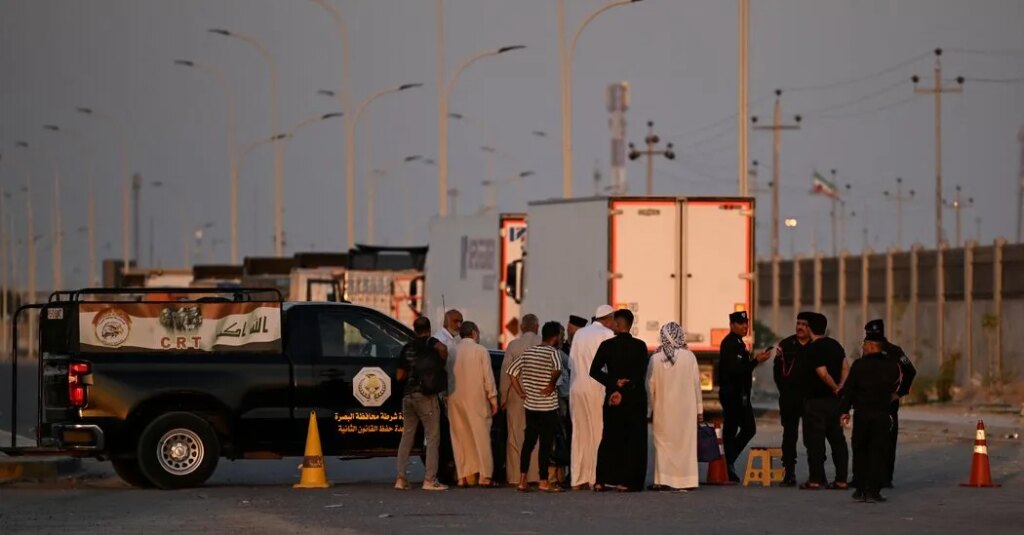
For Iraq — one of Iran’s largest cross-border trading partners — the latest U.S. effort could be particularly dangerous. The Iraqis fear unrest among smuggling networks and militants along a rugged, 994-mile border they cannot fully control. Washington has long been aware of Iran’s use of the porous frontier with Iraq to smuggle weapons and money to its militia allies there.
The task force will consist of 20 civilian and military personnel based in Florida, Centcom said in its statement. An American military official, who spoke on condition of anonymity to discuss operational matters, said they would not conduct military operations, but may instead push neighboring states to use their own militaries to crack down on illicit or sanctioned trade.
The effectiveness of Task Force Iron Gate remains to be seen, but Dana Stroul, the Pentagon’s former top Middle East official in the Biden administration, said it was a “‘Kitchen sink’ strategy.” It will aim, she said, to “squeeze any pressure relief valves the Iranian regime is using to circumvent the sanctions and naval blockade.”
The U.S. official familiar with the talks with neighboring states said that many had voiced fears of “civil insurrection” if they were to cut off smuggling and trade routes vital to businesses and populations on both sides of the border. He said that the latest U.S. efforts were stoking resentment among its regional allies.
Many of those countries were already frustrated with Washington for ignoring their pleas not to start a war with Israel against Iran in February, a conflict in which they have suffered economic costs and physical destruction.
Yet, for President Trump, tightening the blockade may be the best among bad options to try to end the war.
There is still no nuclear deal in place with Iran. And the once freely navigable Strait of Hormuz, vital for oil and gas shipments in the Persian Gulf, is now a dangerous route contested between Iranian and U.S. naval forces.
After months of stalemate, the Trump administration was widely expected to launch renewed strikes on Iran after the midterm elections. But momentum for that has fizzled as officials took stock of a sweeping Democratic victory that many of them, including Vice President JD Vance, linked to the war’s unpopularity with American voters.
The Trump administration is now casting about for other options to pressure Iran to accept a deal more favorable to the United States.
By deepening the blockade, the hope is “it just weakens the system so much from within that there will be implosion,” said Alex Vatanka, a Senior Fellow at the Middle East Institute in Washington. Analysts say U.S. officials are hoping to turn the economic screws until domestic turmoil forces Iran’s clerical rulers to capitulate to U.S. demands, or the government simply collapses.
Since announcing Task Force Iron Gate, administration officials have argued the economic campaign made renewed strikes unnecessary.
“The economic pain that is being inflicted on Iran right now is extraordinary,” Marco Rubio, the secretary of state, told reporters after a G7 meeting in Paris on Tuesday. “We don’t need to conduct military strikes if we’re achieving the same objective through economic means.”
The U.S. naval blockade, analysts say, has effectively cut off Iranian oil exports, the backbone of its economy. Some Iranian officials this summer publicly stated that exports were near zero.
With some 90 percent of Iran’s trade dependent on maritime routes, the blockade was also devastating for Iranians trapped in a spiraling economic crisis.
Iran’s leadership, however, has had decades of learning how to develop secret business and smuggling networks to circumvent U.S. economic sanctions and withstand sustained economic pressure.
The new task force, Mr. Vatanka said, was effectively “a recognition that the Iranians were moving fast to compensate” for their maritime losses through reliance on land routes.
Analysts and diplomats say Iraq, Turkey and Pakistan have been the focus of U.S. efforts so far. Turkey has largely refused to change its border policies, they said, while Iraq has struggled to placate both sides.
The Iraqi leadership has held weekly talks with U.S. diplomats, including the regional envoy, Thomas Barrack, according to two of the three Iraqi officials, who said Iraq was asked to close all but two of the country’s border crossings with Iran.
The officials said Iraq had so far refused but, in a gesture to U.S. demands, had temporarily closed one or two crossings — often to huge uproar among its own population.
Publicly, Iraqi officials have said the closures were made to upgrade monitoring and security measures that would help curb money laundering and weapons smuggling at the border.
Pakistan, whose official yearly trade with Iran amounts to $3 billion, may have taken an approach similar to Iraq’s, analysts said, as it has opened and closed some of its border crossings with Iran in recent weeks.
Pakistani officials have said those recent border shutdowns were based on security issues, or the implementation of new electronic import processes — a move Iranian officials said was linked to U.S. sanctions on their country.
Peyman Sanandaji, head of the Transportation Commission at the Tehran Chamber of Commerce, told Iran’s Mehr News Agency that “banking restrictions related to Iran” risked “effectively bringing Iranian exports to Pakistan to a halt.”
Iran is now moving quickly to exert its own pressure on these countries, telling them not to acquiesce to U.S. demands.
“We, too, are continuing to pursue our efforts with neighboring countries and maintain our discussions with them,” said Iran’s president, Masoud Pezeshkian, in a speech last month, in which he criticized U.S. efforts to pressure countries to stop trade. “We hope we will succeed.”
Working in the Iranian government’s favor is the presence of powerful regional actors, like China and Russia, that are also still willing to work with it.
On Tuesday, Iran’s deputy foreign minister announced he had held a meeting with the Russian ambassador to Iran to discuss “how to counter unilateral U.S. actions, and the so-called Iron Gate plan.”
Iran can exert economic leverage over its neighbors, said Ellie Geranmayeh, an Iran expert at the European Council on Foreign Relations. Pakistan, for example, is heavily dependent on Iranian fuel imports, particularly liquid petroleum gas.
Iraq, meanwhile, relies on Iran for more than a third of its gas, which is used to power its electrical grid. When Tehran has cut off those supplies in recent years — often because of U.S. sanctions that hindered Baghdad’s ability to pay — that has triggered huge power cuts and street protests.
The U.S. midterm election results were seen as such a resounding rebuke to the Iran war that countries in the region may simply choose to ignore U.S. demands, Ms. Geranmayeh said.
“The U.S. is currently an unpredictable and, in some cases, unreliable ally,” she said, “Iran is going to be their neighbor, they know they’re stuck with Iran for life.”
Falih Hassan, Sanam Mahoozi and Shirin Hakim contributed reporting
The post U.S. Efforts to Tighten Blockade of Iran Rely on Reluctant Neighbors appeared first on New York Times.