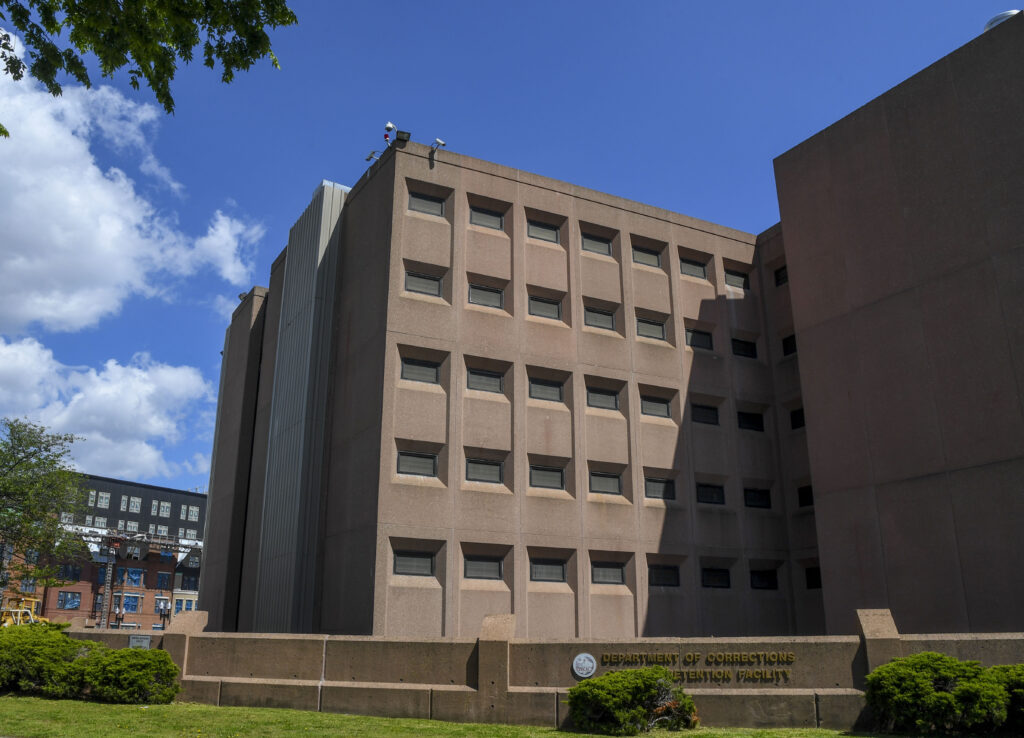
D.C.’s aging jail has been plagued over recent years by sewage backups and overflowing toilets, moldy showers and ceilings, walls that leak water when it rains. Jailers contend with broken cell doors and security gates among a long punchlist of deficiencies, according to recent audits and inspections there.
City leaders have talked about the need to replace or modernize the Central Detention Facility since at least 2010. An audit last year underscored the need for discussion to give way to action. A recently announced federal investigation into conditions there could add urgency to the conversation.
But the ever-increasing cost of rectifying the situation has made officials pause. The price tag went from $463 million in 2024 for the initial phase of a two-part replacement plan to $1.4 billion last year for tearing down the 50-year-old structure and building a new jail.
One new estimate tops $2.7 billion in responses from 11 industry groups that answered the D.C. government’s call for pitches to build a new city jail. The records were obtained by The Washington Post through a public-records request.
Even as the concerning conditions have persisted, D.C. officials have prioritized building a new Commanders stadium. When it comes to a new jail, Mayor Muriel E. Bowser’s administration has said it is interested in turning to the private sector for financing because the city is near its legal limit on debt. Mayor-elect Janeese Lewis George has yet to weigh in.
That short-term solution may drive the cost even higher and stretch out payments across three decades, according to one preliminary estimate.
Six of the 11 groups that responded to the city favored some variation of a public-private partnership financing model, which means a developer would design, build, finance and maintain the new jail while the District operates it.
Such an arrangement could defer payments until after the jail opens, potentially allowing the city to avoid accumulating more debt up front. One of those respondents estimated that privately financing the project could require annual payments of $118 million for 30 years, totaling $3.54 billion.
While some proponents of public-private financing claim it can off-load risk from the government to private companies, Mildred Warner, a Cornell University professor who specializes in restructuring government services, said that common promise is often broken.
Warner said private companies carry an advantage into the contract negotiations with city governments because they have negotiated similar deals in the past and better understand how to take advantage of the framework. She called it “information asymmetry.”
“The side with more information is going to win,” Warner said. “They’re going to write it in a way that would benefit them more.”
Warner said private capital is inherently more expensive for cities, but “if you’re sitting under a debt ceiling, it may be the only thing you can do.”
While advocates and experts have had an eye on jail conditions for a long time, the past year has tested the facility’s limits.
More arrests during President Donald Trump’s crackdown on D.C. and stiffer charges from prosecutors have increased the daily jail population.
Recently filed class-action cases include one accusing jail officials of serving food with rodent droppings, dead mice and fur in it, and another targeted environmental conditions such as mold, extreme temperatures and toilets exploding with raw sewage.
Kathy Patterson, the D.C. auditor who last year released the report calling for urgent replacement of the jail, said public officials have failed to prioritize the new jail despite the deteriorating conditions. The time for urgency was 15 years ago, she said.
“What we have lacked for the last 20 years is anyone to be a champion, to say we are building a new jail, and to say it this year and next year and the year after and make it happen. And no one, no elected official, has done that,” Patterson said.
Patterson said she worries the growing cost estimates might just “scare everybody away” even further.
“Those are very scary numbers — especially when the District is currently looking at flat, if not declining, revenue,” she said. “That’s an enormous challenge.”
At this point, she said public officials have “no choice.”
“If you are going to continue to incarcerate people, you’ve got to have the facilities to do it,” she said.
Officials in the Bowser administration have argued that privately financing a new jail could allow construction to begin quicker, though experts caution that may not be the case.
Warner said faster construction speed, increased innovation and efficiency are claims that are often made about public-private partnerships.
“A lot of those claims don’t hold up,” she said.
Two of the respondents to the District’s request for information recommended a publicly financed design-build, warning that private capital would cost more and limit the District’s control.
Taken together, the responses present the city with a choice between borrowing more cheaply now or paying more money over a longer period with the hopes of shifting construction and maintenance risks to a private partner.
Qingbin Cui, a University of Maryland professor who studies private-public partnerships, reviewed the responses to D.C.’s request and said they show a strong market interest.
Cui said many local governments have been motivated to pursue private financing because of their debt capacity, like D.C., but he cautioned that the partnership should provide value beyond that.
“You should not just do it on the debt capacity,” he said. “That’s not a good reason.”
In response to questions from The Post, the D.C. city administrator’s office said staff are reviewing the responses with construction and finance experts, with a preference for public-private partnerships that would work within existing constraints on new debt issued for capital spending. Once that review is done, city agencies will issue a request for proposals that would include more solidified details on the project scope and financing.
Council member Charles Allen (D-Ward 6) acknowledged that over the years, “to the public, it’s a lot easier and better to build schools and parks and rec centers” than it is to put those dollars into the jail.
He said he did not know enough about the cost estimates to comment on them in detail but agreed that the jail’s current state demanded urgent funds for replacement.
“Politically, it’s always harder to put the dollars into [a jail]. But we can see right now inhumane conditions. The facility continues to fall apart, which is going to cost taxpayers more and more money. … So it’s going to continue to just be a huge drain on our budget if we don’t have a long-term solution.”
Council member Brooke Pinto (D-Ward 2) said she has always believed in keeping the jail in the District’s own capital budget, but said she would remain open-minded about the public-private financing model — “if the numbers make sense.”
“I think it is a priority, it is vitally important that we have dignity and a habitable environment for people in our care and custody, and the current facility is just not an acceptable place,” she said.
She said she wanted to see the incoming mayor prioritize capital funds for the jail in her first budget. Lewis George declined to comment, saying she needed more time for review.
The post D.C. needs to replace its troubled jail. The cost could be a problem. appeared first on Washington Post.