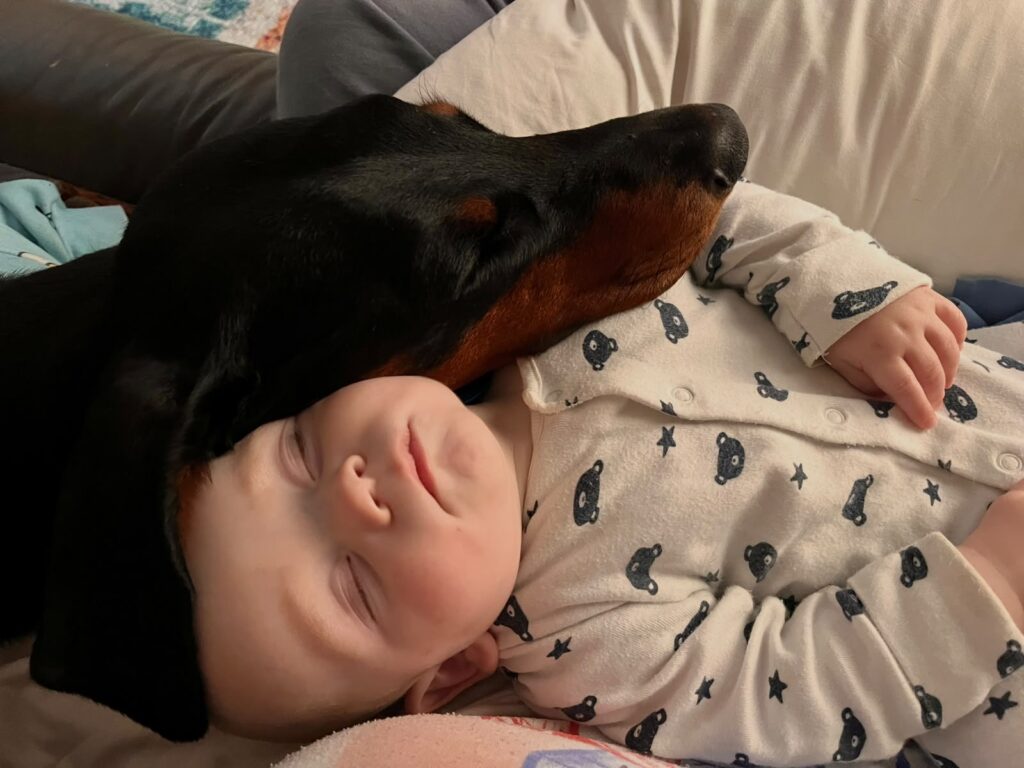
Kim Reynolds noticed that her dog was acting strangely around her son Alexander.
The dog, a Doberman named Saraya, was whining and pacing near the 5-month-old, licking the baby’s face and becoming increasingly distressed. Reynolds’ mother was visiting at the time.
“My mum was like, ‘What is wrong with Saraya today?’” recalled Reynolds, who lives in Somerset County in the U.K.
Alexander seemed fine, so Reynolds didn’t think much of the dog’s behavior until later that day, when Alexander started screaming and crying uncontrollably.
“I tried taking him outside, tried giving him a bath,” Reynolds said. “None of it worked.”
Thinking back to her dog’s strange behavior that Sept. 3 morning, she and her mother decided to take Alexander in for emergency care.
There, they learned the baby’s heart rate was dangerously high: well over 200 beats per minute. Clinicians told Reynolds that Alexander’s heart rate was concerning, especially if sustained.
Hospital staff tried several ways to lower his heart rate, finally administering a medication that worked. The family ended up spending two nights in a pediatric ward as Alexander was monitored and doctors ran tests.
Alexander was diagnosed with Wolff-Parkinson-White syndrome, a congenital heart condition that can cause dangerous heart palpitations. He was prescribed beta blockers, and doctors said he may eventually need a procedure to help regulate his heart rate. For now, Reynolds said, Alexander is doing well.
The signs of supraventricular tachycardia (SVT), the very fast heart rate that Alexander was experiencing, can be subtle in infants. Sometimes it goes undetected for days, which can be potentially life-threatening, said Vassilios Bezzerides, a cardiologist at Boston Children’s Hospital.
“It’s like running a marathon as fast as you possibly can and never taking a break,” Bezzerides said, explaining that this can weaken the heart over time.
He said that when he heard about Alexander’s case, he thought about similar situations he’s seen in his own practice.
“I have a couple patients where this has happened,” Bezzerides said. “Something’s off, the family dog notices something.”
The good news, he said, is that SVT can usually be treated quickly once it’s identified, and the heart can return to its regular functioning.
“When we see a baby with this condition, we’re able to tell the family, we know what it is, it’s not anything you did to cause it, and we have ways to treat it,” Bezzerides said. “I think that’s very reassuring for families.”
Reynolds said she is grateful that Saraya alerted her that something was wrong, because she’s not sure she would have gone to the hospital if not for the dog’s behavior.
“I dread to think what would have happened,” Reynolds said. “It hadn’t even crossed my mind there was going to be a heart issue.”
About 1 in 100 babies are born with a heart condition, and many go undetected, according to Tiny Tickers, a U.K.-based nonprofit that trains health care workers to help identify heart conditions in babies.
“All these years, we’ve been training sonographers,” said Jon Arnold, Tiny Tickers chief executive. “Maybe we could get down a different path and train dogs and place dogs with families.”
Dogs have been known to detect other medical problems in humans, including cancer, impending seizures, low blood sugar and heart arrhythmias.
One 2022 study showed that dogs can smell the difference in a person’s breath before and after a stressful task.
“As your heart rate changes rapidly, it releases lots of different changes and the dogs are picking up on those odors emanating from our breath and our sweat,” said Clara Wilson, a postdoctoral researcher at the University of Pennsylvania, who conducted the 2022 study.
Service dogs can be trained to do this, but Wilson said it’s not surprising that a non-service dog would do this spontaneously.
“The reason why a lot of people got into training these dogs in the first place is because of these type of anecdotal reports,” Wilson said.
Clive Wynne, a dog behavior expert at Arizona State University, said that medical detection in dogs comes down to two things: Their heightened senses of hearing and smell, and their affection for humans.
“The dog noticed something strange in an individual that the dog had a strong emotional connection to, and that’s all it takes,” Wynne said.
Reynolds said she hopes her story raises awareness about congenital heart issues, and empowers parents to listen to their instincts if something seems off.
“Just always trust your gut,” Reynolds said. “It’s better to be safe than sorry.”
Sign up for The Optimist newsletter
Get inspiring stories delivered to your inbox every Sunday.
The post Her dog sensed something was wrong with her baby. It may have saved his life. appeared first on Washington Post.