Morgan Chittum here. The point of venture capital? Get in early on the next big thing. But when one firm backs a buzzy startup, others often rush to follow. The more compelling—albeit riskier—story belongs to the contrarian: the investor willing to get there first and stand alone.
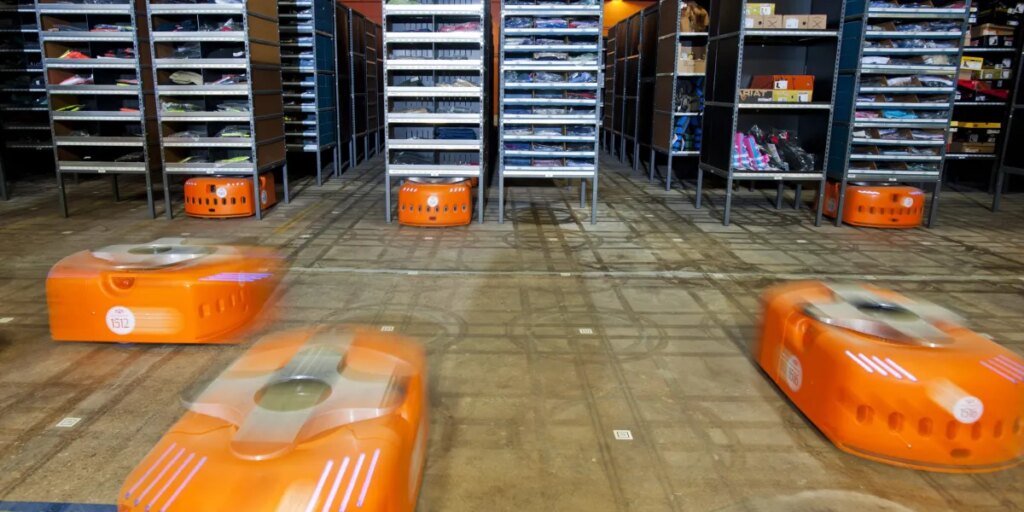
That’s the kind of bet Bain Capital Ventures’ Ajay Agarwal made more than two decades ago, backing a robotics startup that Silicon Valley investors had largely turned away. The company was Kiva Systems, which Amazon would later acquire for $775 million.
When Agarwal met Kiva cofounder Mick Mountz in 2004, the company had no revenue, no finished product, and no customers. At the time, software was a quicker, cheaper route to market. But Mountz’s pitch was simple: Instead of making warehouse workers walk the aisles to retrieve products, have robots bring the shelves to them. “Within five minutes of the meeting with Mick, I thought to myself, ‘This is the best meeting I’ve been in in 18 months,’” Agarwal told me. “I didn’t know anything about robotics or hardware, but he explained the problem in a way that you could explain it to your grandmother.”
Convincing Bain’s partners to invest, however, would take more work. “Their initial reaction, which I don’t blame them for, was ‘We don’t know anything about robots,’” Agarwal said.
Through Bain’s network, Agarwal connected Kiva’s team with Don Ralph, who ran North American e-commerce fulfillment for Staples, for additional due diligence. That one-hour meeting turned into three. The next day, Ralph called Agarwal: “I’ve been in this industry for 35 years. That was the single most compelling technology I’ve ever seen. You have to invest.”
Bain later led Kiva’s first funding round and Staples became its first customer. High-profile companies like Zappos, Gap, and Zara followed suit. Eight years later, Amazon bought it for $775 million. Bain told Fortune its initial investment in Kiva generated a 26.6-fold return.
Now, Agarwal sees an even bigger, wider opportunity. “We’re in the golden age of hardware and physical AI,” he said. That’s the technology that lets robots and other machines perceive and act in the real world.
This time, though, the rest of Silicon Valley has joined in.
Robotics and physical AI startups raised $27.6 billion in funding across 1,009 deals in 2025, more than double the previous year’s total, according to PitchBook figures. Among them is TerraFirma, a construction robotics company that Bain was the first to back in 2024. In July, the startup announced a $100 million Series A led by Kleiner Perkins, with Bain investing again.
What makes Agarwal think this momentum will last? For starters, the talent. TerraFirma’s founders, Noah Schochet and Noah McGuinness, came from SpaceX. Physical Intelligence, another leading robotics startup, was started by Berkeley roboticist Sergey Levine and ex-Google DeepMind researcher Karol Hausman.
“I think it’s a reaction a little bit to people feeling jaded by 20 years of workflow software,” Agarwal said. “People may be feeling like this is not ambitious enough. I want to do something bigger. I want to do something harder.”
The hardware is also cheaper. Many crucial components now cost a fraction of what they did years ago. Part of that comes down to scale: Smartphone and electric vehicle makers buy up cameras, sensors, and batteries in massive quantities, helping drive down the cost of parts that robots use as well. “That means the ROI that you can deliver is so much more compelling,” he said.
Finally, more advanced AI means machines have a better shot at handling real-world scenarios. “They can deal with situations they haven’t seen before,” Agarwal said. “They can adapt and adjust to the edge cases which inevitably happen in a physical environment.”
Twenty-two years ago, Agarwal had to convince his partners to take robots seriously. That’s no longer the hard part. It’s finding a bet the rest of Silicon Valley hasn’t already crowded into.
See you tomorrow,
Morgan Chittum X: @morgan_chittum Email: [email protected]
Submit a deal for the Term Sheet newsletter here.
Joey Abrams curated the deals section of today’s newsletter.
The post Bain Capital’s Ajay Agarwal bet on robots when Silicon Valley wouldn’t. Now he sees a ‘golden era’ for physical AI appeared first on Fortune.