Even for a kaiju movie, “Godzilla Minus One” was a beast.
When it opened in 2023, the movie became the highest-grossing Japanese-language Godzilla movie of all time, surpassing beloved Toho classics like “Shin Godzilla” (2016) and the 1954 original. The film went on to win eight Japan Academy Film Prizes and an Oscar for best visual effects, the first in the franchise’s history.
Clearly a sequel was called for, even for a franchise with dozens of them. But what would Takashi Yamazaki, the director and screenwriter of “Minus One,” do for an encore?
For starters, find a monster for Godzilla to scrap with. There were many to choose from. Over the past eight decades, Godzilla has battled an army of outsized rivals, from giant moths (Mothra) and crustaceans (Ebirah) to alien cyborgs (Gigan) and armored versions of himself (Mechagodzilla).
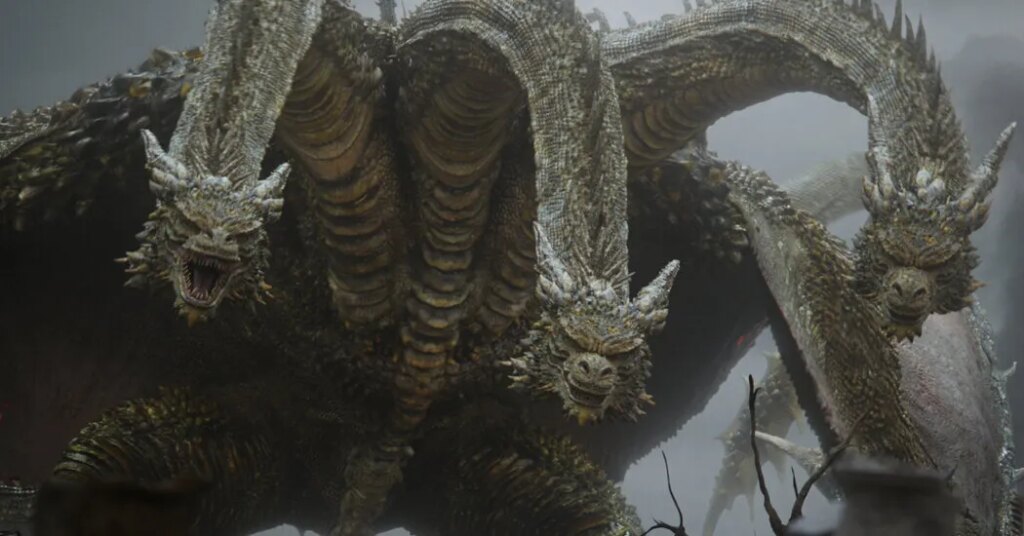
Yamazaki, who also led the visual effects team, selected King Ghidorah, the winged, three-headed, two-tailed dragon first seen in the Toho feature “Ghidorah, the Three-Headed Monster.” The choice, the director said in an email interview, was personal.
“Ghidorah first appeared on screen in 1964, and I was born that same year,” he said. “And 1964 was the Year of the Dragon, which perhaps has something to do with why I love dragons so much.”
Further, in Ghidorah’s cinematic debut, the monster ravages and levels Matsumoto — the city in Japan’s Nagano Prefecture where Yamazaki was born and raised.
In “Godzilla Minus Zero” (in theaters), Yamazaki breaks with all sorts of traditions. The feature is the first in the franchise to receive an R rating (for violent content/bloody images), and, befitting monsters of this size and decibel level, the first Japanese feature film to be shot for IMAX.
Yamazaki’s computer-generated Ghidorah is a quantum leap from the 1964 suitmation original, whose action sequences were performed by a single, seriously overheated actor, Shoichi Hirose, in a cumbersome, full-body costume, and whose multiple heads, wings and tails were controlled by six offscreen puppeteers.
“It’s extraordinary that they were able to achieve so much with those techniques,” Yamazaki said.
In “Zero,” a much larger, much more mobile Ghidorah eats lightning, levitates entire towns, grows extra heads and engages in thrilling dogfights high above the Japanese landscape. (Takayuki Ueki and Eisin Okubo were the visual effects supervisors.)
He also absorbs the life force of all sorts of creatures, including Godzilla.
In a video interview, one of the film’s producers, Kazuaki Kishida, presented an even bigger question about Ghidorah: Can he absorb human life itself? “His strength seems unending,” he said.
And of course, Ghidorah fights Godzilla.
However, unlike similar “Godzilla vs.” marquee battles dating back to “King Kong vs. Godzilla” (1962), there’s no “versus” in the title of “Minus Zero,” and no sight of Ghidorah in the film’s trailers.
Indeed, just who Godzilla was fighting in “Minus Zero” was a much-debated mystery among fans for months — until keen-eared viewers of the trailer heard Ghidorah’s unmistakable roar.
Or three roars — one for each head.
Natsuko Inoue, the film’s sound designer and foley artist, helped bring that roar to life. “The first thing I did was create this harmony of roars between the three heads,” she said in a video call. Each roar was subtly different, she said, with the middle head the alpha.
Inoue recorded the sounds of animals that Ghidorah absorbs to attain their powers (snakes, deer, hawks), and sampled the roars of the original 1964 beast. She also sang.
“Ghidorah’s roar sounds very throaty, and has an almost melodic element to it,” she said. “So I had people, including myself, sing and make different sounds, and those were all sampled in the final roar.”
To build the sound of Ghidorah’s massive wings, she swung around “different rubber objects.” Between the three roars and the flapping wings and the yellow lightning bolts he shoots out of his mouths, it’s a cacophony.
The sound mixer Hisafumi Takeuchi had to ensure the audience heard what they were supposed to hear (dialogue, music) above Ghidorah’s din. “Yamazaki-san likes loud sounds, but I would resist the temptation to just make it louder for the sake of making it louder,” he said in a video interview.
Yamazaki also wanted Ghidorah’s “gravity beams” to actually have an effect on gravity.
“In many of the earlier films, they just tended to make things explode on impact,” he said.
Yamazaki became inspired after seeing a short film made for a limited-time “Godzilla vs. Evangelion” theme park attraction at Universal Studios Japan in which Ghidorah lifts buildings into the air.
He directed his own horrifying scene in which Ghidorah levitates a whirling mass of houses, complete with screaming residents. “By focusing on individuals caught inside them, I thought we could convey the true terror of such an extraordinary situation,” he said.
Even with a rival that’s a flying dragon, aerial sequences in previous Godzilla vs. Ghidorah battles were limited by the technical constraints of suitmation and the fact that Godzilla doesn’t fly. To fight the King of the Monsters, Ghidorah usually had to land.
But Yamazaki really wanted an air battle, particularly after the epic sea battle of “Minus One.”
For Ghidorah’s first scene in “Minus Zero,” Yamazaki has the dragon go up against all-too-human fighter pilots, not Godzilla. The matchup makes for a much more exciting dogfight, one unlike the typical battle between human pilots. “With a kaiju, it’s like being targeted by a wild animal,” he said. “The fear comes from not knowing what kind of attack is coming.”
Even so, Yamazaki knew his two kaiju had to eventually fight, and it had to be big. Early on, he had written “a fight to the death” in the script, but wasn’t sure what that might mean.
“We watched documentaries of animals fighting for their lives, and thought about what such a struggle would look like between enormous monsters that don’t die that easily,” he said.
The result is a battle royale that, without giving anything away, helped “Minus Zero” earn that R rating. “A monster battle isn’t necessarily better just because it’s longer,” Yamazaki said. “I wanted something relatively short that would deliver a tremendous shock.”
The post Ghidorah Brings Gravity to ‘Godzilla Minus Zero’ appeared first on New York Times.