LP O’Brien is a bartender and global beverage strategist.
The holidays haven’t arrived yet, but many bars and restaurants are already testing recipes, calculating costs and placing bottle orders for what you’ll drink in December. That peppermint martini or cranberry cocktail takes time to reach the menu.
Complicating the process this year: tariffs on countries that supply some of America’s favorite spirits. The latest is a ban on imports of certain Canadian whiskies, put in place by President Donald Trump to bring Canada back to the tariff negotiating table.
As a longtime bartender and hospitality consultant, I hope the president’s negotiating gambit works. But I’m also worried about my colleagues in the hospitality industry, who need predictability to plan for the critical season ahead and are already facing tight margins as inflation curbs what customers are willing to spend.
They recently got some good news when Trump announced that he was lifting the tariffs on Irish whiskey and Scotch, two beloved spirits. But it takes time for a supply chain to return to normal, so menus may not reflect the changes by the holiday season. Meanwhile, tariffs and other restrictions remain on favorites such as French cognac, London gin and now Canadian whisky.
This hurts bar owners in several ways, and customers feel it too — whether they realize it or not.
The restrictions drive up costs. Even when the bottles customers want are still available, tariffs make them more expensive for bars to buy. Owners have to decide whether to pass those costs on to customers or absorb them by accepting lower — or nonexistent — margins.
This is a difficult decision because alcohol sales are critical to not only bars but also restaurants — accounting for more than 20 percent of revenue in most establishments that sell alcohol. When those margins are curbed, a restaurant either has to raise food prices or cut costs in other areas. That’s one reason hospitality employment has struggled to regain consistent momentum since the covid pandemic, and the most recent labor statistics from September show continued stagnation.
I recently heard from Jordan Cotton, owner of D.C.-based bar and distillery Cotton & Reed, who shared that tariffs have driven up almost all of his input costs, from bottles and corks to cane syrup. He called tariffs “a double-digit multiplier” on his vendor invoices, and he said he has no choice but to pass on those costs to customers.
These trade disputes also limit the options on the bar shelf in some ways that aren’t obvious. Of course, tariffs on products such as London gin and cognac make them less likely to be available or affordable. But trade wars cut both ways: A cycle of retaliatory tariffs on American spirits has forced many American distillers out of international markets, hurting businesses here at home.
Craft distillers feel it most. For more than eight years, American whiskey distillers have been whipsawed by tariff disputes with the European Union and Britain. Those disrupted key export markets for many small craft distillers that relied on foreign sales to stay afloat. These businesses also continue to have their spirits banned from Canada, with U.S. spirits exports over the northern border down 70 percent year over year since the country’s retaliatory ban on U.S. imports took effect in March 2025.
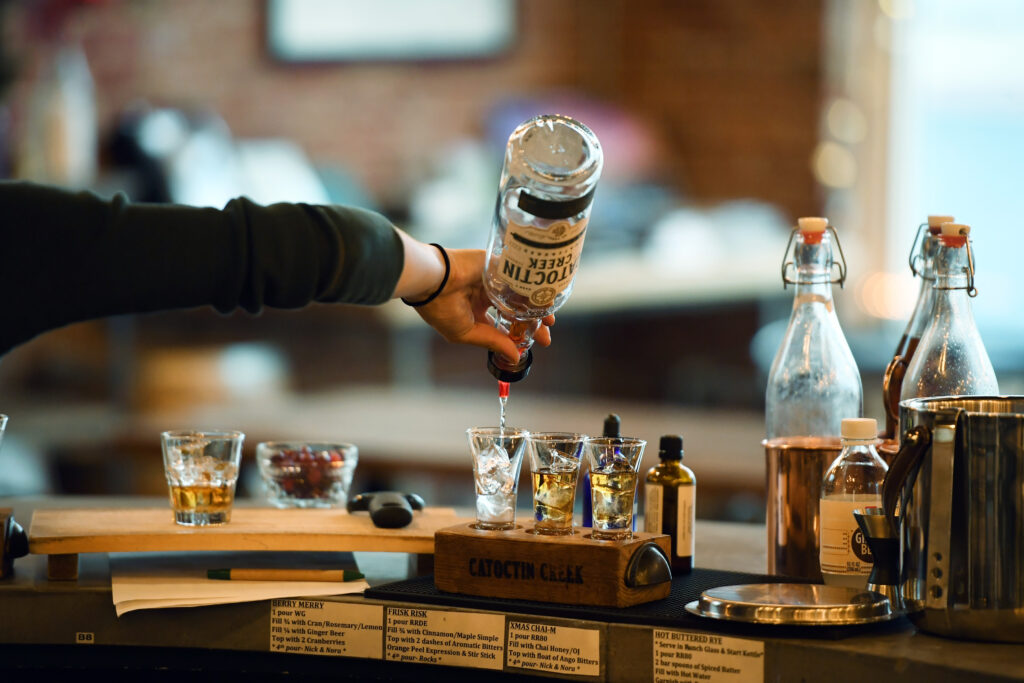
Becky Harris, co-owner and head distiller of Catoctin Creek Distillery in Loudoun County, Virginia, told me that tariffs are also causing some large wholesalers to shed smaller brands that are more vulnerable to the trade disruptions. She knows many in the industry who are considering shutting down. Over the past year, there has been a 6.6 percent decline in active craft distilleries, leading to fewer options for customers.
This raises a related concern: predictability. As a global beverage consultant, my job is to create beverage menus based on data, helping determine the products a business decides to purchase. I need to analyze profit margins, assess availability and weigh difficult trade-offs related to variety and customer preference. All of this is harder when changing policies compromise the ability to plan ahead.
I’ve spent years trying to help bars and restaurants return to growth after the pandemic destroyed many businesses. Policymakers need to understand how much harder tariffs have made it.
I hope American spirits return to Canadian shelves and that the current ban proves short-lived. The goal should be free trade of spirits in both directions, giving American distillers access to customers abroad and hospitality businesses reliable access to the bottles they want at home. That would be a holiday gift worth toasting to.
The post Why is your cocktail so expensive? Ask the White House. appeared first on Washington Post.