Democrats are buoyant. Republicans are licking their wounds. But is it too early to look at the fight for the Senate in 2028?
Democrats will have a 54- to 56-seat Senate majority next year, depending on how uncalled races in Mississippi and Alaska turn out.
Some Democrats speculate that a strong showing in 2028 could position the party to win a 60-seat supermajority with the power to overcome the filibuster.
“Some of the very same states where we won this election will offer new opportunities to expand our majority in 2028 — Iowa, Kansas, the Carolinas, and more,” Chuck Schumer, the New York Democrat who is presumed to be the next Senate majority leader, said Thursday.
In an interview on Thursday, Schumer said Democrats would work with their candidates who won those states to maintain their campaign infrastructure heading into 2028. “We’re not going to just close shop,” Schumer said.
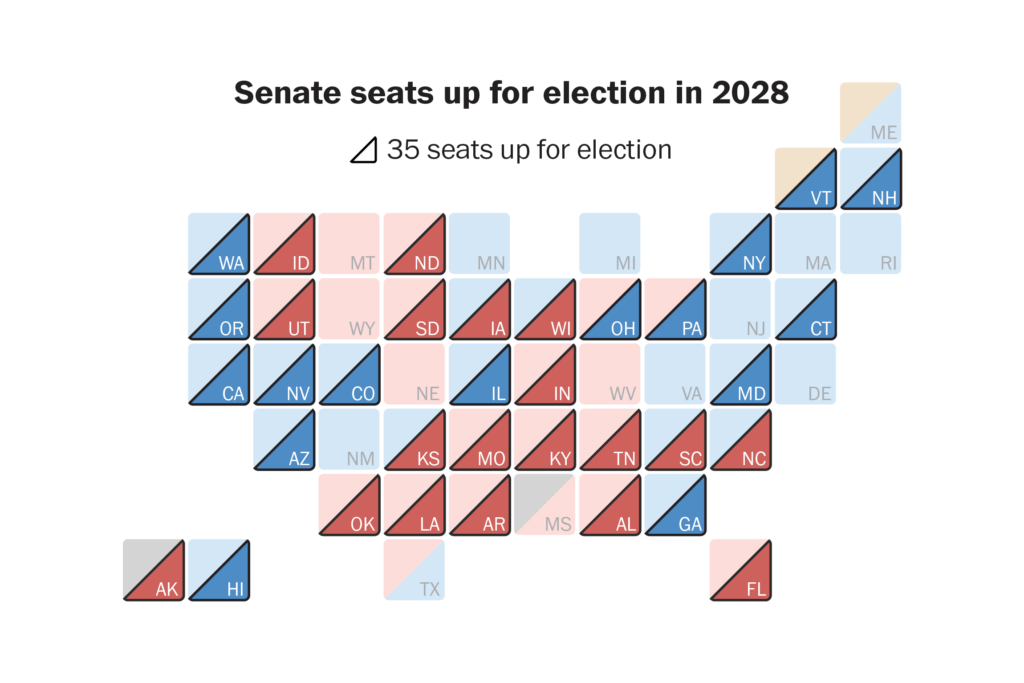
It’s probably wishful thinking, as both parties have promise and pitfalls as they look forward to two years, with 19 Republican seats and 16 Democratic offices on the ballot. (Republican Sen. Marsha Blackburn was elected governor of Tennessee last week. She will appoint a successor — certainly a Republican — for a two-year term until a special election is held in 2028)
Republicans, meanwhile, have already begun plotting a comeback, hoping to reclaim lost ground in a presidential year.
Sen. Tim Scott (South Carolina), the chair of the National Republican Senatorial Committee, did not respond to a request for comment.
The map so far is shaping up to have about seven obvious battlegrounds, five of which are held by Democrats. But as this year showed, the math and the map can shift quickly, depending on retirements, scandals, the political environment and individual political talent.
Here is what to watch for in the 2028 fight for the Senate:
Democrats in Trump-won states
The political environment in 2028 will undoubtedly differ from what both parties faced this year, shaped by a presidential election that will likely make the electorate more partisan.
The good news for Republicans is that Democrats will have to defend five seats in states President Donald Trump won in 2024. Mark Kelly in Arizona, Catherine Cortez Masto in Nevada, Raphael Warnock in Georgia, John Fetterman in Pennsylvania and Sherrod Brown in Ohio are all slated to be up for reelection (Brown, though he just won, will be filling an unexpired term). Meanwhile, Republicans have no seats to defend in states Kamala Harris carried that year.
Democrats are upbeat that all five candidates have shown they can raise serious money and run tough campaigns, but this dynamic means they will spend much of the cycle on defense.
Kelly is widely seen as a possible 2028 presidential contender, complicating his path forward in the Senate should he decide to run for president.
“I haven’t made a decision on it,” Kelly told The Washington Post on running for president in 2028.
The same is true of Warnock, a possible 2028 contender who has toyed with the prospect.
The party’s toughest race in that handful will likely be Brown’s contest. The senator lost his bid for reelection in 2024, won a Senate seat back in a 2026 special election, but will now have to run again in 2028 for a full term.
In Brown’s 2024 race, the candidates and outside groups spent more than $480 million, a record at the time that Brown’s 2026 run broke two years later, with spending expected to exceed $500 million.
Any race Brown faces in 2028 will likely set another Ohio record.
Republicans will also look to go on offense in South Carolina, where Democrat Annie Andrews just won and Scott has said he is running for reelection.
South Carolina, however, is undoubtedly a stretch in a presidential year.
Republicans up in purple states
Democrats proved this year that they can run and win in states where Trump has dominated. The party also has several Republican targets on the 2028 ballot: Ron Johnson in Wisconsin, Ted Budd in North Carolina and Lisa Murkowski in Alaska.
It’s early, and the map is still uncertain, with few incumbents yet to announce whether they plan to seek reelection and race contours still shifting as retirements unfold. The race in Alaska would be far more compelling for Democrats if Murkowski, who has a unique bipartisan coalition in the state, were to retire.
But in a presidential year, races in Wisconsin and North Carolina will attract considerable investment, making Johnson and Budd the top two Democratic targets in 2028.
Budd, who won his first term in 2022 by three percentage points, will likely seek reelection. A handful of North Carolina Democrats could challenge him, including Jeff Jackson, the state’s attorney general, who has won a statewide race in the purple state.
The 71-year-old Johnson, a frequent Democratic target given Wisconsin’s dramatic political swings, has yet to announce whether he will seek reelection and has said he is leaning against it.
“I don’t want to,” he said at the Milwaukee Press Club in 2025. But he added, he learned during his second run in 2016 when he said it was his final campaign, “You can’t say, you know, never, never.”
Johnson won by one percentage point in 2022, the second tightest race of the cycle.
Possible Republican retirements
Republican retirements could also alter the Senate map.
Iowa Sen. Chuck Grassley, a Republican first elected to the legislative body in 1980, will turn 95 a few weeks before the 2028 election, meaning that if he seeks reelection, he would be over 100 if he won a ninth term in the Senate. He has yet to announce his 2028 plans, but many in Iowa believe he will retire.
Grassley used his age to argue that Republicans should support the party’s nominee for governor, Zach Lahn, in 2026.
“One of the reasons I’m worried about who’s going to be elected governor — I don’t plan on dying in office — but if I did, I don’t want a Democrat governor choosing my successor,” he told an audience in West Des Moines this year.
Pat Grassley, the senator’s grandson and the Republican speaker of the Iowa House, is seen as a possible successor. “My grandfather and I don’t ever talk about those things. And that’s the truth. And we don’t really talk about what that would look like,” he said last year.
Sen. Jerry Moran, a Kansas Republican, will turn 74 in 2028 and has yet to announce a reelection bid. The state would be a reach for Democrats, but the party just won a Senate seat there for the first time in a century, and the right kind of recruit, like Democratic Rep. Sharice Davids, could make the race competitive.
Possible Democratic retirements
Democrats also have a few aging senators up for reelection.
Sen. Richard Blumenthal, a Connecticut Democrat, will be 82 by the end of 2028, but has informally said he plans to run. “I don’t have a formal announcement today, but I look forward to being on the ballot in 2028 and continuing to serve the people of Connecticut,” he told reporters this month.
Sen. Peter Welch, a Vermont Democrat, will turn 81 ahead of the 2028 election and has yet to announce his plans.
Sen. Ron Wyden, an Oregon Democrat, will be 79, and Sen. Patty Murray, a Washington Democrat, will be 78 in 2028, but both have said they will seek reelection.
The most compelling possible retirement is Schumer, who will be 78 in 2028. The New York Democrat has not announced a reelection campaign, but the left has pressured him to retire and open the seat for someone more progressive, Rep. Alexandria Ocasio-Cortez (D-New York).
“The Democratic Party’s momentum right now is like a powerful car driving down the highway with its parking brake on, and that thing dampening our momentum is Chuck Schumer,” said Adam Green, the head of the Progressive Change Campaign Committee, a group that has pushed for Schumer to retire.
The Fetterman question
The biggest wild card on the map is Fetterman’s seat in Pennsylvania.
The senator was first elected in 2022 as a progressive champion, merging the party’s leftward lean with working-class populism. But his term has been defined by health issues and his breaks with the Democratic Party, angering those who helped elect him to the point that some Democrats are concerned he could caucus with Senate Republicans, something he has denied.
Democrats, including Rep. Chris Deluzio and former congressman Conor Lamb, are seen to be top possible primary challengers to Fetterman in 2028, if he chooses to run for reelection.
“What John Fetterman does doesn’t affect it one bit for me at this point,” Deluzio told the Philadelphia Inquirer this month.
Deluzio told The Washington Post that he is “thinking hard about my next steps, and will be having that conversation with my family and supporters.”
Lamb, who has been crisscrossing the commonwealth and speaking with voters, told SpotlightPA this year that while he isn’t running for anything now, he will do anything to “stop this slide that we’re on toward a less democratic country and try to create one in which there’s more opportunity for people.”
Fetterman has largely declined to talk about his 2028 plans. “Let’s revisit after the midterm,” he told CBS News in September.
Theodoric Meyer contributed to this report
The post Too early to think about the 2028 Senate map? No! appeared first on Washington Post.