What if a robot could be squishy? Soft, flexible robots could be useful for a wide variety of applications, including artificial muscles and wearable devices—or really any application where a robot must be especially delicate.
This is what has fueled development of “soft actuators” that can flex like a bicep and have a fine-tuned sense of touch as in the human hand. Like your stereotypical robot, soft actuators convert energy—such as electricity, heat, or light—into mechanical motion, but they look nothing like the metal and wire constructs that the word “robot” most often evokes.
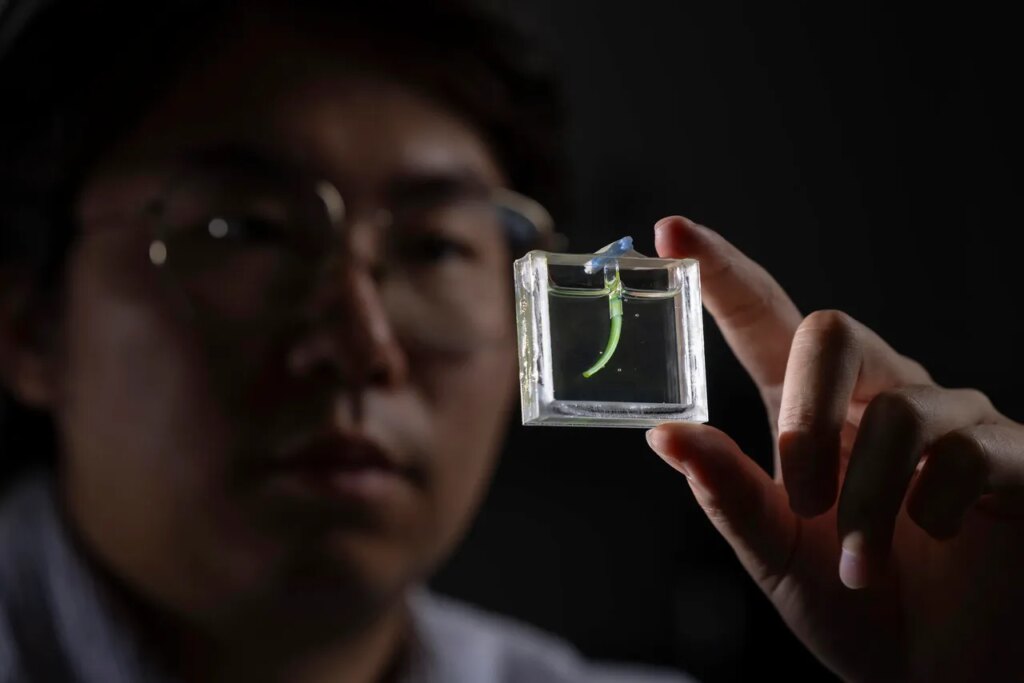
One variety of these soft robots, known as bioactuators, utilizes the functions of living cells to generate motion. These biological machines have attracted particular attention in recent years, and now a research team at Delft University of Technology in the Netherlands has developed a soft robotic arm colonized by algae on its surface, and when the microbes photosynthesize, the arm moves.
“We didn’t start with a specific application. Our goal has always been to bring the research of living materials to new levels,” Marie-Eve Aubin-Tam, who led the research, explained in a press release. “We wanted to explore what becomes possible when living cells are integrated into functional materials.”
The tiny robot arms—about three-quarters of an inch long and about as thick as a credit card—are constructed of two layers of hydrogel that the algal cells live on. One of these layers responds to changes in pH, which are mediated by the metabolism of the algae. When light strikes the algae, they begin to photosynthesize. By absorbing carbon dioxide and fixing nitrogen in this process, the algae make the local pH more basic, making the responsive hydrogel swell. Conversely, when it becomes dark, the algae release carbon dioxide through respiration, returning the pH to the acidic side and the hydrogel shrinks.
The difference in the volumes of the two hydrogel layers controls the bending. According to the researchers, the pH-responsive hydrogel layer changed significantly with the algae’s activity. In acidic conditions, such as between pH 3 and 7, the layer was approximately 37 percent of its original weight, but it had quadruple its original weight at pH 11.
Other researchers have constructed soft robots that respond to pH, but typically the chemistry of all the surrounding liquid has to be altered. This is not the case for the algal bots. The photosynthetic activity has an effect that’s much more local, meaning it would be better suited to applications where minimal environmental impact is essential.
These aren’t, however, the speediest of robots. The chemical shift begins quickly, about 20 seconds after light is applied and about 10 seconds after it becomes dark, but it takes several hours for the hydrogel to bend significantly.
After their first proof of concept, the research team constructed several more algal devices. One was a four-fingered gripper that closes when exposed to light. It successfully grasped and lifted a hollow metal sphere, releasing it when the light was turned off. Another hook-shaped gripper could pick up and put down a rubber ring. These items were extremely light, weighing far less than a small paperclip, but the arms were able to grasp them with great dexterity.
These soft robots also require no external energy source other than light and no complex mechanical parts. “Microalgae are plantlike organisms that are largely self-sustaining,” Aubin-Tam said. This “gives the actuator potential for long-term operation with minimal external input. In theory, it wouldn’t require a lot of energy to run a system based on this technology.”
In the long term, the research team hopes this will contribute to the development of more autonomous, environment-responsive soft robots that could be used as automated agricultural equipment or for fluid control in lab-on-a-chip devices or really as part of any underwater robotics system.
Since the algae do not need to be genetically modified, there are none of the biosafety concerns often associated with microbe-based technologies. If anything, these are exceptionally environmentally friendly machines, since these organisms can absorb carbon dioxide from the atmosphere while deriving energy from sunlight.
This story originally appeared on WIRED Japan and has been translated from Japanese.
The post These Robotic Arms Are Powered by Algae. Watch How They Move appeared first on Wired.