President Trump’s unpopularity was clearly the main engine of Democratic Party’s resounding midterm victory. But his unpopularity alone did not deliver the scale of the Democrats triumph. To win in places like Kansas, Ohio, South Carolina and Texas, Democratic candidates needed to persuade many voters who had previously considered their party unacceptable. The candidates’ success offers a road map to a sensible future for the party.
How did they do it? The simplest summary is that they ran as economic populists and cultural moderates.
That combination is consistent with American public opinion, which leans center-left on many economic issues and center-right on many social issues. By taking this approach, candidates were able to present themselves as beholden to neither of the country’s two political parties, both of which remain unpopular. The heterodox combination also has much to recommend it substantively. It meets the moment, after years of disappointing laissez-faire economic policies and a decade of cultural excesses by the progressive left.
On the economy, this year’s Democrats offered a strikingly populist message. They promised to raise taxes on the wealthy and criticized billionaires for corrupting the political system. They called for higher minimum wages, lower health care costs and expanded government programs. They raised concerns about artificial intelligence and data centers. They did not sound like the triangulating Democratic moderates of an earlier generation who championed Wall Street and free trade.
Nor did they sound like the progressives who shaped the party during the 2010s and early 2020s. This year’s candidates frequently denounced ideas — on immigration, energy, policing, gender and voter ID — that have taken hold in elite left-leaning circles and alienated many working-class Americans of all races. Winning candidates often took a middle ground between a censorious left and an extremist Republican Party. If you do not live in a place with a 2026 battleground campaign, you may not realize how strongly the Democrats turned toward social moderation.
Adam Hamilton, a pastor who became the first Democrat to win a Senate race in Kansas since 1932, captured the mood in an ad in which he spoke directly to the camera while standing on a farm. “America is being torn apart by politicians on both extremes,” he said, placing himself in the populist middle, in contrast to his Republican opponent, Senator Roger Marshall. “On one side, the far left pushes socialism and open borders,” Mr. Hamilton said. “On the other side, Roger Marshall gives us higher gas and grocery prices while slashing our health care.”
Our editorial board does not agree with every message that came from a Democrat this year, and we lament that the party did not do more to lay out an affirmative agenda for lifting Americans’ living standards. Democrats should urgently begin that work. Nonetheless, the 2026 campaign represented meaningful progress for the party.
Even as the factional battles between the party’s left and center will no doubt continue, the Democrats who won difficult races this year largely borrowed the strongest messages from each side. They demonstrated an admirable pragmatism and a willingness to compromise that are central to maintaining democracy in a diverse nation. As Rob Sand, Iowa’s governor-elect, said during his campaign, “I think a lot of people are tired of division, tired of being told that anyone that they love or who’s a friend of theirs that’s in the other party is somehow their enemy.”
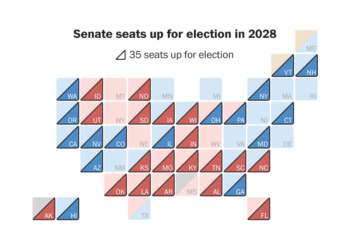
Coalescing around a similar big-tent strategy will be crucial in 2028. The competition between Democratic and Republican candidates today is not merely one about policy. It is, unfortunately, a contest between a party that supports democracy and one that has enabled corruption, lawbreaking and autocratic behavior. The country would be far better off if the Republicans pivoted and nominated a candidate in 2028 who rejected Trumpism. Until Republicans return to being a normal political party, however, the effectiveness of the Democratic Party will remain more than a partisan question. It will affect the health of American democracy.
For most of the 21st century, most Americans have been unhappy with the country’s direction. The reasons are complex and varied, including failed foreign wars, alienation caused by digital technology, slow-growing living standards and deep anxiety about the future. The country is stuck in a long malaise.
This dissatisfaction extends to voters’ views of the two major political parties. Only 38 percent of Americans had a favorable view of the Republican Party heading into the midterms, according to the Real Clear Politics polling average. The Democratic Party’s favorability was barely better, at 39 percent. Many voters say neither party is sufficiently focused on the concerns of ordinary people. Swing voters tend to consider the Republican Party too right wing and the Democratic Party too left wing.
As a result, successful candidates in modern politics often present themselves as being distinct from both parties. They emphasize their disagreements with their own party and highlight their openness to working with anybody who has a good idea. That was a theme among Democrats who won tough races this year.
“It’s time to stop the nonsense from both extremes and start to focus on lowering costs for Iowans,” said Josh Turek, who calls himself a “common-sense prairie populist” and became the first Democrat to win an Iowa Senate race in 18 years. Another Turek ad boasted that he had voted with Republicans more than 700 times in the state legislature. In Ohio, Representative Marcy Kaptur, who won a House district that Mr. Trump easily won two years ago, told voters, “I’ve repeatedly said no to my own party.” In Alaska, Mary Peltola, who leads her Senate race pending a final vote count, said, “When both parties are attacking you, you’re doing something right.”
To demonstrate independence, this year’s Democratic winners took positions on hot-button culture issues at odds with recent progressive consensus. On each one, they rejected the excesses of both sides and found a sensible middle. Five issues stood out:
1. Immigration
One candidate after another criticized the laxness of President Joe Biden’s immigration policy. “A disaster,” said Mr. Hamilton. “Really terrible,” said Paige Cognetti, who defeated a Republican congressman in northeast Pennsylvania. “Out of control,” said Chris Pappas, a senator-elect in New Hampshire, adding that it “made America less safe.”
In Texas, Gina Hinojosa, the governor-elect, went so far as to praise the Trump border policy. “There is no question that crossings are way down, and there is no question it is because of President Trump,” she said. Even Abdul El-Sayed, the progressive senator-elect from Michigan, criticized the party’s loose earlier approach to border enforcement. “We got that wrong,” he said on “60 Minutes.”
Democrats combined these acknowledgments with tough criticism of the Trump administration’s brutal, lawless use of immigration agents. This mix — neither Mr. Trump’s cruelty nor Mr. Biden’s incompetence — is right. Immigration policy should combine a secure border, humane enforcement of laws, clear rules for legal immigration and a citizenship process for some people who entered the country illegally.
Listen to James Talarico, the senator-elect from Texas. At a town hall last month, he called out “the utter chaos” of the “failed” Biden policy as well as the “extremism” of a Trump policy that includes “kidnapping our neighbors off our street.” Then he said: “We have to build a pathway to citizenship for our neighbors who have been here for years and decades. They should pay a fine. They should pay back taxes. They should learn English. And if they can do all those things, I think they deserve a shot at joining our communities as full citizens.”
2. Crime
The emphasis on border security was part of an embrace of law enforcement that served as a rebuke to the anti-police sentiment of many on the left.
In an ad for Roy Cooper, the former North Carolina governor who handily won a Senate race there, the narrator declared, “He bucked his party to oppose defunding the police, worked with Republicans to strengthen bail laws and partnered with President Trump to crack down on fentanyl.” In Arizona, Amish Shah, a winning House candidate, said that he had worked as a state legislator to “fully fund Arizona’s police.”
In the Mississippi Senate race, former President Barack Obama recorded an ad praising the crime-fighting record of Scott Colom, the Democratic nominee. “Guided by his Christian faith, Scott made his communities safer, prosecuting violent crimes as district attorney and fighting corruption,” Mr. Obama said. Mr. Colom, who also played up his support for gun rights, now leads his race by about 2,500 votes.
Police officers and prosecutors must be held accountable when they abuse their authority — and communities need well-funded police departments, as most Americans believe.
3. Voter ID
Republican politicians have long tried to exploit voter identification as an issue and falsely suggested that fraud is a major problem. It is not. Yet most Americans support voter ID laws for understandable reasons. People must present an ID to do many things less solemn than voting, such as checking into a hotel, renting a car or traveling on an airplane.
Many other democracies require voter ID, too. If U.S. states are going to require it, the key is ensuring that it is easy to obtain. Several of this year’s Democratic winners took this position, supporting both ID requirements and easier access.
Amy Acton, the governor-elect in Ohio, announced that she backed a ballot initiative enshrining an ID requirement in the state Constitution. (It passed with 65 percent of the vote.) She also said she would fight to make sure that all eligible voters could obtain ID “easily and at no cost.” Mr. Colom and Mr. Talarico took a similar approach. Senator Jon Ossoff of Georgia and Gov. Josh Shapiro of Pennsylvania, two landslide re-election winners last week and potential 2028 presidential candidates, also spoke positively about voter ID.
4. Energy
Mr. Trump has pursued a self-defeating policy that restricts the development of clean energy and raises costs. Prominent environmental activists have made the opposite mistake and opposed the use of oil and natural gas. This year’s Democratic stars took a smarter approach, advocating an all-of-the-above energy strategy that can both hold down costs and limit carbon emissions.
“If the Democratic Party is going after the good-paying oil and gas jobs here in Texas, I’m going to stand up against them,” Mr. Talarico said. Bobby Pulido, a Tejano musician who crushed an incumbent House Republican in South Texas, celebrated the importance of oil and gas jobs. In Alaska, Ms. Peltola promised to buck national Democrats who opposed “resource development.” In Kansas, Mr. Hamilton said, “Stop the war on domestic energy projects.” Each of these candidates also called for expansions of clean energy.
5. Gender
Along with immigration, gender issues may have been the most frequent source of Democratic repositioning in 2026. Many on the left have urged Democrats to avoid this issue and try to change the subject, but voters can often sense when politicians are trying to hide something. This year’s candidates instead engaged with the subject, even running their own ads about it.
In Texas, Ms. Hinojosa poked fun at the practice of announcing one’s pronouns by closing one ad with, “My pronouns are mom, Texan, and, soon to be, governor.” And the list of candidates who said they opposed trans girls or women playing female sports was long, including Aaron Ford, the governor-elect in Nevada; Annie Andrews, who won a shocking Senate victory in South Carolina; Mr. Sand and Mr. Turek in Iowa; and Ms. Acton and Ms. Kaptur in Ohio.
We are dismayed that some Democrats used harsh and inaccurate language, such as describing trans girls as boys. Still, much of the repositioning on gender is justified. People born with male biology are taller, faster and stronger on average, and most Americans believe that the differences create an unfair advantage in girls’ sports. Too many progressives equate this recognition with bigotry.
The candidates who struck the best balance were those who spoke out against Mr. Trump’s vilification of trans Americans and opposed discrimination in employment, while acknowledging difficult trade-offs in other areas. Mr. Ford, for example, opposed trans girls playing girls’ sports. He also criticized his Republican opponent for “beating up on one of the most vulnerable populations we have in our country, punching down on a group of individuals that don’t deserve to be political pawns in an effort to increase his voter turnout.”
It was another reminder that on many hot-button issues today, there is a middle ground that is both reasonable and popular.
The mistake among some centrists has been believing that the right answer to every policy question lies in the middle of the two parties’ historical positions. In truth, the country needs bold action on many issues. Americans, frustrated by slow-growing living standards and government dysfunction, are hungry for action on the economy.
Many of this year’s winning Democrats promised such action. They called for tax increases on corporations and billionaires, along with a smorgasbord of policies to reduce costs and increase opportunities for most Americans. The all-of-the-above position on energy helps as well.
Mr. Shapiro, often described as a moderate, supported more than doubling Pennsylvania’s minimum wage, to $15. Mr. Turek called for indexing the federal minimum wage to inflation and making it easier for workers to join unions. Ms. Peltola called for a big increase in the child tax credit and tax incentives for companies that pay decent wages. Mr. Hamilton said Medicare should expand to include dental and vision coverage. Mr. Pulido called for breaking up health-care conglomerates. “The people in office have sold us out,” he said. “They’ve allowed these companies to prey on us.”
Along the way, many candidates, including Mr. El-Sayed, drew a limit on their economic progressivism and said that they were not socialists. They described themselves as capitalists who wanted to ensure that American capitalism delivered better results for its citizens.
Democrats still do not have anything close to a comprehensive economic agenda. Many of their ideas remain small-bore or even dubious, especially on housing, where the party is not focused enough on building more homes. It has also failed to produce a plan to reduce the alarming federal debt. The party should raise its ambitions and spend the coming months developing an agenda that will reduce housing and health care costs, regulate A.I., put the country on a sustainable fiscal path and more.
This project will not be easy, but it does not need to tear the party apart. The progressive and centrist wings of the party agree much more on economic issues than they disagree.
Two years ago, the situation was bleak for the Democratic Party. Its ineffectiveness and unpopularity enabled Mr. Trump’s return to the White House, and many Democrats were in denial about why they lost. The party has rebounded from that nadir.
This year, it fielded a diverse array of savvy, appealing and authentic candidates, and they won astonishing victories. Their combination of economic populism and cultural moderation offers the party an opportunity to change its image among working-class Americans who have long viewed it as out of touch and condescending. Common-sense populism presents the most promising path to building an enduring Democratic majority in Washington. Yes, the party still has a long way to go before it can govern the country well and force the Republican Party to return to reasonableness. But the victors of 2026 have started to point the way.
Source photograph by John Tully for The New York Times.
The Times is committed to publishing a diversity of letters to the editor. We’d like to hear what you think about this or any of our articles. Here are some tips. And here’s our email: [email protected].
Follow the New York Times Opinion section on Facebook, Instagram, TikTok, Bluesky, WhatsApp and Threads.
The post This Winning Combination Is the Future of American Politics appeared first on New York Times.