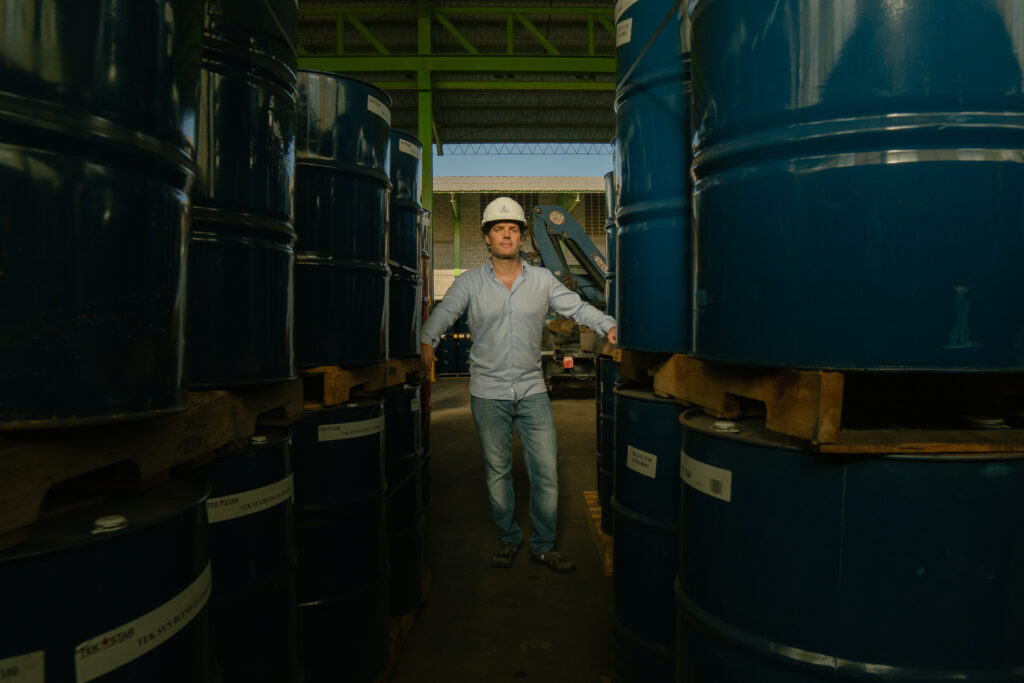
CABIMAS, Venezuela — His helicopter buzzed the wells of Lake Maracaibo as Alejandro Betancourt — the secretive 46-year-old billionaire anointed by the Trump administration to be Venezuela’s new petroleum king — smiled and theatrically spread his arms.
“Welcome,” he said, “to oil land.”
Shortly before, his jet touched down at Oro Negro Airport, gateway to this nation’s vast reserves and what President Donald Trump dubs “the biggest oil deal in world history.”
The unorthodox partnership links U.S. taxpayers with the fortunes of Betancourt, who, over the course of a two-day road show, offered the first public glimpse of the venture, lifting the veil on an operation already pumping what he calls “America’s oil.”
The visit revealed a U.S.-backed oil empire in the making, with sprawling drill sites in the petroleum-rich Orinoco Belt and rebuilt platforms in a lake here brimming with the rusting nubs and oil slicks of a long-broken industry. It also became a journey through the looking glass of Trump’s new Venezuela, a U.S. vassal state where loyalists of a government that once railed against the imperialist north happily rub elbows with U.S. officials they now call partners and friends.
This is a world where Betancourt is playing a starring role as an oilman driven by ambition in a country where he is deeply polarizing and some consider him emblematic of the country’s corrupt past.
The undertaking comes as steep Republican losses in the U.S. midterm elections raise questions about the longevity of Trump’s policies and deals, and as a top presidential contender here — opposition leader María Corina Machado — has suggested she might review the unorthodox contract.
Betancourt — on a billion-dollar-plus personal bet — is forging ahead anyway.
“Look at this, look at it,” he said gesturing toward a shipyard and a burgeoning fleet of retrofitted transit boats built to ferry workers to his growing number of oil platforms on the lake. “We’re doing it. We’re making it happen. This is just the beginning, man. I’m telling you. We’re bringing Venezuela back.”
A secretive deal unveiled
As his driver weaved through Caracas traffic, Betancourt spoke breathlessly about the deal. The first oil shipments under the agreement began arriving late last month, with Trump heralding the initial million-barrel delivery as the “spoils” of a U.S. takeover. Betancourt insists the deal is good for both countries.
“No one had done anything like this,” he said.
He would not provide a copy of the secret contract signed with the United States, citing a nondisclosure agreement. But a review of the 18-page document obtained by The Post revealed a 50-year deal with ironclad assurances for both sides.
In addition to giving the United States a 35 percent stake in his company — North American Blue Energy Partners (NABEP) — for nearly nothing, Betancourt will be locked into sales of 20 percent of his production to the United States at a discounted rate of $30 a barrel, or less than a third of the current market price and what Betancourt describes as “at cost.”
The U.S. has first dibs on the rest of Betancourt’s oil production at market rates. He will receive an as yet undetermined salary set by a seven-member board, but stock dividends cannot be awarded until production tops 1,015,000 barrels a day — a goal he aims to hit by 2033.
Separate deals with the Venezuelan government guarantee the country between 16 and 40 percent of production as royalties at Betancourt’s sites, depending on location and type, according to confidential contracts reviewed by The Post.
Venezuela would take its share before the U.S. receives its 20 percent.
“Venezuela gets paid first,” he said.
Naysayers
The oil deal faces a major potential challenge in the form of Machado, the Nobel Peace Prize winner who returned home last month to push for new elections. Venezuela’s most popular politician, she has accused Betancourt of “obscene corruption.”
Last week, she bluntly said the new agreement “does not reflect the levels of transparency Venezuelan society desires,” suggesting she might not do business with Betancourt if she replaces interim president Delcy Rodríguez, deposed president Nicolás Maduro’s ex-lieutenant who now runs the country with Washington’s blessing and has embraced the oil deal.
Secretary of State Marco Rubio indicated last month that elections could be held next year.
U.S. Democrats — who will now control both chambers in Congress — also have raised alarm, challenging the legality and wisdom of the deal with Betancourt.
Publicly and privately, U.S. oil giants and petroleum analysts discount his chances of success — calling the Trump-Betancourt deal a pipe dream designed to give the White House bragging rights but that ultimately will do little to bring down U.S. gas prices.
“I think it’s 90 percent smoke and mirrors,” said Francisco Monaldi, director of the Latin America Energy Program at Rice University.
Betancourt rebuts that, proffering a vision of legacy that harks to Nelson Rockefeller, the American politician and investor who transformed the Venezuelan economy in the 1930s. Betancourt calls his ramp-up here evidence of progress, claiming he is already on track to overtake Chevron as Venezuela’s largest producer by early next year.
Pumping oil in the neocolony
On a blazing Venezuelan morning, Betancourt arrived at a sprawling drill site in the tropical savannah of the oil-rich Orinoco Belt alongside the acting head of the U.S. Embassy in Caracas, John M. Barrett.
Betancourt, a New England-educated Venezuelan who sports tailored shirts and a finance bro demeanor, fist bumped his way through a crowd of workers, who call him “leader.”
En route, Betancourt waxed poetic about his current favorite show — Paramount+’s “Landman,” with Billy Bob Thornton as a high-stakes fixer in a dramatized Texas oil world of strange alliances, wildcatters and roughnecks. Betancourt calls himself a wildcatter “on steroids.”
A senior official from the state oil giant PDVSA — clad in a shirt emblazoned with the name of Hugo Chávez, founder of Venezuela’s socialist state — clasped Betancourt on the back, then beamed as he vigorously shook Barrett’s hand.
At NABEP’s operation center, a cumbia band played. There were dancing children in traditional costumes, and fresh cold coconuts fitted with straws and little American flags.
As part of the deal, Betancourt secured rights to Venezuelan oil fields believed to harbor 63.7 billion barrels — an amount larger than the entire reserves of the United States.
Since jump-starting operations in Venezuela in late 2023, Betancourt has rapidly increased production to roughly 223,000 barrels a day from 18,000. He insists he’ll be at 275,000 before year’s end and up to 350,000 next year. Over the two-day trip, The Post witnessed drilling activity at four of what Betancourt says are 11 operational sites. Overall, the company has rights to 17.
By Betancourt’s account, NABEP has six drilling rigs to dig new wells and five workover rigs — which are used to repair existing wells — in the eastern part of the country, with two more drilling rigs set to start operating before year’s end. In the west, the company has deployed 14 workover rigs and one drilling rig for land operations, as well as one drilling barge and two workover barges in Lake Maracaibo. The company’s strategy is to reach 60 drilling rigs in total, with the remainder to be fully purchased and deployed within 36 months.
Betancourt’s biggest challenge, experts say, will be here in the Orinoco, where realizing the potential of vast, untapped reserves will require massive investment.
Betancourt’s plan, he said, is to grow NABEP by plowing virtually all of its cash flow — more than $5 billion in 2026 — into expansion in a way oil giants beholden to shareholders can’t. He says that investment will surge with output.
Such a model could work to a point, experts say, especially at dormant but previously drilled sites known as “brownfields.”
But the cost of developing untouched sites — or greenfields — could be exorbitant, especially in the Orinoco, where tapping the thick, sludgy crude requires the added costs of diluents and heated drilling systems, said Oswaldo Felizzola, coordinator of the energy center at Caracas’s Institute of Higher Studies in Administration.
“It will take five to 10 years to develop the bare minimum to extract from [a greenfield] in the belt,” Felizzola said. “And it’s expensive, between $15 billion to $20 billion.”
Betancourt bristles at such critics, machine-gunning numbers and facts. The dedicated power stations he’s building. The hundreds of miles of new pipeline he is laying. The new rigs he is importing. The scores of wells he is drilling.
And now, he has a formidable partner: the U.S. government.
Later, he toured drill sites with Barrett and another senior State Department official. After viewing one of NABEP’s retrofitted Chinese rigs, the group approached an American-made drill. Barrett asked Michael Darwent — a NABEP manager wearing a hard hat emblazoned with an American flag — if the company would dig more than one row of new wells at the site.
“Only one, unless we find more oil,” Darwent said, conservatively.
“Oh, we will,” said Betancourt.
“This one is an American rig,” Darwent added.
“I can tell, this one is way better,” the State Department official said, speaking on the condition of anonymity in line with ground rules set by the department.
“No one is doing what we’re doing in Venezuela,” Betancourt said. “No one.”
A U.S. first
Betancourt’s first oil firm in Venezuela — Petrozamora, an operation backed by Russian state investment — was seized by the Venezuelan government in 2020, with production plummeting under its new, Maduro-assigned management.
Betancourt said he personally invested $700 million of his own funds — “pretty much everything I had” — along with $300 million in equipment leftover from Petrozamora to get most of the company back in 2023. That deal came together following a face-to-face discussion with Rodríguez.
Now Betancourt has many of his old fields back — and far more.
Betancourt said some discussion on how the United States could work with the oil industry in Venezuela to ramp up production occurred in late 2025, before the U.S. military seized Maduro.
But the novel idea of direct U.S. government ownership in his firm took shape around March, several months ahead of the August announcement, he said.
For the United States, the deal is unprecedented. After two wars in Iraq, for instance, the U.S. government never sought direct ownership rights of oil assets.
Mauricio Claver-Carone, a former Trump administration official tapped to liaise with the new Venezuelan government, said Betancourt was chosen as a partner because he is Venezuela’s “most efficient” oil producer with a “proven track record of development.”
Claver-Carone said Washington had been “screwed” by today’s Venezuelan opposition parties when they were in power, as well as by Chávez, arguing both used Venezuelan oil to strengthen OPEC at U.S. expense.
“Having a direct stake in Venezuelan oil production, you are not only guaranteeing energy security for Americans for generations, but you are ensuring Venezuelan oil is never again weaponized against the American people. That is hard power,” Claver-Carone said.
Critics call it neo-gunboat diplomacy.
“You can’t lead a country to accept an agreement with a gun to its head,” said Rafael Ramírez, Maduro’s former oil minister and a vocal critic of the deal who now lives in Rome.
A controversial businessman
The scion of a gold-standard Venezuela family whose great-grandfather served as president, Betancourt entered the public eye as a young Venezuelan entrepreneur. He became part of a class of business executives to make fortunes off contracts with corruption-plagued Chavista governments. In the 2010s, he fought charges in Venezuela of bilking the state in a massive electricity deal.
The case ultimately was dismissed. A study by a professor at Caracas’s Simón Bolivar University showed that Betancourt’s firm was responsible for a relatively small share — 7.33 percent — of the national energy grid expansion between 2008 and 2015. Betancourt blamed problems on faulty maintenance and mismanagement after plants were delivered.
Yet rightly or wrongly, many Venezuelans — including Machado — still blame him for frequent blackouts from a substandard energy grid. David Rebanales, a 27-year-old literature major who attended a Machado rally this month, said Trump’s deal with Betancourt made him only more convinced that the U.S. had sold out the Venezuelan people “just like” it had “the Ukrainians.”
“At first we believed [Trump] was in some way representing the American democratic values that many of us have admired,” he said. “But he [only] wants the resources. He has shown us that he doesn’t care about the people. He just wants what the people are standing on: the oil.”
In August, The Post reported that soon after Maduro’s capture in January, senior administration officials began intervening on Betancourt’s behalf with Swiss authorities over a criminal investigation.
In September, CNN reported that earlier this year, the office of then-Deputy Attorney General Todd Blanche directed federal prosecutors in Miami to close an investigation into Betancourt. Rubio, one of the architects of the oil deal, in September was able to proclaim that Betancourt “has no investigations against him in the United States.”
Bentancourt’s financials
Betancourt, who remains under scrutiny in active money-laundering investigations in Switzerland and Spain, denies any wrongdoing. And he brushes aside suggestions the deal was anything other than good business, calling himself the “only man” in Venezuela with the proven ability to overcome major challenges to rapidly produce oil.
He obtained his initial NABEP investment funds, he said, through reserves left over from Petrozamora, though he also has accumulated wealth from the sale to Uber of a car-hailing service in Spain, his popular Hawkers sunglasses brand and an African bank he invested in, among other enterprises.
Betancourt denied rumors whispered in Caracas and South Florida that members of the Trump family had invested in, or stood to profit personally from, the oil deal. NABEP, he insisted, has no other investors besides him and the United States. (The Defense Department and State Department are named in the contract.)
His father, Leopoldo Betancourt — a doctor and pianist living in Monaco — is named as head of the company, he said, for structural reasons and out of family deference. But Alejandro Betancourt, as chief executive, effectively controls and runs NABEP, often micromanaging remotely from his cellphones.
Betancourt also denied reports that some NABEP contractors and workers have gone unpaid. Two people familiar with the company’s finances said sustained delays in oil shipments last year because of a U.S. blockade on the country caused disruptions and operational delays, but said the issues were cleared up early this year.
Betancourt said he attended meetings surrounding the deal in Washington with Jacob Hirshman, the chief executive and co-founder of Erebor Bank, which is backed by the controversial billionaire Peter Thiel, among others. But he said that while he maintains a “banking relationship” with Erebor, the institution is not an “investor.”
“There are no other investors,” he said. “Not Trump’s family, not anyone. It’s under my father’s name. But it’s me and the United States.”
Government backing
The road show to America’s oil wells began with a Mad Hatter moment.
Betancourt’s entourage of cars — his family, friends and two U.S. State Department officials in golf shirts — pulled up to the private runway at Caracas’s main airport to find a missing plane.
Barrett, initially slated to join Betancourt’s Lake Maracaibo trip, got there first and took off.
After a radio call to the pilot, the plane returned. While waiting for another takeoff with everyone on board, a call came in, and Barrett deplaned. He would later appear beside Rodríguez for a government live stream in Caracas to celebrate the Betancourt-Venezuela-U.S. partnership.
After a visit to an overwater compressor using natural gas to pump oil beneath the lake, Betancourt’s motorcade sped past lines of roadside wells painted in the yellow, blue and red of Venezuela’s national flag. He is installing more and more, he said while visualizing Venezuela’s future.
“I want to bring us back to a time when workers went to baseball games, when they could really live,” he said. “Oil is what Venezuela has to do this.”
Rodríguez publicly has celebrated the deal, going so far as to portray it as a pillar of her interim government and proof of national gains that are possible under what she politely calls Venezuela’s “partnership” with the United States.
At a pumping site, Betancourt arrives for the live-steamed event with Rodríguez — she in Caracas and he in the field, surrounded by NABEP and PDVSA workers. Before the event — which ended abruptly due to a power outage in Caracas — an animator reminiscent of Chavista political events addressed the officials and workers, reminding them “to keep your hands out of your pockets and applaud.”
When they go live, Rodriguez is sitting next to Barrett, promising the Venezuelan people that the deal with Betancourt and the Americans would “translate into pay for our workers, into health, public hospitals, schools, food, the well-being of the population, public services, electricity, water, roads.”
“I congratulate you,” she told Betancourt on the live stream. “Let’s keep working together … [with] our partner, the United States.”
The post Mysterious billionaire shows off ‘America’s oil’ — and Trump’s Venezuela appeared first on Washington Post.