Harwood, North Dakota, may be the only place in the United States that voted in favor of data centers last week.
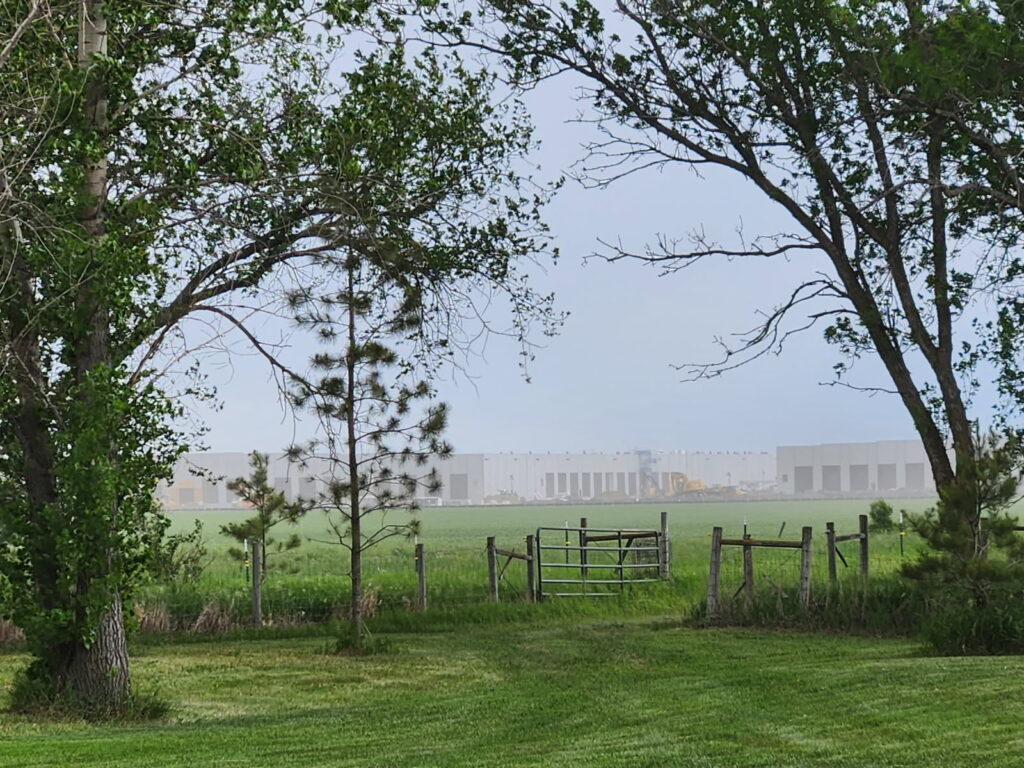
The town, population 845, faced the prospect of a $3 billion, 1.8-million square foot facility on its outskirts.
Resident Michael Swartz hadn’t liked the idea. He said he felt city officials had rolled over for a mega-developer who wanted to cash in on the artificial intelligence boom. “It’s changing … our small town, and I don’t know if it’s for the good,” he said.
So Swartz, a software engineer, organized to get a measure on the ballot demanding independent reviews and public hearings for big new industrial projects, as well as proposed modifications and expansions of existing ones.
It was one of at least 40 ballot measures in 10 states this election cycle that could have restricted data center development.
On Tuesday, in dozens of cities and towns across the country, voters overwhelmingly endorsed those restrictions. They also elected candidates who campaigned against Big Tech.
Nationally, too, the mood was decidedly anti-data-center. In TV network exit polls, 76 percent of voters said they would oppose the construction of a new data center in their community, and 57 percent (including nearly two-thirds of Democrats) said AI would do more to hurt than to help society.
But confronted with same debate that played out in dozens of other communities, a majority of voters in Harwood were convinced of the merits of data center development. They gave a resounding “no” to increased oversight by a margin of about three to one.
‘Not because I like data centers’
Harwood residents tend to describe their town as a bedroom community. There’s not much there besides a couple bars and a grain elevator, they say. Many residents commute to work in Fargo, North Dakota’s most populous city, and the surrounding metro area.
From the beginning of the data center project, Harwood faced the prospect of losing it to their next-door neighbors. Although Texas-based Applied Digital had already contracted 900 acres when the project was announced, Harwood and Fargo disputed who had claim to annex the land.
“It was always going to get built right around the same area that it was now,” said Blake Hankey, the mayor of Harwood. “If the data center is going to get put in this similar location, we might as well get the tax benefits and the tax revenue from it.”
Hankey estimated that the project would net the town $1.65 million in property taxes once fully completed — about six times the property tax revenue Harwood collected in 2024.
Applied Digital, meanwhile, said it expects the data center to create at least 200 full-time jobs.
The company has also given money to the fire department and to the city for things like a new warming shelter at a local park.
“Proud to be building in Harwood,” Jason Zhang, Applied Digital’s president, said on social media after Tuesday’s ballot measure failed. “Community trust is earned by showing up, listening and following through. Thank you to the people of Harwood for supporting long-term investment in North Dakota.”
Mark Kerkvliet, a 40-year resident of Harwood, said he was initially worried that the data center would drive up the costs of power. But talking to officials at the local utility company, a member-owner co-op, assuaged his concerns.
“As soon as I was comfortable with the power use, I was on board,” he said. “Not because I like data centers or I like artificial intelligence or anything like that, but because this was very good for the city of Harwood.”
He helped organize a door-to-door and mail campaign to counter the ballot initiative, which he was concerned could result in legal action against the town or jeopardize the data center altogether.
Still, Harwood’s situation had many characteristics that infuriated communities elsewhere. At contentious council meetings, residents raised questions about environmental impact. They asked about noise. They objected to how the deal had come together.
The mayor signed a nondisclosure agreement when Applied Digital first came to town. And Swartz and other critics complained of a pressure campaign by Applied Digital, with a lawyer for the company weighing in on the prospective text of the ballot measure at a June city council meeting. Swartz eventually rewrote it, using AI.
Eric Sinner, who helped organize the ballot measure, pointed to the example of Janesville, Wisconsin, where he used to live. Janesville was the site of a historic General Motors plant that was decommissioned in the early 2000s, leaving an empty site that would cost the city $35 million to clean up.
“I compare that to what’s going to happen to these data centers when they’re done,” he said. “Who’s going to be left with the bill?”
Janesville, coincidentally, was the site of its own referendum after a development company proposed repurposing the GM site into a data center. Residents there passed a measure requiring voters to be consulted on any changes to the old auto plant, adding another obstacle for potential data center construction.
And elsewhere in the U.S., voters let their searing dislike of data centers be known. In Piqua, Ohio, the site of a prospective $1 billion project by Meta, voters approved a ban on large data centers and recalled the officials who had backed the project. Meta said in a statement that it was “proud” of its investments in Ohio and would “work with local officials to determine the future of our investment in Piqua.”
Voters in Texas, the location of many major data center projects, elected to the governor’s mansion a Democrat, Gina Hinojosa, who has championed a moratorium on new projects.
In response, some large tech companies are emphasizing a more conciliatory approach. OpenAI, the maker of ChatGPT, said Thursday that it would report how much water its data centers use, halt the use of nondisclosure agreements and commission independent noise studies. (The Washington Post has a content partnership with OpenAI.)
But in Harwood, just 105 voters sided with restrictions on data centers. Another 325 voted not to pass the ballot measure.
“We would have chased what otherwise would be a good neighbor away,” Kerkvliet said.
The data center, which broke ground in the fall of 2025, is scheduled to go fully online by the beginning of next year.
The post The only town in the U.S. that said yes to data centers appeared first on Washington Post.