NEW YORK — On the day she would finally snap, Isabelle Garbani wore jeans and a bright yellow T-shirt. She wanted to look cheerful. Approachable. Her streak of five-star reviews depended on it, she thought.
The clients she led to the Statue of Liberty and Ellis Island had praised her as “fun,” “enthusiastic” and “a real charmer.” Most were on vacation from across the country — small towns, big cities, opposing realities — so Isabelle, 59, tried to unspool her message diplomatically.
Four in 10 of you, she liked to say, probably have an ancestor who passed through this gateway to America. As for her, she had come in 1984 from a tiny French village, which explained her accent, but her last name is Italian, and her paternal grandmother was Polish.
“This tour,” she’d explain, “is focused on immigration.”
Focusing on immigration lately made it harder to stay charming. Since President Donald Trump returned to office and ordered what he touted as the “largest mass deportation operation of illegal aliens in history,” Isabelle had read reports of federal authorities making arrests without reasonable suspicion, entering homes without judicial warrants and deporting people in spite of protective orders to nations they had never visited. Agents who had sworn an oath to uphold the Constitution had detained U.S. citizens unlawfully and killed people who Isabelle thought seemed innocent.
She had heard the conservative arguments about undocumented criminals overwhelming the borders, distributing lethal drugs, spreading gang violence and “poisoning the blood of our country,” as Trump had put it. But in her 42 years here, two decades as a citizen, Isabelle had never felt as unsafe as she did now, and what she feared was the government abusing its power.
She hadn’t mentioned any of that on a tour. Some sightseers, she guessed, might support what disturbed her — including, she assumed, the client who’d said his Mexican family had relocated to California “the right way.”
There used to be no wrong way, Isabelle had replied in what she hoped was a playful tone. Millions arrived before the United States had a national screening system, she pointed out. (The man didn’t leave her a review.)
Now she waited near the Battery park ferry terminal with a sign that read “TOURS BY LOCALS,” wondering what she would hear next. Isabelle scanned the crowd. On this October morning, a family of five was supposed to meet her for a four-hour exploration of what the National Park Service called a “memorial to all who pursued the American dream and have made this nation their adopted home.”
For seven years, this gig had subsidized her passions: art and acting. Isabelle listed improvisation as a “special skill” on her résumé, and adapting to the energy of any group, politically right or left or apathetic, helped her book enough $396 tours to cover the rent for her Bay Ridge apartment.
All she knew about today’s clients were their names: the Espinozas. Perhaps they were immigrants, too. That didn’t mean they’d sympathize with her anger. Reading the room meant stifling the urge to blurt out: Did you know that, yesterday afternoon, about 14 miles from where we’re standing, a federal agent shot a Dominican man right in front of his 5-year-old son?
“Hellooo!” Isabelle called out to the young woman waving at her.
“How are you?” chirped the woman, who introduced herself as Carina.
“This is Samantha,” Carina said, nodding to her 17-month-old daughter.
“Hiii Samantha!” Isabelle cooed.
The toddler stared up from her travel stroller.
“And this is Sam, Karla and Deisy,” Carina continued, pointing to her husband, niece and sister-in-law.
“Where are you guys coming from?” Isabelle asked in her singsongy autopilot.
“San Diego,” Carina replied, tucking a section of wavy black hair behind her ears.
“Oh!” Isabelle exclaimed. “It’s so beautiful out there.”
This crew seemed friendly, she thought, if a bit tired. She guided them to a ferry named MISS FREEDOM, where passengers were lining up for the 11:30 a.m. ride to Liberty Island.
Check out the Manhattan skyline, she said. Workers from at least four continents forged those skyscrapers.
“New York became what it is because of immigrant labor,” Isabelle said, watching her clients’ faces.
AS A TEENAGER in rural Longueil-Sainte-Marie, France, Isabelle couldn’t picture her future. “Only blankness,” she recalled. Maybe she was depressed. Her father had pressured her into studying science, an academic track she found boring.
Then he got a printer technology job near Boston, and Isabelle landed in what she saw as a world of possibility.
She started painting. She got cast as a hula dancer in her high school’s production of “Get Smart.” She got into puppetry. She got into poetry. She met her partner of three decades, Daniel Collins, and he followed her in 2005 to New York, where she earned an MFA in sculpture.
“This is the rest of my life,” she had thought.
The couple agreed to prioritize freedom — she didn’t want kids, and he didn’t want marriage — and indulge each other’s ideas, no matter how outlandish. Like his Dungeons & Dragons vlogcast, and her sense that stuffed animals had feelings. (“Well, obviously,” Daniel replied.)
Isabelle became a tour guide in 2019. Shepherding visitors to America’s most famous landmark — a gift from France, by the way — felt as natural to her as pronouncing the statue’s original name: La Liberté éclairant le monde. Liberty enlightening the world.
Now, she worried the president of the U.S. could get angry at Emmanuel Macron and decide to deport all the French.
“There are no rules anymore,” Isabelle complained.
“It’s chaos,” Daniel agreed.
When Immigration and Customs Enforcement arrests tripled in the first months of the second Trump administration, Daniel’s union at Kingsborough Community College, where he teaches math and computing, posted a callout for “court support.” He volunteered to guide asylum seekers through a busy federal immigration office in Manhattan. Some had missed hearings, a colleague told him, because they weren’t notified of a room or time change. The penalty could be deportation.
Isabelle joined a Signal group dedicated to helping immigrants and handed out “Know Your Rights” fliers at Yemeni restaurants, Palestinian bakeries and halal grocery stores in their Brooklyn neighborhood. That felt empowering until January, when federal agents in Minnesota shot and killed two American protesters — a poet with three children and an intensive care nurse.
“What is the point of knowing your rights?” Isabelle asked.
She and Daniel had lived in the same apartment for 21 years. Only a massive rent hike, they’d reasoned, could force them out. Yet on an August trip to Copenhagen, both were relieved to be far away. Getting married, Daniel half-joked, would make it easier for him to obtain a European passport.
Isabelle, though, wasn’t ready to leave New York. Someone had just paid her $50 to read lines from a rough-draft script, and she would soon audition to play a concerned rabbi in a show about Trump’s ICE surge in Minnesota.
The range of creative outlets thrilled her, but she felt most at home on the subway, where she thought everyone looked and sounded different. “An array of colors and languages,” she marveled.
The Yemeni cafe two blocks from home made the best ice cream sundae. The Muslim mayor she voted for spoke to his constituents in Mandarin. Her favorite poem in English was inscribed on the Statue of Liberty.
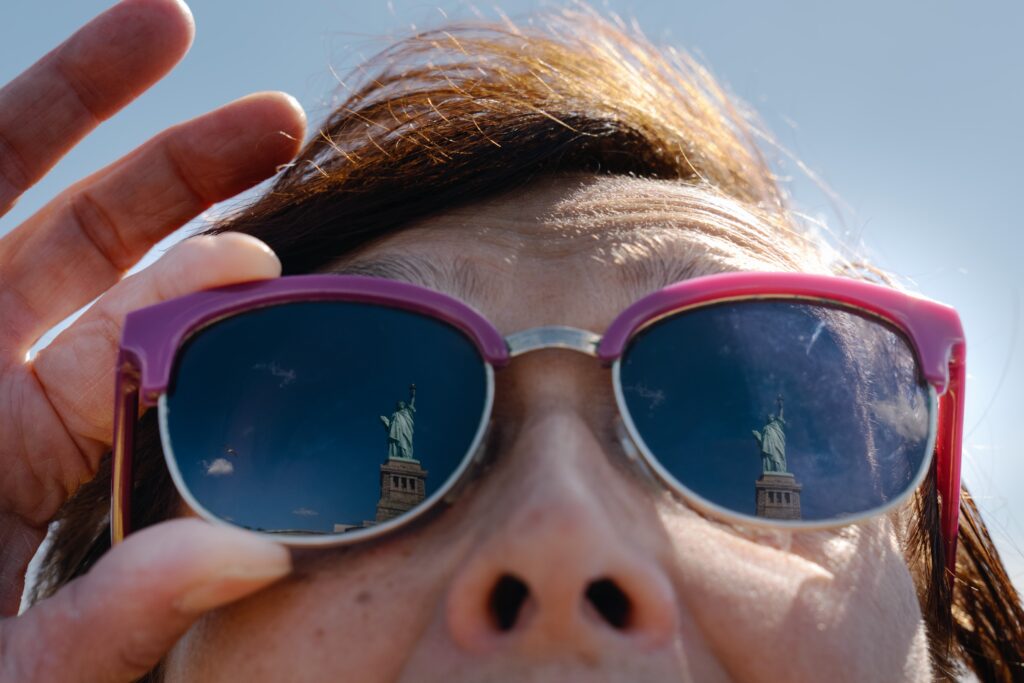
ISABELLE LED THE ESPINOZAS off the ferry to Liberty Island, where everyone stared up at the green copper icon.
“She has broken shackles and chains at her feet,” the tour guide said, “so she has broken the chains of tyranny.”
Below that sculpted metaphor, on a bronze plaque inside the stone pedestal, was the 1883 sonnet by Emma Lazarus. The New York poet, Isabelle said, had cast the Statue of Liberty as “Mother of Exiles.”
“Ahhh,” Carina murmured.
The paralegal, 30, was interested in this history, really, but she was also watching her toddler, who was stomping in pink Velcro sneakers around the brick pavilion.
“Maaa!” the 17-month-old screeched as she crouched over a yellow leaf. Carina scooped her up as Isabelle recited “The New Colossus.”
Give me your tired, your poor, your huddled masses yearning to breathe free…
Carina didn’t recognize what she caught of the poem, but she could relate to “yearning to breathe free.”
When she was a baby, Carina’s mom brought her from Tijuana, Mexico, to San Diego on a tourist visa. They never left. Carina had no memory of Mexico. She had gone to American schools, married an American man and given birth to an American daughter, but she might never be American, not technically.
Pursuing citizenship would require leaving the country while her case was pending with no guarantee of when or if she could return. So every two years, Carina renewed papers that authorized her to work anywhere in the country under the Deferred Action for Childhood Arrivals program. That was also supposed to protect her from deportation. But during Trump’s second term, dozens of “Dreamers” like her, with no criminal record, had been deported. Two had been arrested at what sounded to Carina like routine appointments.
She was so nervous she could barely speak when she reported in January to an immigration office for her latest round of fingerprinting. The woman operating the biometric scanner must have noticed.
“Honey, it’s okay,” she had told her. “Just relax.”
Now, Carina struggled to relax under the Statue of Liberty. She had expected to feel awe and was annoyed to feel sad. Angry, even. The chains of tyranny were broken up there, sure, but the headline that had flashed on her husband’s phone the evening before was: ICE agents shot at man in car with his 5-year-old son.
What if that had been Samantha terrified in the back seat?
Gratitude, Carina reminded herself. Her family was here and healthy. Holding her baby for the first time, she’d thought, “My lucky girl.”
Turning back toward her tour guide, Carina appreciated the tenderness in Isabelle’s voice.
Send these, the homeless, tempest-tost to me,
I lift my lamp beside the golden door!
Lazarus wrote those lines, Isabelle said, after Congress passed a law that barred Chinese laborers from entering the U.S.
What she wanted to add was: See how dumb that was! And what did we learn? Instead, she summarized a mainstream view from that era, one she found unnervingly recurring.
“People blamed the immigrants,” Isabelle said, “for everything bad that was happening.”
“Well,” Carina chimed in, squeezing Samantha, “we’re pro-immigrant.”
TWO HOURS IN, Isabelle had detected no tension she needed to banter away. Some of her previous clients looked uncomfortable when she mentioned darker parts of America’s past. She’d heard a few variations of: My ancestors followed the rules.
The Espinozas had been nodding along. Pro-immigrant, Carina had said.
“These guys get it,” Isabelle thought.
The issue now was they were hungry. Up next was what she’d advertised as a “melting pot picnic” on Ellis Island. Unfortunately, hundreds of people waited ahead of them to board the next ferry to that prime tourist destination.
“We’ve got at least 25 minutes,” Isabelle estimated, eyeing the crammed dock.
The group was quiet for a moment, gazing out at the glittering water.
“I guess I could do my Ellis Island spiel,” Isabelle offered.
She started like she usually did.
“So Ellis Island opens in 1892…,” she said. She breezed through the island’s backstory to 1924, when the U.S. enacted a law that sharply limited immigration from nations lawmakers deemed threatening to the “racial status quo.”
“Specifically designed to exclude the Italians,” Isabelle said.
All around her, she realized, more people were listening. One red-haired man seemed to be scowling. Did the shameful facts of a century ago irritate him, she wondered, or was that the sun in his eyes?
“Those quotas existed until the 60s,” Isabelle continued.
She moved on to 1965, when Lyndon B. Johnson, standing at the base of the Statue of Liberty, signed the law that abolished that system — “a cruel and enduring wrong,” he called it — and allowed immigrants from around the world to join their families in the U.S.
Approximately 12 million immigrants, mainly Europeans, traveled through what used to be America’s busiest processing station. Most entered before any visa was required. They just needed to pass a medical evaluation and answer some questions.
“Then you could walk in and do whatever you wanted,” Isabelle said.
She enjoyed how that line surprised some people. The Espinozas simply listened. So did a woman behind them wearing a foam Statue of Liberty headband, Isabelle noticed, and a man in a Rip Curl cap, and another in tactical shades, and another with a Canon camera dangling around his neck.
“A whole theater of people,” Isabelle thought. She would normally stop there to guide her clients to the museum, but they were still stuck on the dock, and was that guy scowling?
Perhaps her habit of scanning for cues was throwing her off. Or riling her up. That guy couldn’t leave her a review, Isabelle thought. That guy’s going to listen to me.
She could have stayed “fun” by asking if anyone wanted a photo. She could have transitioned into talking about the unseasonably warm weather. But wasn’t this place supposed to be a memorial to all who had made America their adopted home? How was that going for immigrants now?
Maybe it was the silence she reflexively tended to fill, or the adrenaline she felt while speaking publicly, or the anger she could no longer contain to conversations with Daniel.
Isabelle ditched her spiel.
“Now, it’s a goddamn mess,” she snapped.
That might have been her first curse word on Liberty Island. She spoke louder and faster.
“Let’s just be clear,” she said. “People are being deported left and right. People who are here legally are being deported. People are being deported to countries they don’t even know.”
Isabelle looked around. Yeah, that guy was scowling.
“ICE agents are actually grabbing people from the courthouse. So people who are trying to make their situation legal — people are being dragged directly from the courthouse.”
Now, dozens were just watching.
“They are making things confusing for people,” Isabelle said. “‘Oh, we sent you a letter to change your appointment. You didn’t get it? Too bad. You’re deported.’”
She wouldn’t mention the bloodshed, like the shooting from the day before. There were children around.
“So, it’s a horrific thing happening in the U.S.,” she concluded.
Nobody clapped. The tourists turned back to their groups and phones. But Carina’s husband nudged her arm, and she understood what he meant: She’s cool.
“EVERYONE DOING OKAY?” Isabelle asked as they finally headed to lunch.
Still amped, she redirected her attention to her guests, shifting back into her singsongy autopilot. This way to the Ellis Island museum. That way to the cafeteria. Bathrooms are on the left. We can fit at that table in the corner.
Decades of riffing onstage had conditioned her not to dwell on whether a performance had bombed, but what about a rant as a tour guide? Had she gone too far for a family trying to enjoy themselves on vacation?
“I laid it on thicker,” she told the Espinozas, “when I saw that guy scowling.”
Carina hadn’t seen the man Isabelle described. With red hair, though, she imagined his ancestors were immigrants who had been lucky enough to seek a better life before ICE existed.
“They immigrated 500 years ago, so they are special,” Carina said sarcastically.
“They were on the Mayflower,” Isabelle quipped back. “Like, good for you!”
The ferry wait had delayed their meal by an hour, but the group seemed looser than they had all day. Isabelle laid out a spread of croissants, turkey, hummus, guacamole, tomatoes and potato chips. “What the immigrants brought, food-wise,” she said as everyone dug in.
Carina didn’t tell Isabelle, but the tour guide’s candor had impressed her. “This is a safe space,” she had thought. They could joke about pilgrims, and Carina didn’t have to worry about not sounding grateful for her place in the only country she’d ever known. This was a pleasant diversion from monitoring the news and worrying about getting torn from her toddler.
“I don’t even believe in borders,” Isabelle confessed while they ate.
Nine days later, she received her 55th straight five-star review.
“Hands down,” Carina had written, “the best tour we’ve been on.”
The post Her Statue of Liberty tour was supposed to be upbeat. Then she erupted. appeared first on Washington Post.