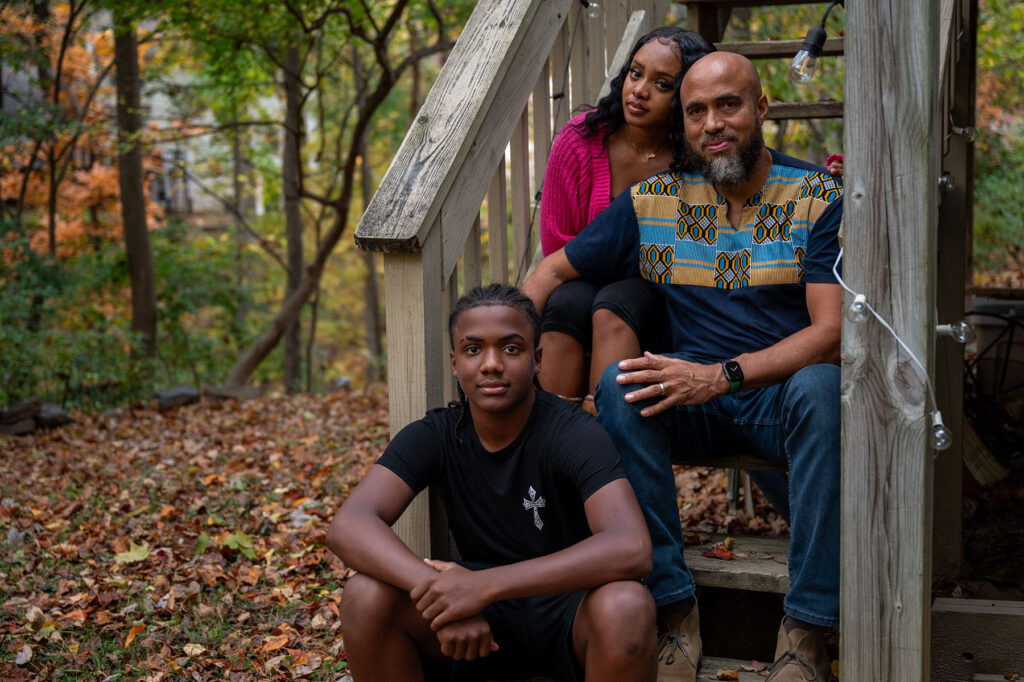
Winston Cox remembers how he used to bark orders up the stairs, yelling across the room for his children to do something, and towering over their smaller frames when he spoke with them.
Then through the recommendation from a friend, he participated in a special summer session of the Parent Encouragement Program, which aims to help parents build stronger connections to their children.
Cox, a father of two teenagers who lives in Silver Spring, said it has always been important to be a good communicator because he was determined to be better than what he saw growing up. Through the program, he learned simple changes that helped him connect with his kids more.
“Some of the most powerful tools that we’ve talked about or shared, the face of them seem incredibly basic and simple,” he said. “Something as basic as getting on the child’s eye level when having a conversation. … It never occurred to me to think about that physicality and how that might be experienced by somebody who’s smaller.”
Cox said he also acquired other tools, including nonverbal communication techniques and understanding the best time to have a conversation.
The Parent Encouragement Program (PEP), which has offered sessions for parents since it was founded in the 1980s, will soon be able to reach more families through a partnership recently announced by Maryland Gov. Wes Moore (D). Up to 300 more fathers will be able to attend its eight-week Family Resiliency Program through the effort; a new cohort started recently.
The partnership is part of an effort to close opportunity gaps and support long-term well-being for boys and young men across Maryland, according to a news release from the governor’s office.
The current cohort prioritizes fathers from 30 communities in 13 Maryland counties that are part of the ENOUGH Initiative, a state program to reduce the number of children living in poverty.
“We couldn’t be more pleased and really thrilled to be working with the Governor’s Office for Children to lift this work up and to really lift this up for fathers and for young men and boys, because young men and boys really are struggling,” said Kathy Hedge, PEP’s executive director.
Cox, now a facilitator for the current cohort, said programs like PEP are incredibly rare, especially for Black fathers like him.
“I think there’s a socialization as men that we really need to challenge, that it’s the sort of ‘rugged individual’ concept or that there’s some shame involved in asking for help,” he said.
During the program, fathers meet once a week in person for small group sessions in which they learn and discuss parenting tools. In addition to the sessions, instructional videos also are provided.
“We know men and boys face unique challenges that can affect their mental health and well-being,” Maryland Health Secretary Meena Seshamani said in a news release announcing the partnership. “Building supportive relationships, encouraging help-seeking, and creating opportunities to connect with others can strengthen resilience and improve mental health outcomes, which, most importantly, means saving lives.”
PEP started in 1982 as a small group of parents discussing the hardships of parenting and learning some new tactics. The classes were held in founder Linda Jessup’s home in Kensington. Now, PEP has a mix of in-person and virtual offerings and has also offered special programs for groups such as Latino fathers or single parents. All facilitators in the program were also once participants, according to Hedge.
The program is run three times a year, during fall, winter and spring.
Hedge said, like any other job, parenting is one that requires some level of training or assistance and doesn’t always come naturally.
“I think a lot of the time people think parenting is intuitive or should be intuitive and, to me, there’s no reason why we should think this,” Hedge said. “Love is intuitive, but parenting is not intuitive.”
Some of the popular tools acquired in the program include reflective listening, which involves listening to understand rather than to be understood, and the “four S’s,” which help a child feel seen, safe, secure and soothed.
It’s a tool Cox said he often returns to. “It just helps me sort of have a way to check in with myself,” Cox said. “‘How am I? How am I doing against those four S’s?”
According to a 2025 report by NORC at the University of Chicago, 83 percent of parents in PEP reported having a stronger bond with their child after participating in the program; 82 percent reported feeling more capable and confident in their parenting skills; and 71 percent reported seeing positive changes in their children after the program.
The post A parenting program that helps fathers will reach hundreds more in Maryland appeared first on Washington Post.