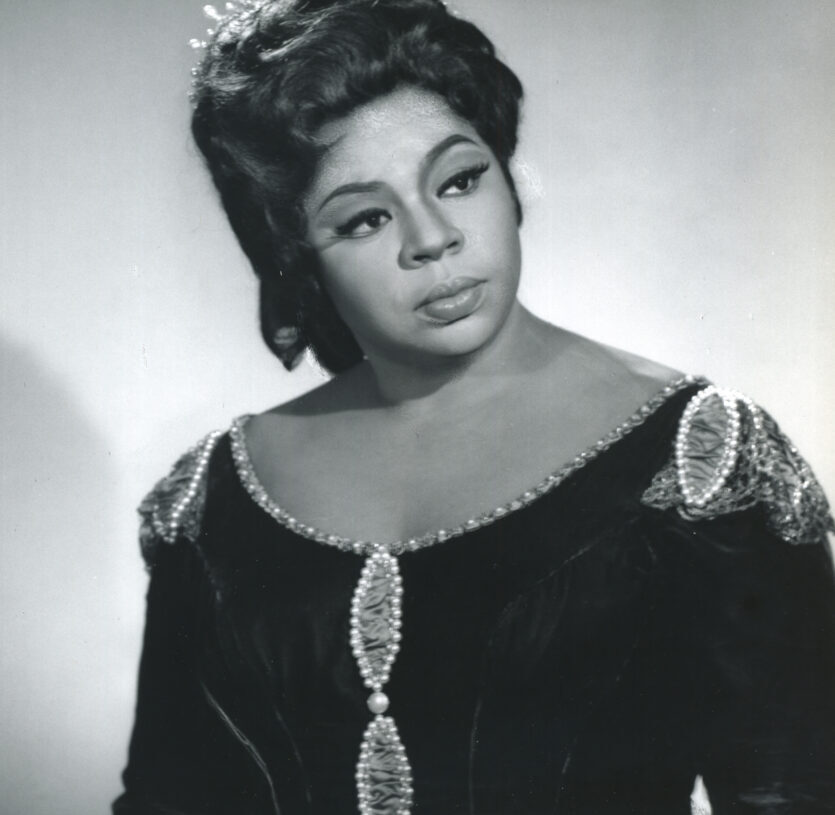
In a celebrated career as an international superstar of opera, the soprano Martina Arroyo appeared on many of the great stages of the world, from La Scala in Milan to Covent Garden in London, from the Vienna State Opera to the Paris Opera and Teatro Colón in Buenos Aires. But, in some ways, her longest journey never left Manhattan, where she was born and lived for most of her life.
Ms. Arroyo, who died Oct. 13 at age 90, grew up in Harlem at a time when few Black singers imagined that a career in opera could be possible. As a child, she took dance lessons, sang in church choirs, attended concerts and listened to opera broadcasts on the radio. But she had little expectation of becoming an opera singer in her own right, let alone one of its most luminous stars.
Ms. Arroyo began taking vocal lessons in earnest at 14, studied languages in college, and was a teacher and social worker before she became a professional singer, performing in Europe and in occasional small operatic roles. Her breakthrough came at New York’s Metropolitan Opera in 1965, when she took on the lead role in “Aida” at the last minute after an ailing soprano dropped out. She received a standing ovation and was praised by New York Times music critic Raymond Ericson for having “one of the most gorgeous voices before the public today.”
Ms. Arroyo was promptly signed to a contract by the Metropolitan Opera, completing her sojourn from 111th Street in Harlem to the world’s most prestigious opera company, then in Midtown Manhattan. The Met would become her primary musical home for two decades.
She would win renown in the 1960s and 1970s as one of the busiest sopranos in opera, performing many of the greatest roles in the repertoire, including Cio-Cio San in Giacomo Puccini’s “Madama Butterfly,” the title role in Puccini’s “Tosca,” Elsa in Richard Wagner’s “Lohengrin” and both principal soprano parts in Mozart’s “Don Giovanni,” Donna Anna and Donna Elvira.
Ms. Arroyo shared the stage with such acclaimed singers as Joan Sutherland, Plácido Domingo, Luciano Pavarotti and Sherrill Milnes. Renowned conductors, including Leonard Bernstein, Eugene Ormandy and Zubin Mehta, sought her out for concert performances.
Above all, Ms. Arroyo was known for her interpretations of major roles in the operas of Giuseppe Verdi, including “Aida,” “La forza del destino,” “Il trovatore,” “Un ballo in maschera” and “Macbeth.” She was regarded as one of the leading “Verdi sopranos” of her generation for her clear, soaring tone, particularly in the upper register, and for her ability to project her voice above the orchestra, with a commanding yet lithe presence.
“It’s such a rich, rotund and luscious sound,” the operatic tenor George Shirley told The Washington Post’s classical music writer Anne Midgette in 2013, when Ms. Arroyo was awarded the Kennedy Center Honors.
“There was a quality of the tone and her artistry that made her distinctive,” Shirley added.
What also made her distinctive was that she was a Black woman triumphing in an art form that had been an almost exclusively White domain for well over a century. It wasn’t until 1955 that Marian Anderson, then in her late 50s, was the first Black singer to perform at the Met, in a secondary role in “Un ballo in maschera.” Leontyne Price became a featured soprano at the Met in the early 1960s, followed by Ms. Arroyo, Grace Bumbry and Shirley Verrett.
Ms. Arroyo said she encountered little overt discrimination in the opera world, in part because she had grown up in New York.
“I had never been an outsider,” she told The Post in 2013. “It gives you a type of fearlessness because you don’t know you’re going to run into the problem, and I didn’t run into it. Or if I did, I didn’t know about it.”
Martina Arroyo was born Feb. 2, 1936, in Harlem, the younger of two children. Her father, Demetrio Arroyo, was a mechanical engineer who had grown up in Puerto Rico. Her mother, the former Lucille Washington, was originally from Charleston, South Carolina, and played piano. Ms. Arroyo’s brother, 16 years her senior, became a minister.
Despite her father’s Puerto Rican heritage, Ms. Arroyo considered herself African American and attended Baptist churches in Harlem.
“I am what you see: a Black woman,” she told The Post. “I’m a New Yorker through and through.”
Ms. Arroyo learned piano from her mother, and both parents emphasized education and cultural awareness. She was admitted to Hunter College High School, then a selective public school for girls with an emphasis on the arts. While sitting in on an opera workshop at nearby Hunter College, Ms. Arroyo and some of her fellow high school students began to imitate the older singers. The director of the workshop, Josef Turnau, told them that if they liked singing so much, they should audition.
“I sang what I thought was the Jewel Song” — from Charles Gounod’s “Faust” — Ms. Arroyo told The Post, “in what I thought was French.” Amateurish as her effort may have been, the quality of her voice impressed Turnau, who allowed her to attend his college-level workshop. He recommended that she take lessons from Marinka Gurewich, who remained Ms. Arroyo’s vocal coach throughout her career.
A Notable Life
This article is part of A Notable Life, an obituary feature telling the stories of remarkable people every Saturday. Read more from the series here:
Born to a science dynasty, he broke away and made a photosynthesis breakthrough
An Army colonel who stuck to his principles, even when it cost him a dream
Later, while attending Hunter College, Ms. Arroyo studied Italian and other Romance languages but began to neglect her vocal training.
“And there came a time when Madame G. warned me that if I didn’t take my voice more seriously she’d drop me,” she told the New York Times in 1972. “This was a turning point for me. Up to then, I must have been, in my mind, treating singing as a hobby, a lark — something I loved that I was dabbling in. … But Madame G.’s warning made me face up to myself as a professional.”
Ms. Arroyo graduated from Hunter in three years, in 1956, taught English at a Bronx high school for a year, and then spent two years as a social worker in New York. All the while, she continued her vocal studies and sang in small productions.
In 1957, she failed a Metropolitan Opera audition, but the next year she was accepted, winning a scholarship to the company’s training school, where she studied drama, diction and even fencing. She made her operatic debut at Carnegie Hall in 1958 in the U.S. premiere of Ildebrando Pizzetti’s “Murder in the Cathedral,” then had a small role as the Celestial Voice in Verdi’s “Don Carlo” at the Met in 1959.
With only four days’ notice, Ms. Arroyo stepped into the lead role in “Aida” on Feb. 6, 1965, after Birgit Nilsson withdrew. It was a career-making performance, leading to 199 appearances at the Met, plus many more at the world’s leading opera halls. In a fitting bookend to her career, Ms. Arroyo gave her final performance at the Met — and her final performance as Aida — in 1986. She continued to sing in recitals until 1992 before devoting herself to teaching, primarily at Louisiana State University and later at Indiana University.
While at Indiana, Ms. Arroyo developed a course on how to prepare for an operatic role. That course helped lead to the creation of the Martina Arroyo Foundation, which has helped launch hundreds of students on careers in opera and music. In addition to her Kennedy Center Honors, Ms. Arroyo was a fellow of the American Academy of Arts and Sciences and a Carnegie Hall board member.
Known for her effervescent sense of humor, Ms. Arroyo made more than 20 appearances on Johnny Carson’s “Tonight Show” and played herself in a 1975 episode of the sitcom “The Odd Couple,” singing an aria from “Il trovatore” and Stevie Wonder’s “For Once in My Life.”
She was sometimes coy about her age, once remarking, “The 10 years between 29 and 30 are the hardest.”
Her first marriage, to Italian musician Emilio Poggioni, ended in divorce. She was married to French banker Michel Maurel for more than 35 years until his death in 2011. Ms. Arroyo’s death, at her home in Manhattan, was announced by the Metropolitan Opera. She had no immediate survivors.
Ms. Arroyo was meticulous in her preparation for roles. The vocal part was relatively easy, but the more difficult part was reaching the emotional and psychological depth required of such dramatic roles as Lady Macbeth, Tosca or Amelia in “Un ballo in maschera.”
“If people think a kind of magic happens on stage, they ought to know that what they’re seeing is a lot of work,” she said in 1972. “To me, ‘charisma’ is just a fancy word for rehearsals. And if I catch you using the word ‘effortless’ about me, I’ll laugh in your face.”
Grieving a loved one? Tell us what made them special.
The Post is publishing reader-submitted obituaries as part of a weekly feature, What We Remember.
Last week’s installment included a student of revolution who ate rats and bugs during WWII.
The post Martina Arroyo was a luminous star of opera who broke racial barriers appeared first on Washington Post.