Nicolas Gabard wasn’t dressed for the weather.
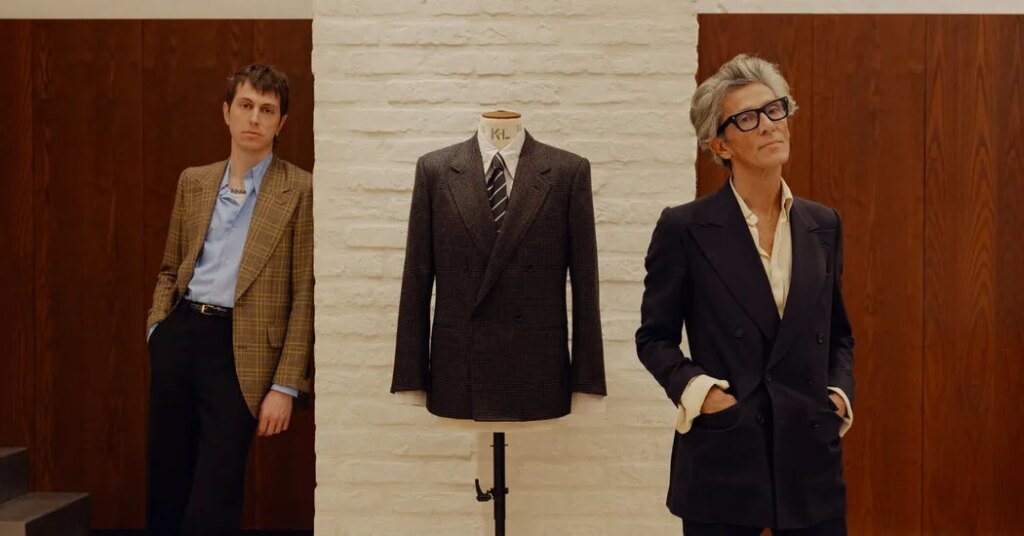
It was in the mid-70s on an early October afternoon in Paris, but Gabard, a 57-year-old man with a healthy dollop of silver hair, was dressed, as he pretty much always is, in a suit. It was a dark chalk-striped three-piece that looked like flannel. A scarf was looped in a perfect knot around his neck. He looked like Serge Gainsbourg if Serge Gainsbourg had been addicted to running instead of cigarettes.
Gabard was standing in a back alley in the Marais neighborhood, showing off the new flagship location for his French suiting label Husbands, which has taken off among men (and, unexpectedly, women) who are drawn to evocative silhouettes, heeled boots and flared jeans.
“People used to dress for collective obligation, and that disappeared in the last 30 years,” said Gabard, who left his career in law and then communications to start Husbands 14 years ago.
Gabard was betting on the idea that there were more people like him out there — people who wore custom dress shirts to the beach, who still, to this day, fly in suits. OK, maybe not that far. But he did tap into a curiosity about wearing a suit not because you had to, but because you craved it.
“We wanted to give men, and women, a desire to dress up again,” he said.
Husbands has spread like fire among wonky dressers who savor a suit that swerves beyond, say, J. Crew’s slim and understated stock fit. Just after opening the new Paris shop, Gabard and Julien Wolff, the company’s chief executive, who, looking like a bassist in Roxy Music with his checked jackets and mop haircut, headed to Los Angeles and then New York City. In Manhattan, Wolff spent an afternoon scouting storefronts for a New York location for the brand.
Gabard, who doesn’t advertise, entrusts his customers to pass along the Husbands name when someone stops them to ask: “Hey, where did you get that suit?”
“When you’re dressed in Husbands, it’s instantly recognizable,” said Carl Casuga, who lives in Connecticut and owns three suits, three jackets, “a lot of boots” and a couple shirts from the brand.
The look, he said, is a “vision of masculinity,” centered in the 1970s.
Some Husbands converts have also been taken in by a word that catches in the throats of middle-aged men who might not look like Gabard, who might be a foot shy and 20 pounds heavier than the average Husbands model. An ideal that men, though they rarely like to say it, do aspire to: sexiness.
It’s right there fizzing on the Husbands Instagram page, full of models in high-waisted jeans and shirts left undone for maximum man cleavage.
“The new store is a necessity, to be honest,” Wolff said. In the brand’s previous Paris location, a buttonhole in the Second Arrondissement barely larger than a boulangerie, men would flip through wool fabric books shoulder to shoulder.
Husbands doubled its revenue last year compared with the year before. Forty-five percent of its business is in made-to-measure garments. The rest comes from its ready-to-wear assortment, which includes Cuban heeled boots, slim patent-leather belts and denim, primarily its va-va-voom flared jeans, introduced in 2021.
Twenty percent of its business, as well, is from women like Caroline Kessler, a documentary film editor in Brooklyn who had previously been buying her suits off the rack and having them tailored.
She was keyed in to Husbands by her partner. It “was the first time where a suit was available to fit my form properly,” Kessler said. Now she owns two bespoke suits and two blazers from the company. She enjoys the process so much that she makes mood boards before her Husbands appointments. Her last one featured different shades of green for a new blazer.
But often, like so many of Husbands’ male shoppers, she just looks at Gabard and thinks: That’ll do.
Even as the staff of Husbands has grown to 14, Gabard remains its central figure. To some shoppers, having him wait on them is as if Yves Saint Laurent were actually the man fitting your Saint Laurent suit.
“My joke is kind of whatever Nicolas is wearing when we go is what I end up buying because I just love his style,” Kessler said.
Many designers take their cues from the street or pore over reference books to sniff out a design detail they can rip and reinterpret. Gabard said he liked to watch old movies.
A Husbands gabardine trench coat echoes one worn by Alain Delon in the 1967 noir “Le Samouraï.” Take one of the brand’s pale blue button-up shirts and tuck it into a pair of Husbands slender white jeans with a black belt, and you have an outfit right out of “Blow-Up,” the 1966 slow-burn thriller by Michelangelo Antonioni.
The brand’s name is a reference to a John Cassavetes movie from 1970.
“My culture is really rooted in the past,” Gabard said.
Still, he insists his tastes are more catholic. A brown plaid shirt the brand sells appears nearly grungy. A raglan-sleeve overcoat looks like something a younger David Byrne might have worn. Gabard said his next collection “will be full of Manchester” in the ’80s. He grinned with pride as he noted that Peter Saville, the designer who created New Order’s famed album covers, was now a Husbands client.
“They have this sort of cultural fluency,” said Elliot Ackerman, an author who visited the old Paris store seven years ago and has since had Husbands invade his entire wardrobe.
From this perspective, Gabard’s business grasps how so many men think about clothes: Hey, that guy looks cool — I wonder if I could wear that, too. When Ackerman started plotting a custom suit recently, he sent in a couple photos of Cy Twombly wearing his utopian ideal.
“It wasn’t like an exact replica of the suit, but it was this starting point to have a conversation about what I want this thing to be,” Ackerman said. He and his Husbands tailor now call it his Twombly suit.
It was Gabard’s own frustrations as a shopper that catalyzed him to give up his training as a lawyer and get into lapels.
In his 30s, flush from a legal job, he would shop at Jil Sander or Dior. Yet, he always felt “a bit frustrated” by the offerings, he said, adding, “I’d think: ‘Why couldn’t the shoulders be like this? Why is Hedi Slimane so low rise with his jeans?’”
There was an arrogance to this. Gabard, with no training, was convinced that he could do these designers better. He started frequenting custom tailors who could make tangible his finicky ideas: suits with swoop and high shoulders, suits with presence. Eventually, he began to think others might also want what he was making.
“The first words I wrote were, ‘Husbands: Rediscover the grammar of men’s wardrobe,’” he said, adding with a head shake, “It’s really pretentious in a way.”
But his timing was fortuitous. Fashion in the aughts had downshifted into sweats and jersey. The pandemic only nudged more men into elastic waists and stretch cottons. As this casualness infected the market, a contingent of men wanted to swim the other way.
“If I’m going to get dressed, I’m not just going to slide on some sweatpants,” Ackerman said.
A newish clique of tailors, including Saman Amel in Sweden, J. Mueser in New York City and Husbands in Paris, bubbled up to cater to this crowd. Each was informed by the city it called home.
“There’s just something about the Parisian aspect” of Husbands, said Ben Duhl, who has been shopping at the brand for five years. For him, that sensibility comes through in the longer cut of a jacket and the rise of the trousers.
All those unbuttoned shirts, stacked-heel boots and crotch-highlighting trousers can also feel risky. They simmer with a certain feminine energy, complicating one’s gendered assumptions.
Gabard leans into this. From go, he cut those high-waisted pants tight around the seat, accentuating a part of the body many were keen to hide.
“At the beginning, it was really surprising because the man was in the mirror and he said, ‘I cannot show this,’” Gabard said. “Why? Why can’t you show this?”
Gabard is interested in that “transformative moment when you discover that you could be this person, and then you learn to dare,” he said.
Duhl doesn’t wear his Husbands suits daily, he said. He after all lives in Los Angeles, the epicenter of T-shirted business meetings. But when he puts the suits on, he said, they “make me feel different than anything else.” They make him feel elegant, louche and, well, yes, sexy, he said.
“And that’s what I want to sort of project out there,” Duhl said. “Even though I’m a dad with an 11-year-old.”
The post Suits for a 1970s Leading Man, Made for Now appeared first on New York Times.