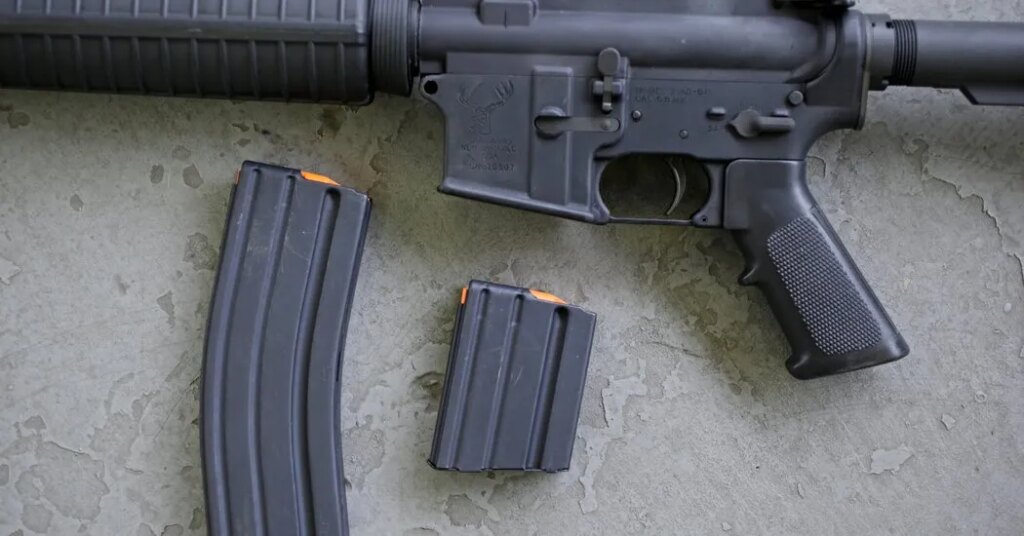
The Supreme Court received an unusual request late last week in one of its biggest cases this term, a challenge to state and local bans on AR-15s and other semiautomatic weapons.
In a one-paragraph filing, the lead plaintiff, Cutberto Viramontes, asked to be dismissed from the case. The 36-year-old Illinois resident had sued officials in Cook County in 2021, arguing that a local ban on semiautomatic rifles violated his Second Amendment rights, a dispute that spiraled into the Supreme Court case the justices have agreed to hear next month.
Mr. Viramontes’s court filing offered no explanation for his decision. It is also unlikely to derail the challenge, in which the justices will weigh the constitutionality of such gun bans. That’s because the court agreed to consider two similar cases, Mr. Viramontes’s challenge to Cook County’s restrictions and a parallel case from Connecticut.
But the last-minute shake-up, less than a month before the Dec. 2 argument, injects questions and chaos into what is shaping up to be a landmark Second Amendment case. In recent years, the court’s conservative majority have announced a series of rulings expanding gun rights, and people on both sides of the debate have long been anticipating the showdown over assault weapons bans.
“It’s unprecedented for a gun-rights plaintiff to abruptly pull their name from a major Supreme Court case with zero explanation,” said Janet Carter, managing director of Second Amendment Litigation at Everytown Law, the legal arm of Everytown for Gun Safety, which advocates tighter guns laws.
She added that “in a case with stakes this high,” she thought that “the public deserves to know why the lead plaintiff is suddenly walking away.”
Reached by phone, Mr. Viramontes declined to say why he wanted to drop out of the case. “I would not like to make a comment,” he said.
Mr. Viramontes is represented by Cooper & Kirk, a law firm that has litigated other Second Amendment challenges. The firm declined to comment.
Cook County officials responded to Mr. Viramontes’s request with one of their own. On Thursday, they asked the justices to drop the Cook County case altogether, arguing that there is no one left in the Illinois matter who even wants to own an AR-15-style rifle. If the justices agree, that would leave the Connecticut case standing alone to test the issue for the nation.
In that case, Grant v. Higgins, a coalition of people seeking to own semiautomatic weapons and gun rights advocacy groups challenged a Connecticut law put in place after the Sandy Hook elementary school mass shooting.
Lawyers for the Cook County State’s Attorney’s Office argued that without Mr. Viramontes, no one in the Illinois case would have standing — the legal doctrine that requires that a plaintiff must show a direct and concrete injury — to continue the case.
Mr. Viramontes’s desire to own an AR-15-style weapon had given him “a concrete stake in the question presented,” the Cook County lawyers wrote. But now that he was withdrawing, and without explanation, “the most natural inference from the bare-bones motion” was that his “circumstances have changed in some significant fashion.”
Mr. Viramontes’s lawyers have not yet responded to Cook County’s request. They may argue that the remaining plaintiff and the two gun rights groups also involved in the case, the Firearms Policy Coalition and the Second Amendment Foundation, have standing on their own, and that the case should continue without Mr. Viramontes.
Originally, the case against Cook County involved three residents who all claimed the ban violated their constitutional rights to carry weapons. One plaintiff, Rubi Joyal, dropped out before the case reached the Supreme Court, leaving Mr. Viramontes and a third man, Christopher Khaya.
Mr. Khaya, a 30-year-old Chicago resident, said in a deposition in the case that he worked as a grocery delivery driver. He said he had joined the Firearms Policy Coalition after learning about it through a YouTube channel that featured reviews of various guns because he wanted “to stand up for Second Amendment rights.”
Mr. Khaya declined to comment on the case.
Unlike Mr. Joyal and Mr. Viramontes, Mr. Khaya never claimed to want an AR-15. Rather, he said in court filings that he hoped to own a gun known as an IMI Galil, an Israeli-made semiautomatic rifle that the Cook County lawyers claim is rare in the United States.
That could be an important distinction, lawyers for Cook County asserted in their filing to the justices. They argued that the justices had agreed in June to hear arguments “specifically limited” to “AR-15 platform and similar semiautomatic rifles.”
As for Mr. Viramontes, a 2022 deposition in the case offers a few details about his life. He told lawyers that he lived in Chicago and had left college without a degree because he “didn’t really have a sense of direction, and it was very expensive” and worked as a real estate agent before becoming an office manager. He said he practiced shooting at a range in Illinois and hoped to purchase an AR-15 for “self-defense.” In his deposition, he said that it was not his idea to file the lawsuit and that, to his knowledge, it came from the Firearms Policy Coalition.
Supreme Court plaintiffs often become the public faces of legal cases about some of the most consequential issues in American society. The cases bear their names, which are then used as shorthand for landmark rulings, forever linking them to the court cases.
Fred Korematsu, for instance, lent his name to a case about the internment of Japanese Americans during World War II. Mildred and Richard Loving gave theirs to a challenge to Virginia’s ban on interracial marriage.
But while some named plaintiffs attend Supreme Court proceedings, they do not testify or participate in the argument. That’s done by lawyers, who are often specialized appellate attorneys, many of them former clerks to the Supreme Court justices. It’s the lawyers who often drive cases by finding people willing to sue over particular issues.
Legal experts who closely track Second Amendment cases said they were puzzled by the last-minute maneuvering in the case, particularly since it is widely believed that the gun rights movement has a strong chance of winning.
“This is a very big surprise,” said Adam Winkler, a law professor at U.C.L.A. and the author of “Gunfight: The Battle Over the Right to Bear Arms in America.” “It’s just kind of bizarre when he’s about to win and become the face of the gun rights movement.”
Julie Tate contributed research.
The post Mysterious Request Scrambles Major Supreme Court Gun Case appeared first on New York Times.