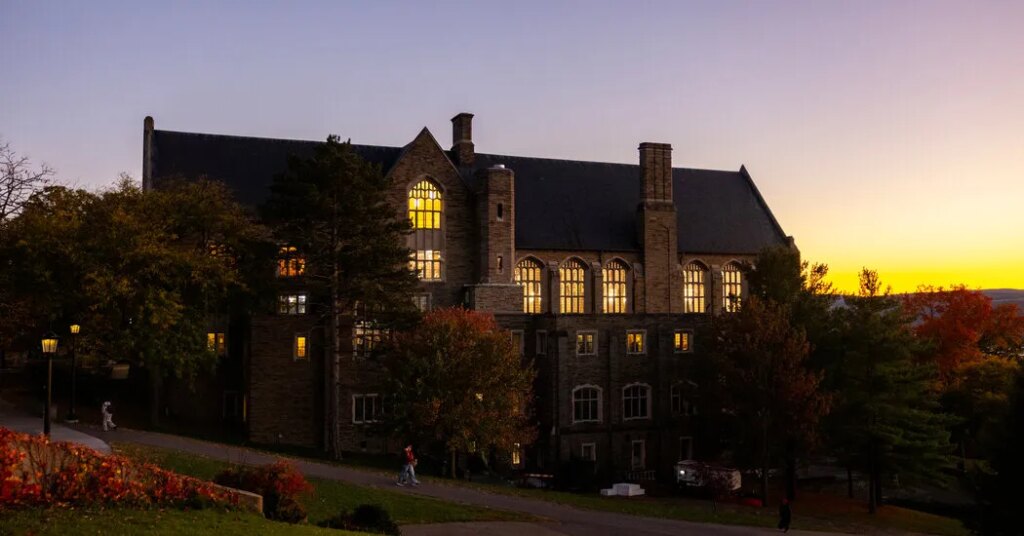
The Cornell faculty senate passed a resolution of no confidence in Cornell’s central administration on Friday, urging change in how the university should handle the persistent and troubling issue of sexual assault on its campus.
While largely symbolic, faculty members said that they believed the vote would serve as a rallying cry for those who wanted a new approach and new leadership to resolve a crisis that was sparked seven weeks ago, when a former student filed a lawsuit alleging she was gang raped at a fraternity house in 2024.
“This vote is only the beginning,” said Iris Packman, a faculty co-sponsor of the resolution, at a news conference on Friday afternoon. “It says to the Cornell community that the faculty do not stand behind this administration’s response to this crisis. And importantly, it says to all of the Jane Does out there, we have your back.”
It passed by a vote of 75-50, with five abstentions and five members not voting, according to a copy of the results obtained by The New York Times.
Cornell’s powerful board of trustees, which appointed Michael I. Kotlikoff as the permanent president after years of his service as provost, has ultimate control over the university’s leadership. It released a statement on Friday indicating it continued to support him.
“The Board of Trustees remains confident that President Kotlikoff and his administration are the right leaders to thoughtfully and comprehensively address the serious problem of sexual assault on our campus,” said Anne Smalling, the chair of the board of trustees, in the statement.
“This confidence is rooted not only in the administration’s actions to date and plans moving forward, but also in its track record of navigating complex problems, as it did in restoring federal funding, preserving free speech, and leading the university through Covid,” she said.
The no-confidence resolution was proposed by more than a dozen of the university’s faculty senators in early October. Unlike similar resolutions at other universities, the resolution does not name specific university leaders, or call out exactly what mistakes were made.
Instead, its one sentence simply states that the faculty senate, an elected group of 135 faculty members, “has no confidence in the ability of the central administration to effectively address the ongoing crisis of sexual assault at Cornell University.”
Supporters of the resolution have argued that its sweeping language was designed to indicate that the ongoing problem of campus sexual assault must be treated as a systemic issue. Passing the measure, they said, is meant to send a signal to students, alumni and the wider world that they know Cornell needs to do a better job in responding to allegations such as those made by the former undergraduate, known as Jane Doe.
Beginning in 2024, Cornell’s Title IX office conducted a lengthy investigation into her allegations and issued punishments to the seven men that she accused. Two were expelled; two others were suspended; and three more were given lighter punishments, including writing reflection papers. But critics have argued that those punishments were not enough and that Cornell’s police should have done a better job convincing the local district attorney to bring the case before a grand jury.
The men have denied wrongdoing, and none of them have been charged with a crime.
More recently, critics have faulted Cornell’s central administration for taking too long to respond publicly to the lawsuit after it was first reported on by The Cornell Daily Sun on Sept. 18, leaving toxic rumors and discourse to build online.
Mr. Kotlikoff waited more than two weeks to make a public statement about the case. Mr. Kotlikoff did not pledge to suspend fraternity parties on campus until the public relations crisis over the case intensified and nearly two additional weeks passed.
“Instead of taking some kind of systemic approach as leaders, the Cornell central administration has had a reactive and piecemeal approach, which has eroded the trust of students, faculty and staff,” said Risa Lieberwitz, a faculty co-sponsor of the resolution, who spoke in favor of it in late October. “They don’t seem to have the desire, either, to really lead systemic change.”
While faculty no-confidence votes remain rare, they have picked up in the last decade, driven by increasing tensions on college campuses, including over how presidents handled Covid-19 policies, protests over the bombing of Gaza and sexual misconduct, said Willis Jones, a higher education professor at Southern Methodist University.
University faculty do not have the power to remove administrators. But even the calling of such a vote can sting, putting frictions on public view and unsettling boards eager to protect their schools’ reputations. And because the academic world has historically embraced the notion of shared governance — dividing campus power among boards, administrators and faculty members — the votes can upend fragile alliances and traditions.
“While no-confidence votes don’t mean presidents automatically lose their jobs or will be reprimanded by their boards, they deliver a publicly damaging message that can ultimately lead to their demise,” Michael T. Nietzel and Charles M. Ambrose wrote in a book published this year, “No Confidence: When College Faculty Turn Against Their Presidents.”
Some presidents, of course, have stayed in their jobs for years after losing no-confidence votes. Eli Capilouto, for instance, remains atop the University of Kentucky more than two years after such a vote, and Laura Rosenbury still leads Barnard College, though the faculty voted no confidence in her in October 2024.
But Lawrence H. Summers resigned as Harvard’s president in 2006, less than a year after a no-confidence ballot. And Minouche Shafik stepped down from Columbia University’s presidency about three months after losing a similar vote in 2024.
Surveys and studies have found that roughly half of campus leaders who lose no-confidence votes leave within a year, though it is not always clear how much the votes factored into those moves.
“The full impact of many no-confidence votes cannot be known until there’s been sufficient time to allow a full assessment of the sequelae,” Dr. Nietzel and Dr. Ambrose wrote. “Often, what is said and what unfolds in the immediate aftermath of a vote is very different from the final disposition of the matter.”
Last week, Cornell’s faculty senators voted 76 to 48 against delaying the no-confidence vote until after an investigation into the Jane Doe abuse allegations is completed. It will be led by Sally Yates, a former U.S. deputy attorney general.
John Dyson, one of the university’s major donors and a longtime former board member, whose $25 million gift underwrote the university’s School of Applied Economics and Management, said he believed the no-confidence vote would not impact the board’s support of Mr. Kotlikoff.
“In my view, not one vote will change,” he said in a text message, adding that he believes the faculty should have let the investigations and other reforms play out. “This group, in the general view, does not represent the faculty as a whole,” he continued, calling them “activists.”
News of the results began to trickle out to students late on Friday. “I think it’s a validation of what the entire nation has seen — that Cornell’s administration has unequivocally failed,” said Sam Poole, a Cornell junior and student organizer, after hearing the news at an on-campus cafe.
He said that he hoped the resolution resonated beyond Cornell, and “inspires faculty and students and university communities to take stock of what’s happening on their own campuses.”
Benjamin Leynse, Emily Steel and Vimal Patel contributed reporting.
The post Cornell Faculty Lose Confidence in Top Leaders After Sexual Assault Case appeared first on New York Times.