Researchers at Vanderbilt University said this week that they had identified suspicious prediction market activity before the releases of two recent New York Times/Siena polls.
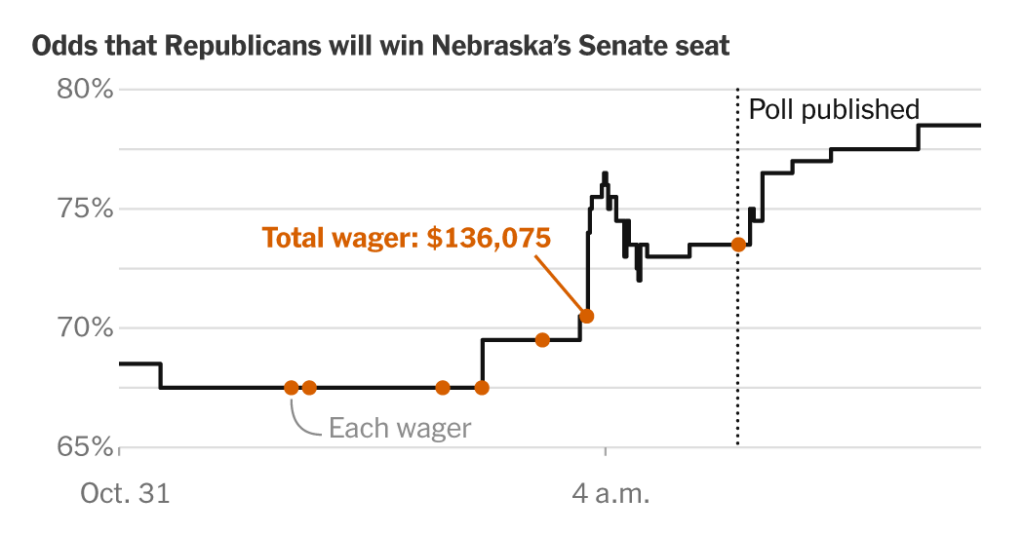
A user on Polymarket placed a series of bets worth $191,277 in the early hours of Oct. 31 that Senator Pete Ricketts, a Nebraska Republican, would win re-election. About an hour later, at 5:05 a.m. Eastern time, a Times/Siena poll came out with Mr. Ricketts six points ahead — among his largest leads in the race.
It was unclear if the user had access to inside information or simply made well-timed trades.
After the bets were placed, the Polymarket odds that Mr. Ricketts would win rose to around 73 percent from around 67 percent. After the poll was published, they continued rising to 79 percent. The user made more than $77,000 in profit.
The same user also wagered $622,608 during the same period that the Democratic nominee would win Michigan’s Senate race, according to the researchers. The next day, another Times/Siena poll showed that the Democrat, Abdul El-Sayed, held a significant lead. The user made more than $180,000.
The user also sent large sums of money to Kalshi, and large bets were placed on similar markets shortly after, the researchers said. Outside of having insider knowledge, researchers theorized, the user could have guessed the timing of polls without knowing their contents, had his or her own beliefs on who would win or was making more complicated trades to offset losses elsewhere without any specialized knowledge.
“There’s a series of circumstances here that it’s hard to write it off as a random occurrence,” said Brett Goldstein, a co-leader of the team that studies prediction markets at the Vanderbilt Institute of National Security. It “requires further investigation.”
A Polymarket spokeswoman said that the company had spotted the trades immediately and that it was investigating. Kalshi declined to comment.
Polling data is typically tightly controlled before its release because of its value as breaking news and because pollsters can take days to lock in the numbers.
Spokesmen for The Times and the Siena Research Institute said that the companies took the allegations seriously and that they planned to review and analyze the research to see if any conclusions could be drawn.
Charlie Stadtlander, a spokesman for The Times, said the company prohibited its staff from using unpublished coverage to make investments. Lyle Durbin, the chief executive of ReconMR, a data collection firm and the parent of the Siena Research Institute, said employees were bound by confidentiality and nondisclosure agreements prohibiting the use of unpublished data for any purpose.
The trades are the latest in a string of suspiciously well-timed and profitable bets that have been identified on the platforms over the past year, as the markets have come under scrutiny for how they may enable insider trading.
Prediction markets, including Polymarket and Kalshi, let anyone wager on practically anything, from election results to pop culture. As the markets’ popularity has increased, states have begun questioning whether they violate gambling laws and watchdogs have grown concerned over exploitation of proprietary knowledge to win big.
Trading activity on Polymarket is public, though often anonymous. Kalshi and Polymarket’s smaller American website, Polymarket US, keep specific trades private.
The Vanderbilt report was reviewed by Nansen, a crypto analysis company, and the Anti-Corruption Data Collective, a Washington-based research group. Both confirmed the report’s overall findings, but could not offer additional clarity.
The Anti-Corruption Data Collective highlighted that the account held its bets until Election Day. “We might expect an insider trading on nonpublic polling data to sell at market highs after the polls get released,” they wrote.
Vanderbilt researchers built a forensic history of the trading activity, which began when the user deposited more than $2 million into an anonymous cryptocurrency wallet on Oct. 30 around 5:30 p.m. Eastern time. The user then funneled the money to Kalshi and Polymarket over the next several minutes, buying the large stakes in the Michigan and Nebraska races.
At 3:27 a.m. on Oct. 31, the user placed a $349,135 wager that a Democrat — Mr. El-Sayed — would win. Later that morning, at 5:20, the user bet another $273,473 on Mr. El-Sayed.
The next day, Nov. 1, at nearly 8 p.m., The Times released a poll with results from Michigan and several other states. In it, Mr. El-Sayed had a big lead. The poll was conducted from Oct. 23 to Nov. 1, according to its methodology, meaning some polling results would have been at least partly assembled as the Nebraska poll was released on Oct. 31.
Odds that Mr. El-Sayed would win subsequently increased by a few points. He won the race two days later.
Altogether, the user made more than $250,000 on 25 trades placed over two hours on the Michigan and Nebraska markets.
On Polymarket, the user had bet in just three markets before October.
The same anonymous cryptocurrency wallet was also used to buy $910,000 in tokens from World Liberty Financial, a company owned by President Trump’s family, in 2024. The purchase accounted for nearly one-third of all tokens sold that October. The tokens were not widely available to the public and early buyers needed to be approved by the company at the time. The user made more than $3.6 million after selling some of the tokens when trading opened the following year.
The post Researchers Identify Suspicious Prediction Market Activity Before Times/Siena Poll Release appeared first on New York Times.