Investors seemed uncertain of what to make of the political earthquake of the midterm elections this week and the sustainability of America’s artificial intelligence boom, as markets surged, then dropped and then appeared to somewhat stabilize by the close of trading on Friday.
The tech-heavy Nasdaq composite index and the S&P 500 finished up 0.3 percent and 1.1 percent respectively on Friday. The Dow Jones Industrial Average lost 0.5 percent.
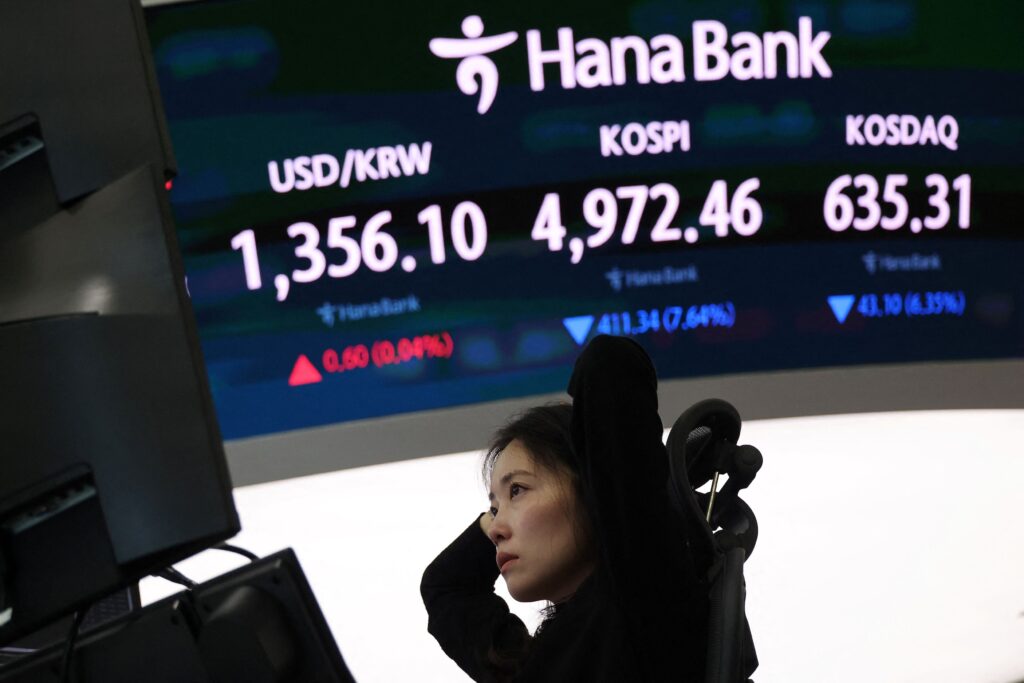
Asian and European stock markets dropped Friday, extending losses seen in U.S. indexes a day earlier amid investor concerns that Democratic control of Congress could increase regulatory scrutiny of AI development.
Japan’s Nikkei and Korea’s KOSPI index both dropped about 6 percent, while Hong Kong’s Hang Seng and the Shanghai composite index fell about 1 percent on Friday. Major stock indexes in Britain, Germany and France lost between 1 and 2 percent.
But U.S. chip stocks, which took heavy losses on Thursday, saw a partial rebound on Friday. The iShares Semiconductor ETF, an investment fund tracking chips, rose about 3.5 percent. Nvidia, Taiwan Semiconductor and Broadcom all rose. Advanced Micro Devices rose by 11 percent.
Other technology stocks did not see as dramatic gains; Microsoft and Apple dipped 1 percent and 0.5 percent respectively.
Reports circulating Thursday that Anthropic, the maker of the chatbot Claude, may go public at a lower valuation than expected appeared to feed into jitters.
“Of the six conditions our US team identified as critical to sustaining the AI boom — backlogs, financing, compute demand, competition, politics and the Fed — three were already showing cracks: competition, politics and the Fed,” wrote Bloomberg economists Jamie Rush and Maeva Cousin and risk analyst Malcolm Scott in a Friday morning note.
“Rapid market repricing puts a fourth — financing — on the cliff edge,” they added, writing that a rate hike from the Federal Reserve could intensify the impact of a sell-off.
Priscilla Thiagamoorthy, a senior economist at the Bank of Montreal, said in a note after markets closed Thursday that the pullback was notable because stocks had for so long resisted “mounting economic headwinds.”
“But Thursday’s sell-off was a reminder that when expectations and valuations become stretched, even a modest shift in sentiment can trigger a swift repricing,” she added.
Ed Mills, a policy analyst at the firm Raymond James, said he expected to see continued volatility in AI driven by policy.
“We see very frequently after big moves, a recovery, [but] it’s too early to know exactly where that is,” he said.
Dozens of ballot measures placing restrictions on data center development were approved in Tuesday’s elections, while states that have been hubs of data center development including Texas and Ohio will have new Democratic governors who have promised tighter regulation.
Oil prices have sunk over the past week as decisive midterm results boosted hopes of a renewed push to end the Iran war.
The price of Brent crude oil, the international benchmark, settled to around $98 a barrel on Friday. It still remains below the $117 a barrel mark from one week ago.
The U.S. economy showed unexpectedly strong jobs numbers Friday morning, with the unemployment rate ticking down to 4.1 percent. The economy added 165,000 jobs in October, nearly triple what forecasters had anticipated.
The new job numbers buoyed expectations that the Fed will hike interest rates next month, raising the cost of borrowing.
The post Tech stocks steady to end volatile week for markets appeared first on Washington Post.