A certain, subversive, queer motif has come va-vooming back into the culture, snapping its garters. Lovers taunt each other with criminal transgression, or enact weird dominance games with lethal outcomes. Murder is on the aphrodisiac menu! Could a little death (a victim’s, say) add a frisson of meaning to erotic play?
There’s often something deliberately retro about this “be gay, do crimes” aesthetic: Think of the blood-smeared Gillian Anderson and Hannah Einbinder at the end of Jane Schoenbrun’s ’80s-esque horror-burlesque “Teenage Sex and Death at Camp Miasma”; or the recent revivals of “The Rocky Horror Show” and Jean Genet’s 1947 “when girls attack” shocker, “The Maids.” Patricia Highsmith is back, too, again: The author’s often queer-coded Tom Ripley character is most recently portrayed by the liquidly seductive Andrew Scott, a killer who sort of invades his victims, ontologically speaking.
So this style of fantasy isn’t just about sex, and it’s not just about crime-qua-crime either. Where does it come from?
Two plays in New York right now look to the source of this elision of libido and norm-breaking and death — it’s telling that both are steeped in the Freudian revolution of the 1920s. (The subconscious is each drama’s silent extra character.) The Fiasco Theater revives Susan Glaspell’s odd hybrid “The Verge,” from 1921, which grafts a liberatory feminist domestic comedy onto a psychosexual tragedy, and the New Group attempts a new version of “Rope.”
“The Verge,” directed by Jessie Austrian at the Public Theater, frequently refers to characters’ being “queer,” although in 1921, the word still mostly meant “strange.” Glaspell may not have been overtly (or consciously) referring to same-sex relationships, yet straight sexuality is certainly depicted as explicitly deranging.
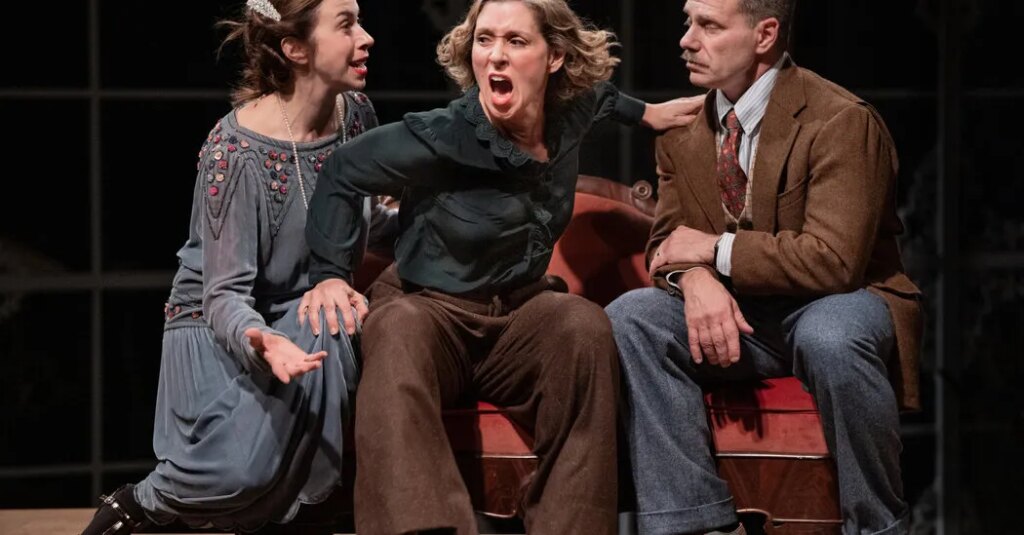
Miriam Silverman plays Claire Archer, a freethinking married botanist with a string of male beaus. Claire is breeding a new plant species, something that can be “alive in its otherness,” even as her husband (Noah Brody) and vapid daughter (the wonderfully funny Amara Leonard) try to get her to be normal. “Don’t encourage her to be queer,” her husband begs their friends (and Claire’s secret suitors), hoping she’ll conform. But any pressure — even an embrace — drives her to madness.
Rather, that’s what I think is happening. Glaspell’s gothic, self-consciously lyrical dialogue is frustrating, metaphor-drunk, syntactically sclerotic. (“We were shut in with what wasn’t so,” Claire says, opaquely, about the recent world war.)
As a performer, Silverman is a tremendous realist, which makes her a strange match for Claire, who speaks like an opera heroine in therapy. Austrian’s sometimes confusing direction includes an obstacle course made from tables, which actors must clamber over just to reach Claire. You definitely learn a lot about the way psychoanalytical paranoia (unknown selves dwell within us!) overtook the early 1920s, but this trippy, hothouse production is clear only when it’s violent. To wit, you know when Claire changes into her most gorgeous outfit, some guy’s about to die.
The guy is already dead in “Rope,” which is not the well-known Patrick Hamilton play by that name from 1929, but the playwright Gordon Greenberg’s updating of the same plot. Greenberg moves the action to the ’50s, perhaps because the febrile 1948 Alfred Hitchcock movie is as much in the air as the play’s other antecedents, including the notorious crime perpetrated by the friends Nathan Leopold and Richard Loeb, who killed Bobby Franks in 1924.
As in those other, earlier iterations of “Rope,” two men have killed a third and hidden his body in a chest, and they invite their friends over for a strange dinner, titillated to have such a terrible secret.
Hamilton and Hitchcock kept the interplay between the two young men largely sublimated; Greenberg and the director Scott Elliott haven’t got that much patience. We therefore see the dominating Garrett Stern (Cameron Monaghan) and his submissive “roommate,” Nate Singer (Corey Fogelmanis) in several hot clinches, and Garrett also grapples sensually with their professor, Rupert Cadell (Jason Butler Harner), who harbors pointed suspicions.
Elliott’s production is nicely moody, with thunder periodically interrupting Garrett and Nate’s creepy party. Yet the cast, particularly the grinning Monaghan, is too distracted by the rat-a-tat period dialogue to create anything darker or slipperier. The two leading men have spent so much time making it seem as though they are having sex that they sort of forget to make it seem as though they’ve done a murder.
There is, bizarrely, a cost to bringing the subtext out of the closet. Greenberg may wish to amplify what’s already in the play, but instead he drowns it out. The gay-crime fetish drama, rooted in the Freudian belief that our true desires are opaque even to ourselves, requires something more than the occasional toss on the sofa. It wants a sense that the important clues are all hidden away in a chest — whether the one in the center of the room, or the one encasing a character’s heart.
The Verge Through Nov. 22 at the Public Theater, Manhattan; publictheater.org. Running time: 2 hours 5 minutes.
Rope Through Dec. 6 at Theater at St. Clement’s, Manhattan; thenewgroup.org. Running time: 1 hour 30 minutes.
The post ‘Rope’ and ‘The Verge’: The Joy of Sex and Death appeared first on New York Times.