When President Trump returned to the White House last year, his administration downsized or eliminated teams across the government that protected elections from foreign meddling.
He was still angry that senior officials in his first term had declared that the 2020 presidential election was not stolen from him, and he appeared intent on preventing a repeat.
Democrats and election-security advocates feared that without a robust federal effort, an adversary could intrude in American democracy on a scale comparable to Russia’s elaborate and well-funded operations in the 2016 presidential race.
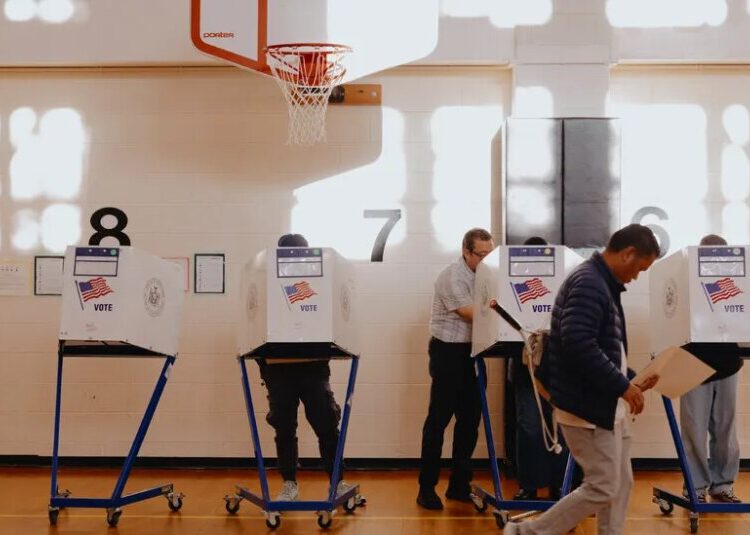
Despite the federal government’s broad retreat from election security, the midterm elections went off without a major hitch. Efforts by Russia, Iran and other foreign adversaries to covertly influence American voters were minimal overall leading up to the vote and did not spike as expected around Election Day, according to current and former U.S. officials and disinformation and election-security experts.
And while there were routine technology failures and other disruptions on Election Day, there were no signs that overseas hackers interfered in the voting process or ballot counts, officials said.
Current and former officials have said for years that even if bad actors wanted to alter votes remotely, doing so would be incredibly difficult. Paper ballot backups, which are now nearly ubiquitous across the United States, would help ensure election integrity, they said.
Mr. Trump himself told The New York Times late Tuesday night that he would accept the results of the election, which amounted to a Democratic wave.
“This past Election Day was just another Tuesday on the internet,” said Chris Krebs, who led the Cybersecurity and Infrastructure Security Agency, or CISA, during Mr. Trump’s first administration but was fired after declaring the 2020 election was free from manipulation. “That’s a good news story, alongside the continued expansion of paper ballots and post-election audits across the country.”
Mr. Krebs said the only caveat to his assessment was the possibility that the U.S. government had identified less activity because fewer people were now looking for it.
Current and former U.S. officials said they were unsure why Russia and Iran both appeared to engage in less meddling than in years past, including the 2024 election. But midterm elections tend to be less appealing — and harder — targets for foreign powers, which care more about who occupies the White House.
Russia-linked actors did make some efforts to inject disinformation into select battleground Senate races, including in Texas and Ohio, that sought to smear Democratic candidates with unfounded accusations of criminal behavior. Those efforts included the use of artificial intelligence and paid actors in videos.
The Times reported in September that classified U.S. intelligence assessments had concluded that the Kremlin once again had approved a digital influence campaign to peddle covert disinformation across social media in hopes of seeding or amplifying domestic divisions during the election season.
But those efforts appeared to achieve little liftoff, researchers said.
Iran, some officials said, may have wanted to avoid jeopardizing a potential deal with the Trump administration to end the war. Tehran has found far more success in recent months with overt propaganda than with any clandestine influence efforts, some disinformation experts said. The newer efforts include a series of videos made with artificial intelligence depicting Mr. Trump and other U.S. officials as Lego figurines.
Iran’s leaders also assumed a Democratic shift was likely in Congress, and that political pushback against the war would come without their help, should the conflict continue into next year, the officials said.
And China appeared to largely sit on the sidelines, they said, as it has mostly done in the past, according to previously disclosed U.S. intelligence assessments.
Some instances of potentially malicious cyberactivity were detected, but they appeared sparingly and were deemed harmless. An unidentified election office reported discovering some basic online reconnaissance and hacking attempts, according to a private summary of election infrastructure threats shared among election officials, a copy of which was seen by The Times.
There were also “multiple brute force attempts” on an unnamed agency that came from the same IP address — a discovery that resulted in several election offices reporting that they found malicious web traffic linked to that address going back to mid-October.
“According to open-source threat reporting, this IP address is known for a variety of malicious activity,” the document said.
Mr. Krebs said the activity described in the report was “fairly run-of-the-mill stuff that election offices deal with every day, and the majority of it was detected and ultimately unsuccessful, remarkably similar to 2024, 2022 and 2020.”
CISA, the election security agency, did not directly respond to a request for comment about whether Tuesday’s election was secure from foreign manipulation or other forms of potential tampering.
Instead, the agency said in a statement that it had “operated around the clock to receive and assess reports of threats and incidents, develop a comprehensive threat picture and provide recommendations that informed coordinated responses and helped safeguard America’s election infrastructure.”
Former U.S. officials and disinformation researchers said that Russia likely devoted few resources on the midterm elections because its top priority — undermining international backing for Ukraine — already benefits from having Mr. Trump in the White House.
Instead, there are signs that Moscow’s trolls are already focused on France’s presidential election next spring, believing that helping the far-right candidate Marine Le Pen could break NATO’s support for Ukraine. Russia has targeted past presidential elections in France to support Ms. Le Pen, according to Western intelligence officials.
“My sense, watching right now, I think they’re really focused on France,” Gen. Paul M. Nakasone, the former chief of the National Security Agency and U.S. Cyber Command, said last week before the U.S. vote.
General Nakasone, who during the first Trump administration established teams to combat Russia’s election meddling, said the Kremlin’s work in France had likely already started.
“There have been incredible demonstrations that have taken place in Paris over the past several weeks, and we know from past history that the Russians have worked information operations against the French election systems,” he said at a national security conference in Sea Island, Ga.
Mr. Krebs said that Russia and other foreign powers have learned that it is nearly impossible to change actual vote counts, thanks to cybersecurity protections, paper ballots and other measures. That means influence operations are the only game in town — even if they often appear to draw little attention from U.S. audiences anymore.
“It’s cheaper, they can measure it, and there’s basically no consequence,” Mr. Krebs said. “A.I. could change that math if the more capable tools get into the wrong hands, but that’s where we’ve been heading for five cycles now.”
The post U.S. Finds Subdued Foreign Meddling Operations in Midterm Elections appeared first on New York Times.