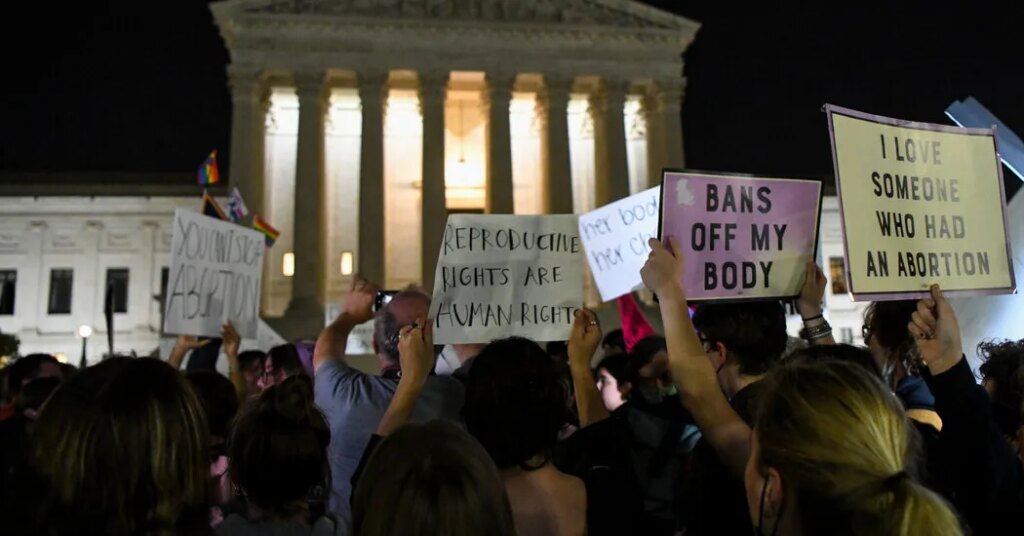
The Justice Department is pursuing a criminal investigation into who leaked the Supreme Court’s 2022 decision overturning the right to abortion, examining the inner workings of an institution that has long operated in secrecy and resisted oversight from the other branches of government.
At issue is who provided the draft decision to Politico two months before it was formally released by the court, a seismic breach of confidentiality that led to intense partisan accusations about the motivations of the leaker.
Despite an internal inquiry by the court, no leaker has ever been publicly identified. An F.B.I. official said last year that the Justice Department was exploring the issue.
But prosecutors are now pursuing a criminal case, which has not previously been reported. The investigation has ramped up in recent weeks as prosecutors have sent grand jury subpoenas for testimony and sought information from people who worked at the court at the time of the leaks, according to people familiar with the inquiry.
From the beginning, the question of how to deal with the leak has been complicated by what charge could be brought even if the leaker were identified, as well as by concerns about the constitutional issue of separation of powers between the executive branch and the court.
The U.S. attorney in Washington, Jeanine Pirro, a Trump ally, is overseeing the investigation. Along with several career prosecutors, Ms. Pirro has assigned one of her top lieutenants to the investigation. That prosecutor, Carlton Davis, has led efforts to investigate local fraud and violence and also oversaw a failed effort to indict six Democratic lawmakers for reminding troops they could refuse illegal orders.
It is not clear what law prosecutors believe might have been broken as a result of the leak, or whether investigators have developed new evidence pointing to a potential suspect. Nor is it clear why the investigation has picked up steam now, including if political pressure from the White House may have played a role. Some potentially relevant laws have five-year statutes of limitations that would expire in the spring.
Many conservatives have pushed for a criminal investigation, convinced the culprit was a liberal seeking to derail the abortion decision, a call echoed by President Trump.
“That person should be found,” he said in July.
The Justice Department’s handling of the case echoes a now-familiar pattern. Mr. Trump demands an unorthodox investigation, and then his political appointees try to deliver on his wishes. The dynamics raise questions about whether the inquiry may be another attempt by Mr. Trump and his allies to harness the vast law enforcement powers of the federal government to settle political scores.
But on the long list of Trump administration legal targets, the Supreme Court and its employees stand apart. The investigation comes as the justices consider cases that go to the heart of Mr. Trump’s agenda and his assertions of executive power. The inquiry could expose the court’s inner workings to a kind of scrutiny that it has always worked to deflect, said people familiar with the inquiry.
The justices have repeatedly said they would like the culprit identified. But cooperating with a criminal inquiry could mean providing investigators with access to court employees and highly restricted internal records, like the files showing the justices’ private deliberations in the case — a sharp break with the court’s tradition of maintaining secrecy around its work.
Patricia McCabe, a Supreme Court spokeswoman, did not respond to questions, including about the extent to which the court has cooperated with the inquiry or turned over information.
A spokesman for the U.S. attorney’s office in Washington declined to comment. The people who described the inquiry to The Times did so on condition of anonymity because they were not authorized to discuss the matter.
When told of the inquiry, some legal experts said the administration might be again pushing into uncharted territory through its use of its law enforcement powers.
“Once again, the Trump Justice Department has created questions about whether there are precedents when there are no precedents,” said Samuel W. Buell, a professor of law at Duke University and former federal prosecutor.
The Justice Department has the right to investigate any federal crime committed at the court, such as insider trading based on advance knowledge of a case outcome, said Michael C. Dorf, a constitutional law professor at Cornell. But if the leak does not amount to a crime, the investigation could violate the separation of powers that ensures the court’s independence, he said.
That could amount to “the executive branch harassing members of the judicial branch,” he said.
An indictment could end — or extend — the court’s four years of trauma over the leak.
The day after the Politico article was published, Chief Justice John G. Roberts Jr. ordered an internal investigation. Supreme Court clerks, valedictorian types who win a year of apprenticeship and a lifetime of prestige, were pressed for information and required to sign affidavits swearing they had not leaked the document. Staff members did the same. In all, 97 court staff members and clerks were interviewed. In contrast, the justices were treated lightly, consulted but not formally interviewed, The New York Times has reported.
Conflicting theories about who was responsible circulated in legal circles and on the internet. Many conservatives believed that the leaker was a liberal, throwing a desperate grenade before the decision was finalized. On social media, some pointed fingers at clerks for liberal justices, posting their names, photos and unsubstantiated theories.
Many liberals, meanwhile, theorized that a conservative did it to lock in the abortion decision. The Times has reported that at the time of the leak, some of the justices were pursuing compromise efforts that might have preserved some federal right to abortion, efforts that ended with the publication of the leaked draft.
The court’s monthslong investigation led nowhere. In a report published in January 2023, its top security official concluded she could not identify a suspect through a “preponderance” of the evidence. The report called the court’s information systems outdated and security practices lax, and added that the online allegations against liberal clerks remained unsubstantiated.
Months later, Justice Samuel A. Alito Jr. told The Wall Street Journal that he had “a pretty good idea who is responsible” but not enough evidence to name anyone publicly.
Meanwhile, Mr. Trump called for jailing the reporters to get them to reveal their source. When he returned to office in 2025, the leak in the case, Dobbs v. Jackson Women’s Health Organization, quickly joined a list of other matters that he and his allies promised to solve. In a May 2025 post on social media, Dan Bongino, the deputy director of the F.B.I. at the time, said the Trump administration was continuing to pursue the leaker.
Members of the court have said in recent months that they remain eager to find the culprit.
“We will pursue it till the end,” Justice Elena Kagan told Congress while testifying in July. Justice Amy Coney Barrett, speaking alongside her, called leaks of some court materials illegal.
The Trump administration has aggressively used the Justice Department to try to punish unauthorized publication of government information, including sending subpoenas to New York Times journalists and raiding a Washington Post reporter’s home in January.
Each of those cases, however, involved the release of information related to national security, which is protected by law. No such law specifically forbids the release the internal records of the Supreme Court.
Some experts have said prosecutors could try to charge the Dobbs leaker with violating a statute that prohibits theft of government property or one intended to protect against the disclosure of confidential government information, though either would be a relatively novel uses of the laws.
Another avenue prosecutors could pursue would be to target any false statements that employees made during the court’s initial investigation. During that inquiry, employees were warned that they could be prosecuted for lying to the government.
If prosecutors bring charges, another challenge could be securing an indictment in Washington, where grand jurors and judges have repeatedly thwarted attempts to mount cases that have even a whiff of following through on Mr. Trump’s demands.
The increasing public distrust of the Justice Department by grand juries in Washington has convinced some senior officials there that it may be impossible to bring a politically sensitive case until Mr. Trump is out of office.
In another twist, several clerks who were employed by Republican-appointed members of the court at the time of the Dobbs decision now work at the Justice Department.
T. Elliot Gaiser, for instance, clerked then for Justice Alito, who wrote the Dobbs majority opinion. He now heads the influential Office of Legal Counsel, the Justice Department office responsible for providing legal advice to the president and executive branch agencies.
Asked if Justice Department employees, or any of the justices, are being interviewed, or if the court handed over the records from its initial investigation, the court, the U.S. attorney’s office in Washington and the Justice Department did not respond.
Devlin Barrett contributed reporting. Julie Tate contributed research.
The post Justice Dept. Steps Up Criminal Investigation of Supreme Court Abortion Leak appeared first on New York Times.