Democrats just partied like it’s 1974. On Tuesday night, they pulled off the largest midterm victory since the post-Watergate wave. Democratic Senate candidates conquered longtime Republican strongholds like Kansas and Texas — and probably (in the view of the internet’s gamblers) Mississippi and Alaska. When the dust settles, and all ballots are tallied, Democrats are expected to boast a 13-point popular vote victory and more than 250 House seats.
Taken together, these results exceeded many Democrats’ wildest dreams — and Republicans’ greatest fears. Countless Americans are therefore asking: How the hell did that happen?
To make some headway on that question, I spoke with the Democratic data scientist David Shor. Founder of the consultancy Blue Rose Research, Shor has access to volumes of large-sample polling, precinct-level data on which voters did (and did not) turn out in multiple states, and fine-grained estimates of demographic shifts in party allegiances.
Historically, Shor has been one of the Democrats’ most prominent Cassandras. For years, he has warned that his party’s falling support among working-class voters threatened to make Democratic Senate majorities a thing of the past.
Key takeaways
- Democratic turnout surged, particularly among young, politically disengaged, and Latino voters.
- The Iran war was Trump’s downfall.
- Campaign donors have weird priorities and issue positions, which can undermine politicians who take their money.
- Polling is getting harder.
- Americans think AI might take their jobs and kill their families.
So, I wanted to ask him about the story that his numbers are now telling — and whether it challenges his past assumptions about how American politics works.
On Wednesday afternoon, we also discussed shifts in youth turnout, why Elon Musk’s money bought Republicans so little, and Americans’ growing contempt for artificial intelligence, among other things. Our conversation has been edited for clarity and concision.
What happened Tuesday night? How did Democrats end up with the biggest landslide in half a century?
It’s early; a lot of precincts haven’t come in and we only have individual-level data in a couple of places. But Democrats appear to be running about 7 points ahead of where Kamala Harris was.
And it seems like a very large portion of that was due to turnout. You can see this in both the precinct and county-level data. But we also have data on individual voters in Texas and Georgia. And in those two places, Harris supporters turned out at a rate about 9 points higher than Trump supporters did. That’s likely the largest turnout advantage going back to at least 2006. For context, the gap in 2018 was about 3 points.
Democrats turned out at something like a 10 percent higher rate than Republicans did. That’s Democrats’ largest turnout advantage since at least 2006. For context, the party’s advantage in 2018 was maybe 3 percent.
And a lot of that was young voters. It’s funny; in 2022, everyone said there was a “youthquake” — a huge spike in youth turnout — which was overstated. But this time, one genuinely happened. In Georgia and Texas, there was an enormous increase in youth turnout and actual declines in turnout among voters over 65.
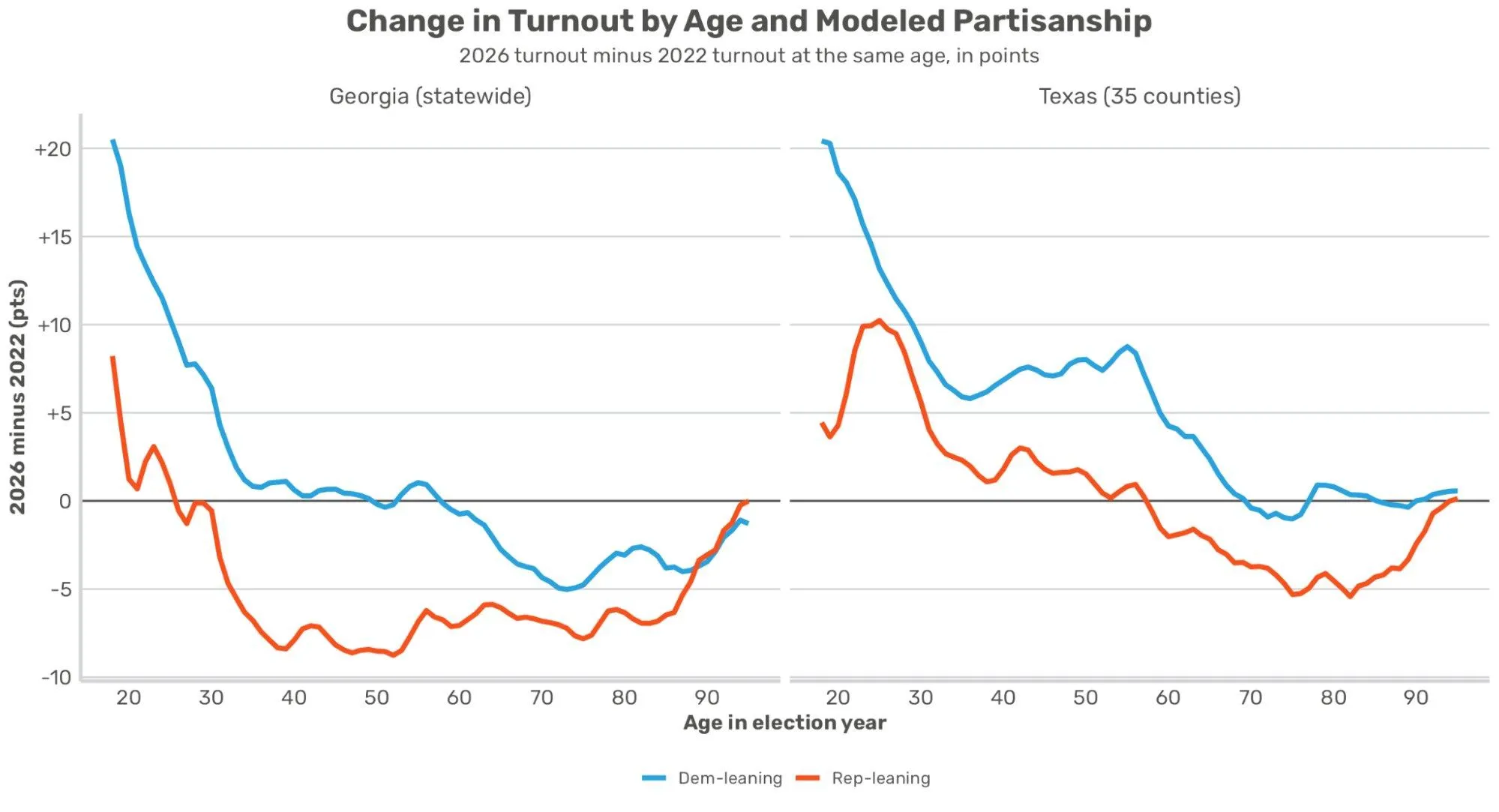
We also have evidence that Democrats gained ground with politically disengaged voters. In the precincts that had the lowest turnout rates in 2022, Democrats gained something like 11 points. Whereas the highest turnout precincts swung toward us by only 2 or 3 points.
It’s a little hard to distinguish changes in support from changes in turnout. But it’s clear that young voters, Hispanic voters, and infrequent voters swung toward us, reversing much of the gains that Republicans made with those groups in 2024.
How big was the increase in Black turnout? Looking at Democrats’ remarkable success in South Carolina and Mississippi, it seems like African American mobilization must have been a factor.
In the Georgia data, we see a 4-percentage point increase in the Black share of the electorate relative to 2022, which is quite a bit. And in Texas, we see a nearly 6-percentage point increase in the Latino share of the electorate.
What explains these shifts in turnout and voting patterns?
If you look at Trump approval — both from 2016 to 2020 and then from 2024 until the end of 2025 — it was really quite stable. Obviously, it was highest at the beginning of his terms and went down after a month or two. But then for most of Trump’s first term, he was hovering around the mid-40s in our data and it really barely moved in response to events. And it was much the same for the first year of Trump’s second term. Which was worrisome: Trump had all of these scandals, but at the end of the day, the line didn’t move. A good day would be like, “Oh, Trump approval is down three-tenths of a percentage point — amazing!”
So, a lot of people became very nihilistic. They were like, “Oh, we really live in this world where nothing matters.”
But then, the Iran war happened. And there was a giant structural shift in public opinion. His approval rating on the cost of living plummeted. To put some numbers on this, the day before the Iran war, Donald Trump had a 49 percent approval rating on gas prices. Within a week, it was 33 percent.
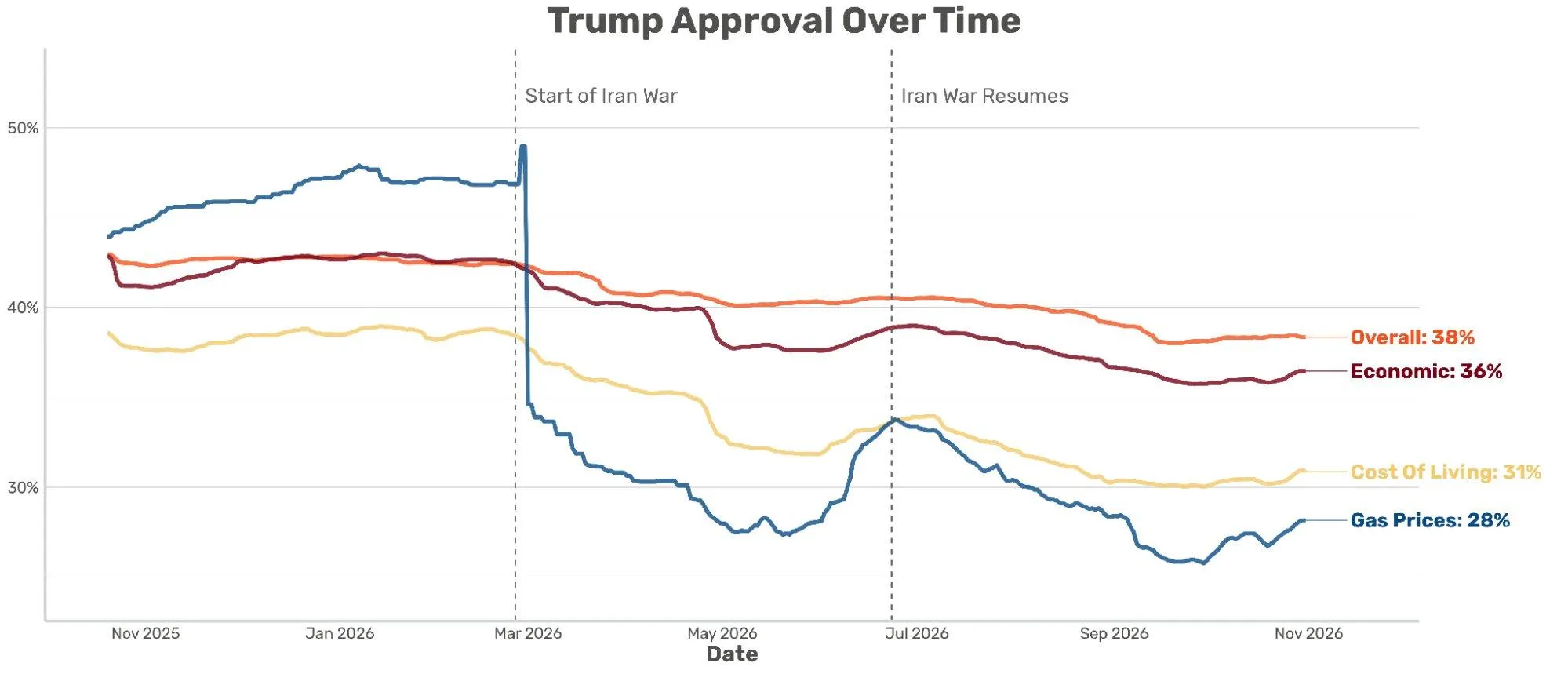
Trump’s overall approval rating isn’t that much lower than in 2018. And his approval on immigration, healthcare, and a lot of other issues is pretty similar. The big change in our polling has been a giant decline in Trump’s approval on the economy.
And previously, voters’ trust in his economic management was the one thing propping him up. But the Iran war destroyed it. And he went from being a complicated political figure — who was popular on the economy but unpopular on other things — to being unpopular on everything.
So, Tuesday’s wave had less to do with what Democrats did right than what Republicans did wrong? Are there portable lessons here for Democrats besides, “When a GOP president engineers a massive increase in gas prices, tell voters you disapprove?”
I’m not going to claim that the Democratic brand is perfect. But I think the Democratic leadership and both wings of the Democratic Party — the left and the “establishment” or whatever — deserve a lot of credit for making big concrete shifts in their messaging, specifically, focusing more on economic issues that affect people’s everyday lives. That was not a given. It was not uncontroversial at the time. And it paid dividends.
Right before the 2024 election, Republicans had a 12-point trust advantage on the cost of living. Today, among 2026 voters, Democrats actually have the trust advantage on the issue, which continues to be voters’ number one concern by far.
We ask voters questions like, “What do you think the Democratic Party cares about?” And when we asked that question a year after the 2024 election, voters thought Democrats prioritized catering to their base over the cost of living by 4-to-1.
When we ran that survey again right before this year’s election, voters thought Democrats cared about the cost of living more than anything else, just like them. They thought Democrats’ second concern was fighting Donald Trump, which maybe wasn’t a total positive. But then number three was healthcare and number four was the economy. And so Democrats really did execute a big pivot.
And meanwhile, if you ask voters what they think that Trump cares about, they say border security, immigration, national security, and war in the Middle East. You have to go far down the list to get to costs.
The other thing I’d say for Democratic strategy: The 2025 government shutdown did damage Trump.
Until then, Trump really felt like he had escalation dominance, that basically every time he would violate norms and trigger a fight, he felt — based on previous experience — that he would win and that Democrats would have to back down. And this was the first high-profile fight between Democrats and Trump where he really paid a big price and his approval started to go down.
And I think that partly reflects Democrats choosing to center the shutdown on healthcare, one of the issues voters really cared about. There were a lot of people in the Democratic Party who wanted to focus on other things, for understandable reasons. But if you look at the postmortem, the healthcare shutdown corresponded with a massive increase in the salience of healthcare in the minds of voters. And that correspondingly led to an increase in support for Democrats and disapproval of Trump.
In our past conversations, you often painted a pretty bleak picture of the Democratic Party’s prospects for winning control of the Senate. And not without reason.
In the last few elections, it seemed like moderate Democratic candidates were having a harder and harder time competing in Republican-leaning states. Which was a problem, since Democrats couldn’t win control of the Senate without prevailing in states that voted for Trump every chance they got.
And you argued that Democrats’ problem was structural: Voters increasingly got their political information from national outlets, which focused on the big-picture ideological divides between the two parties rather than the idiosyncratic positioning of individual candidates. Culturally conservative Montana voters realized that voting for Jon Tester meant empowering social liberals. And so Democrats were kind of screwed, unless they found a way to moderate their national image.
And yet, the national Democratic Party didn’t really moderate any of its issue positions between 2024 and 2026 — yet still managed to win statewide elections in Kansas, Iowa, and probably Alaska and Mississippi. So, how do you reconcile these results with your model of political reality?
I’m a little more wary of making long-term predictions than I was in my 20s. Obviously, I would have been shocked in 2019 if you had told me how many Senate seats we would have today. But it’s worth walking through what happened, year by year.
What’s interesting about 2022 and 2024 is that we really should have lost a lot of races, in many different senses. What saved us is that, in both those years, Democrats had a historic advantage in candidate quality — measured by objective things like, “Was this person elected to a previous office?”
And if you really drill into individual details, this was largely because Trump intervened in swing-state primaries in the House and Senate to support lower quality candidates who were loyal to him.
One mathematical way to see this is to look at how Democrats in swing races did relative to Democrats in non-swing races. And in 2014 and 2018, the gap was basically zero. But in 2022, it was something like 3 percent. And then in 2024, it was a little bit more muted, but similar.
So, I think Republicans were on the cusp of securing a level of power in American politics that no party had experienced in decades. But Trump spent down that power to accomplish his goals. I definitely didn’t see that coming.
As for this election, I did not predict that Trump would start a super unpopular war while also doing massive tariffs and making a bunch of other domestic political miscalculations.
I have two takeaways from all this. The first is I think that political parties have a real tendency towards equilibrating behavior, where in response to having lots of seats, they go and do a bunch of politically counterproductive things.
The other piece is: In the past, I had said that it was impossible to hold the Senate without Democrats winning culturally conservative voters in states that backed Trump by large margins.
And that continues to be true. The question was, “Is it possible for us to get there?” At the time, I think a lot of people really thought that these levels of overperformance were impossible. But it turns out there are different paths to getting there, and one is having the president launch a giant unpopular war, while doing everything he can to drive down his own approval rating.
What do you think this election tells us about the power of money in politics? The GOP had a financial advantage this cycle. And yet, at first glance, it doesn’t look like Elon Musk’s $445 million investment in Republican power made much of a difference.
Obviously money does matter. Ads do work. It’s not like these effects are zero. But as the amount of money in politics has increased, political parties have started catering enormously to the whims of donors who are really quite weird.
In our issue priorities polling, the cost of living is the top issue for every subgroup imaginable — young voters, Hispanic voters, Black voters, old voters, whatever. Every single group, except for the 0.7 percent of the population that has donated to a Democratic campaign in the last year. And for them, climate change is number one, voting rights is number two, you have to go down to like 11 or something to get to the cost of living. And I think that explains a lot about elite Democrats’ behavior historically.
So, it’s better to be outspent and in touch with the American voter than it is to be the opposite. I like to say: whichever party listens less to their donors usually wins.
You can’t blame donors for everything in the Trump presidency — tariffs were probably all him — but if you look at what he did, his donors pushed him to take incredibly unpopular positions on AI and on data centers.
“In our issue priorities polling, the cost of living is the top issue for every subgroup imaginable — young voters, Hispanic voters, Black voters, old voters, whatever.”
After Jacob Coxon resigned from Anthropic, Trump said that no new AI regulations were needed. We polled that statement. And it was literally the most unpopular position I’ve ever seen a mainstream politician endorse. About 8 percent of people supported it. That’s three times less popular than defunding the police.
Holding all else equal, more money is helpful. But if getting it requires you to spend 70 to 80 percent of your time talking to some of the weirdest people on the planet — and forces you to prioritize issues that the general public doesn’t care about — you’re better off with less money.
Zohran Mamdani is an example of this. He showed that if you single-mindedly focus your campaign on voters’ top issue — affordability — you can really do incredible things, while your opponents are wasting time arguing about Israel.
Why did the polls underestimate Democrats so significantly? In some recent elections, polls had tended to overestimate Democrats, particularly in redder areas. And you argued this was because voters with low social trust had become both less likely to answer a pollster’s call — and more likely to support Republicans. And that led pollsters to systematically undercount Trump voters. But this time, the miss went in the other direction.
We’re still trying to piece together exactly what the data says. But the fundamental problem in polling is that the two biggest predictors of answering a phone survey are: 1) How interested you are in politics and 2) your socioeconomic status — as measured not only by education and income, but also things that are much harder for survey takers to gauge like, “how educated were your parents?” or “what’s the occupational prestige of your job?” or, “What kind of neighborhood do you live in?”
In 2012, a voter’s level of interest in politics wasn’t super correlated with support for Obama or Romney. But now they are.
And technology is part of why. If you go back to the 1950s, if someone received a call from a pollster, they’d be like, “Oh my God, there’s a researcher who wants to know my views on contemporary events!” and they would excitedly drop what they’re doing and talk to them. But now there is a multitrillion-dollar war for people’s attention. And so it is in fact quite hard to get non-random samples of people excited to take that call. That problem isn’t going away. So I expect more polling misses in the future.
How do you interpret the variation in Democratic performance between states? Democratic Senate candidates in Texas and Iowa vastly outperformed Kamala Harris’s 2024 margins, while those in Maine and Michigan did so more modestly. How much of that gap is driven by demographics — Trump simply induced a backlash among specific groups that are more present in some states than in others — versus candidate quality? And to the extent that candidate quality was important, did that boil down to ideological positioning or more intangible assets?
We did a big survey right before the election where we asked voters, “How moderate do you think this candidate is?” And then we also asked a bunch of other questions like “How much do you think this person cares about economic issues?” “How in touch are they with the economic struggles that everyday people face?”
And we found that perceived moderation is associated with higher voteshare. Though I think in the House, these effects are smaller than a lot of people would guess. What’s more interesting, though, is it really seems like the extent to which voters see you as focused on economic issues — and in touch with what regular people care about — is much more predictive of overperformance than ideology.
And I think that if you go and look at individual politicians, there are lots of examples of both progressive and moderate politicians who are perceived as out of touch.
And I think the left is learning this. If you look at the ideological penalty that candidates supported by Justice Democrats have paid each election cycle, they’ve gone down over time, as these groups have matured a bit and focused on economic messaging.
One big story from Tuesday night was the massive backlash to data center construction. Forty out of 41 ballot proposals for restricting data centers passed. What do you make of that? In your polling, is this opposition driven primarily by concerns about the structures themselves — their appearance, pollution, and impact on local energy bills? Or is it primarily an outlet for voters to express their antipathy for AI as a technology?
Over the last two years, voters have grown increasingly concerned about AI. In 2024, AI ranked 40th out of 40 on our list of voter priorities. But it’s gained salience by more than any other issue since the start of Trump’s presidency; now it’s ranked 24th out of 39, roughly tied with crime.
And as that salience has increased, people have become increasingly negative about AI. In December of last year, we asked people whether they were more optimistic or pessimistic about AI, and optimism led by about 5 points. In our most recent polling, pessimism leads by 10 points.
Late last year, when we asked, “Do you want a data center built in your neighborhood?” we saw 45 percent support. In our polling a month or two ago, that fell to 14 percent. For context, when you ask voters whether they want a prison in their neighborhood, that figure is 15 percent.
And obviously, part of that is NIMBY concerns. But I think that this is part and parcel of AI becoming more unpopular.
And I think it’s impossible to understand why AI is unpopular without considering voters’ views on the broader economy. Consumer confidence is roughly at the level it was right after the Great Recession. Ask people, “Do you think the economy is rigged for elites or are things fair?” people say “rigged.” Ask, “Do you trust our business elites?” People overwhelmingly say no. And these are very big changes from before the pandemic.
So, if you believe the country’s elites cannot be trusted — and then you also hear a bunch of business people saying, “AI is going to change everything!” — it’s natural to assume that change is going to screw you.
And in fact, 80 percent of voters say it’s either very likely or somewhat likely that there will be large-scale job loss due to AI in the next five years. And something like 64 percent say it’s either very likely or somewhat likely that AI will threaten human survival. So the median voter thinks that there is a considerable chance that AI will take their job and kill their family.
If America’s tech elites really want this large-scale build out and reorganization of the economy to happen, they will have to actually pressure Congress to meaningfully protect the downside risks of the American people and guarantee them some share of AI’s upside. Because, as we saw yesterday, we live in a democracy. And the American people will not allow this AI transition to happen unless they get something for it.
The post The moment Donald Trump blew the midterms appeared first on Vox.