As is only proper, the weight of post-election punditry has fallen on the question of the demographics and political impetus of Tuesday’s blue wave. But it’s not too early to ponder how Democrats should use their new congressional majorities.
Job 1 will have to be calling a halt to the Republican project to dismantle Franklin Roosevelt’s New Deal, rebuilding the compact it represented between Americans and their government, and filling in the gaps that have persisted since the New Deal’s creation in the 1930s.
That’s not to say that examining the forces that provoked Tuesday’s rout is a waste of time. That will mean holding to account the blithering nincompoops whom President Trump has endowed with unwarranted power over our lives — Pete Hegseth at Defense, Brooke Rollins at Agriculture, and certainly Robert F. Kennedy Jr. at Health and Human Services, where he has presided over a nearly historic outbreak of measles and undermined public health in myriad other ways.
Moreover, the voters delivered an unmistakable message about how they feel about the domination of our political and economic space by mega-billionaires. Elon Musk immolated about a half-billion dollars by attempting to sway voters toward Republicans, only to see the candidates who enjoyed his patronage lose at the polls.
More than a year ago, I wrote of looking beyond the end of the Trump era by reaching out to my most trusted sources in science, medicine, labor and other fields, hoping to hear encouragement that the current situation would be fleeting. The process, I recounted, produced a string of the most sepulchral conversations I’d had in my career — and I had covered two foreign civil wars and more stock market crashes and economic slumps than I could count.
Those conversations might have different coloration now, the the task of rebuilding looming before us. But the scale of the challenge hasn’t changed.
Already, the Democratic victors are being counseled to use their new power sparingly. “Americans voted to rebuke Trump, not for a repeat of Biden-era left-wing overreach,” the Wall Street Journal’s editorial board posted shortly after dawn Wednesday.
The Journal editorialists, unable to come up with too many examples of this purported overreach, settled for citing Biden’s purported “spending binge.”
Is that right? Most of the spending the Biden administration undertook was related to COVID, including financial assistance for households affected by the pandemic, which I don’t recall provoked much backlash. In fact, the pandemic spending started under Trump, and in any event, Trump has done more damage to the national fisc through debt-fueled spending than did Biden.
The Journal did acknowledge that some Democratic priorities are “warranted,” including investigations of Trump’s “misuse of the pardon power, his cryptocurrency plays, and Don Jr.’s investments in firms that do business with the government,” and into “the government loans to or investment in private firms, especially those in which Trump family companies have stakes.”
But it’s the role of government in Americans’ lives that needs to be returned to the principles established by FDR, which remained central through Democratic and Republican presidential policies until the presidency of Ronald Reagan, which began in 1981. That’s when the neoconservative principle of small government took root — supplanted under Trump by a policy of arbitrary malevolence toward those needing succor from what Roosevelt called “the hazards and vicissitudes of life” when he signed the Social Security Act in 1935.
It’s true that the conditions that led to the New Deal were very different from those underlying Tuesday’s vote. Roosevelt erected an edifice of regulation and public assistance where nothing of the kind had existed in American history.
The federal government had been powerless to stop the banking industry from digging itself into a nearly inextricable hole; FDR remade the Federal Reserve System into a forceful overseer of banking practices. Wall Street was a hive of chicanery and imprudence; he created the Securities and Exchange Commission.
The Depression rendered millions of Americans jobless, homeless and hungry; he created programs such as the Works Progress Administration to tide them over until the cloud passed. Seniors were especially vulnerable; he gave us Social Security.
The landscape prior to the New Deal was one of government inaction. The landscape today is one of wreckage and ruin. Consequently, the rescue plan must be a tad different. The New Deal is only the model.
Some responses to the wreckage can be undertaken through new leadership. The Justice Department’s loss of credibility in court is one example — what’s known as the “presumption of regularity” that judges habitually granted government lawyers (that is, the assumption that they invariably tell the truth) has evaporated, but that can be remedied through the appointment of a new attorney general and a restaffing of the department.
Kennedy’s enfeeblement of government public health governance by his cashiering of expert advisors and his promotion of anti-vaccine claptrap will end once a professional is installed at Health and Human Services.
Obviously, none of this can be achieved while Trump remains in office, and it is assuming that a Democrat (or a thinking Republican) is installed in the White House. Reversing the budget cuts that have enervated Medicaid and the food stamps program SNAP, and restoring the premium subsidies for Affordable Care Act plans that expired last Dec. 31, will require not only congressional action but also Trump’s signature, which may or may not be forthcoming. But the time to map out an ambitious, even audacious plan for the post-MAGA future is now.
What will that road map look like? A good place to start is a collection of reports published in the spring of 2025 by the progressive Roosevelt Institute, under the title “Restoring Economic Democracy.” Its writers called for strengthening organized labor and restoring the progressivity of the federal income tax, which has declined under successive Republican administrations. The latter would include expanding the child tax credit and earned income tax credit so they reach more low-income households.
On healthcare, the work requirements imposed on Medicaid enrollees through last year’s obnoxiously titled One Big Beautiful Bill Act should be abolished. Work requirements for public healthcare programs have been a long-term Republican hobby horse, despite ample evidence that they don’t increase employment, raise administrative costs and are catastrophic for the target population because their underlying purpose is to obstruct enrollment.
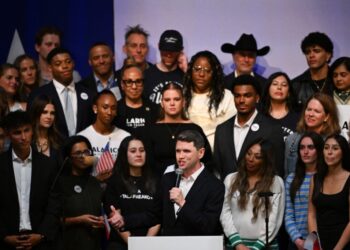
A key initiative cited by the Roosevelt Institute is universal healthcare. Its report on the topic was written by Abdul El-Sayed, a physician and public health expert who won his bid for the U.S. Senate from Michigan in Tuesday’s election after having made so-called Medicare for All a linchpin of his campaign.
I’ve written that the term “Medicare for All” is best viewed as a slogan rather than a specific policy, because Medicare as written — as a program mostly for Americans over 65, with substantial gaps in coverage — would need significant amendment to be universally serviceable.
But our fragmented healthcare system is also a factor in so many of the ills that afflict ordinary American households within the sphere of “affordability.” El-Sayed made that point in his report.
Universal healthcare, he wrote, “could mean that every single American would have access to at least the same baseline health insurance coverage, with no deductible and no co-pays. There would be no insurance CEOs and no bloated CEO salary — and so no incentive to deny health-care coverage. Most importantly, every single American would be covered — and no one would have to worry about losing their health insurance for simply living their life. Bringing the idea of full and equal citizenship to healthcare would transform the lives of millions.”
I wrote in my 2011 history of the New Deal that it instilled in Americans the principle that economic security was a collective responsibility, a concept that Trumpism treats as anathema. Voters made their views of Trumpism crystal clear, but in a sense they were only endorsing the view of Frances Perkins, who as FDR’s labor secretary midwifed Social Security.
“The people are what matter to government,” she said in a speech in 1963, two years before her death at the age of 83. “A government should aim to give all the people under its jurisdiction the best possible life.” Is there a better principle to guide the incoming Democratic congress?
The post With Trump and GOP on the run, Democrats have a chance to make a new New Deal appeared first on Los Angeles Times.