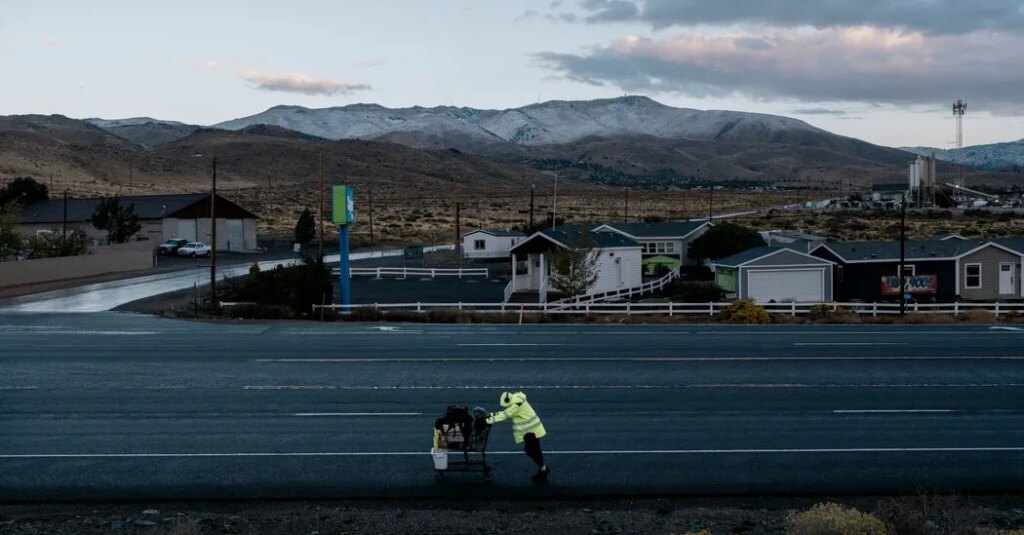
In the minutes before sunrise in Mound House, Nev., Chantz Rivera, bundled in a high-visibility yellow-green coat, climbed out of the blue tent where he’d spent the night, just off the shoulder of U.S. Route 50.
It was a chilly morning in the high desert. The sky lightened and mountains appeared on the horizon. He would soon be crossing through the Sierra Nevada foothills, walking with his shopping cart full of belongings.
Rivera, 29, is slight of build, bearded and handsome, with a Bronx accent. He was born and raised in the Gun Hill Houses, a New York City Housing Authority complex in the Williamsbridge neighborhood of the Bronx.
He had spent his whole life in the city, and earlier this year, he had been feeling stuck. So he’d started walking. That was four and a half months ago.
On this day, his destination was Carson City, just seven miles away and downhill — light work for Rivera, who had been walking 20 to 25 miles a day. He would sleep in a motel for the first time in a few nights.
He held up his phone and filmed himself, the tent and the busy road.
“Day 135!” he said with a grin, speaking to his online following, which had grown to around 60,000 since hitting the road. “We out here!”
He ducked back into the tent and gathered his bedding, camera and pillow. He retrieved the cart from where he had parked it, near a reflector post on the roadside.
Then he put on his headphones, cued up Meek Mill and headed west along the shoulder of Route 50 as cars and trucks flew past.
‘Even When I Was Leaving, I Was Hesitating’
The American phrase “Go West, young man” is almost 200 years old — credited to the famed newspaper man Horace Greeley — and there is a long history, from John Steinbeck’s Tom Joad to Jack Kerouac, of young men heading out to the frontier, to discover the country and themselves.
For Rivera, it was a way to turn things around.
He tries his best to see silver linings. Growing up, his father worked, and his mother used drugs, but he considered himself lucky to have two parents. He wasn’t great at basketball, but he still played every day, even when there was snow on the ground.
But as he entered the work force after graduating from high school in 2015, it was harder for him to find upsides.
He worked at a warehouse. Then as a door-to-door salesman. Then as a dishwasher for a catering company — $20 an hour, no benefits, no path up the ladder.
“I’m working and I’m paying the bills and then I still can’t afford much,” he remembers thinking. “I can’t do nothing. I’m just stuck here.”
He thought joining the Army could be a way to leave. See the world a bit, get paid for it. But he knew he had a record — “weed charges, disorderly conduct, a bunch of misdemeanors.” The miliary recruiter denied him, he said. By April, Rivera was wandering around New York, unemployed and wondering what to do.
If you don’t have a job in this country, he said in a video on Instagram, “You might as well be dead.”
“Because what are we living for?” he continued. “To keep struggling and striving and working so the next man can have money?”
Rivera had about $500 to his name. He spent it on a tent, a sleeping bag and a backpack, and filled it with supplies — water, granola bars, a big jar of peanut butter, portable chargers and a survival kit complete with first-aid supplies. And bear spray and a machete, for protection.
His bag was too heavy, so he bought a foldable grocery cart.
His parents gave him $250. It was all the money he had.
“The hardest part was definitely leaving,” he said. “Even when I was leaving, I was hesitating,” he continued. “I’m walking around with the bag on, everything in the bag, walking back and forth down my hallway — like, am I gonna be walking like this?”
He left a few days after his 29th birthday.
That first day, not far past Tarrytown, the grocery cart broke. Rivera replaced it and kept going. He slept on a bench in a railway station that night. The next day, he said, a man saw him and asked if he was homeless.
“No,” he replied, “I’m walking across America.”
‘You Doing All Right?’
Rivera had never hiked before. He’d never been camping. For his trip across the United States, he chose the most direct route the map showed — which mostly meant walking on highway shoulders, drowning out the car traffic with his big headphones on. (His playlist included a lot of rap — Future, A Boogie, Lil Dirk, Young Thug, Kodak Black — but for motivation he also liked to play Kate Bush’s “Running Up That Hill.”)
“In the beginning, everything was hurting,” Rivera said. “I was so cramped and sore and my knees hurt,” he added. “I was literally limping for like a week.”
In New Jersey, his tent fell out of the cart he was pulling without him noticing, and he had to backtrack to find it.
In Pennsylvania, it was too hot to sleep with the rain tarp on, and the forecast looked clear, but it ended up raining and he got soaked.
During those first few days, he did think about turning back. But he’d talk himself out of it.
His second cart broke — then his third, then his fourth.
He would replace them at supermarkets or big box stores, which — along with gas stations — is where Rivera would use the bathroom and resupply. Powerade was a staple, as were 15-count boxes of individually wrapped peanut butter and jelly Uncrustables sandwiches. Those could be breakfast for two weeks.
He began to develop routines. When possible, he would line up his walking schedule so that sundown corresponded with his arrival in a town, where he’d find a cheap motel to stay for the night. If he arrived early enough, he would take in whatever sights there were to see — statues, monuments, museums, rivers, railroad tracks. If he slept in a motel, he’d stay in the room until the very last minute before checkout, maximizing his bed and bathroom time.
Sometimes he would find himself between towns at sunset. On those nights he would sleep on a bench or at a bus stop, or set up his tent in a field or a park — or in a liminal space behind a church, gas station, fast-food joint or a Walmart.
“You doing all right?” a law enforcement officer in Indiana asked.
“We got a call that you were pulling a cart and looked exhausted,” the officer continued. “Just wanted to make sure you were all right.”
“Yeah, I’m good,” Rivera said. “I’m walking across America.”
Getting stopped by police officers or state troopers also became routine. It happened in almost every state, he said, often multiple times a day. Sometimes the officers would drive him to the next county, or to a road they deemed safer for pedestrians.
Because of his brown skin, people commenting on his posts warned him about racism and sundown towns, but Rivera found warmth and hospitality instead. “I went through a lot of small towns that was nothing but white people,” he said. “And I got love — like, they showed me love.”
In Ohio, a pastor picked him up and gave him a lift to a motel. (Unlike some extreme walkers, Rivera was not a purist; he accepted a few short rides when offered.)
In Indiana, a woman gave him a bottle of water and some beef jerky, and a man brought him ice, water and iced tea.
In Missouri, two guys noticed the wheel of his cart was wobbling. The men drove Rivera and his cart to their garage. “We’ll put a Band-Aid on this thing,” one of the men said as he repaired the wheel with thick black tape.
In Colorado, a reporter at a radio station interviewed Rivera and gifted him a pair of white and red Nike Cortez sneakers — the same ones Tom Hanks had worn in the movie “Forrest Gump.”
Unlike Forrest Gump, Rivera did not inspire people to actually join him on the road, but more and more people began to follow him online. Some of the hospitality he encountered was surely spontaneous, but other times it came from people who had seen what he was trying to do and wanted to help him succeed.
When he hit Nevada, a woman named Jennifer commented on one of his posts: “You near Fallon yet? Got a home-cooked meal for you.” Rivera wrote back: “I NEED THAT!” Sure enough, Jennifer and her husband, Matt, let Rivera pitch his tent on their property, he said, and fed him mac and cheese, steak, ribs and potatoes.
Usually, people go to New York to find fame — for Rivera, leaving town is what did it.
Back home, his journey became news: He did a phone interview with Hell Gate, the New York news site. And he told the Bronx Times about how the kindness he’d encountered had surprised him: “Being in the city, you think everybody’s just, like, for himself.”
His followers prodded him to work out a way to let people send him money. Rivera waved away that suggestion at first, but he eventually relented and set up a GoFundMe account that raised more than $10,000.
Mitchell Hulse, a researcher in New York, gave $10 after reading Rivera’s interview on Hell Gate. “I think when somebody pulls something like this off,” Hulse said, “it can show you your own capability.”
Nev Schulman, one of the hosts of the MTV show “Catfish,” donated $300.
“He’s a young Black man from the Bronx taking on something incredibly ambitious,” Schulman said. “And I think there’s real value in helping people from communities that have historically had to work harder to have their stories heard.”
“What he’s doing,” he added, “is bigger than just walking across the country.”
‘You Need to Have a Reason?’
For those not accustomed to traveling major roadways on foot: The trek from Mound House to Carson City is far from peaceful. The traffic whizzed by on the multilane Lincoln Highway, so loud it made talking impossible. Gusts of brisk desert wind blew this way and that, and the whole situation felt, frankly, dangerous.
But Rivera seemed unperturbed. He just kept pushing his cart — past an auto body shop, a self-storage business, and then gas stations, thrift stores, pizza places. Before long he spotted the Nevada State Capitol Building.
He parked his cart on a path, and entered the grand wooden doors.
“Is the governor here?” he asked a woman behind a desk in the office. “I want to meet him. I’m walking across America!”
The governor was not available. Rivera went upstairs and browsed the small museum, which featured exhibits about Nevada’s mining history and Native American heritage. “Oh, that’s the ram!” he said when he saw a taxidermy bighorn sheep kneeling in the corner of the museum. “I seen one of these in person! In real life.”
Before embarking on the walk, he had left New York only twice — once to Florida, for a week, and another time to Washington, D.C., for a weekend.
Now he had seen Amish people with buggies. He had seen sheep, cows, horses, an attraction described as the world’s largest Czech egg. He had seen incredible desert sunsets, snow-capped mountain landscapes, the most stars he’d ever seen in his life. He had discovered that true happiness could be found alone beneath the stars in Colorado.
“People are like, What are you doing?” Rivera said. “What are you doing it for? When I tell them I’m walking across America — ‘Oh, what’s your reason?’ You need to have a reason?
“I just want to be free. I’m just walking because I’m using my free will. That’s it.”
After lunch, he went back to the Capitol building to check again if the governor was available.
“He’s in Vegas,” an officer posted in the lobby said.
“Oh, he’s at the craps table, huh? He’s gambling it all away?”
The officer laughed.
Afterward, Rivera made his way to a Motel 6. He had prepaid for a room that was on the ground floor, so he could wheel his cart inside. He hadn’t let the motel know he had a cart.
“Sometimes they say ‘no carts,’” he said. “The motel lady in Kansas was actually saying, ‘Homeless people come all the time’ and this and that.” That had upset him a bit. He couldn’t believe some places would turn people away because of a shopping cart. “I’m not homeless, you know? Why are you discriminating? Judging me.”
And so he tried to keep a low profile as he pushed the rattling shopping cart through the door of his room. The next day he would be walking uphill to his final state.
‘More Free Than I Was’
Two weeks later, Mr. Rivera stood on a rocky shore and pointed his camera across the bay at a distant skyline.
“I ain’t gonna lie, I think that’s San Francisco, bro,” he said in a video he posted to social media.
Just shy of the Golden Gate Bridge, he stood on his cart and filmed a mailing label stuck to a road sign. In the “to” field, in black marker, it said: “WALK ACROSS AMERICA COMPLETE DAY 149!!”
The next day, in San Francisco, someone stole his portable chargers and survival kit from his cart while he was using the restroom at a McDonald’s on Fillmore Street.
Rivera didn’t care about the kit, but he’d stored a memory card and a flash drive in a pocket of that bag. Some videos he’d filmed were now lost.
Perhaps the greater loss was that his walk was over. Over the phone, he sighed but said he felt relatively calm about everything, even the missing belongings. “In a way, I feel more free than I’ve felt, ever,” he said.
The plan now was to spend a few weeks in California before flying home to New York.
But he was already thinking about his next big walk. Europe, maybe. The language barrier would be a new challenge, but he felt he could figure it out.
“You know, even if I do feel stuck, I’m more comfortable leaving now,” Rivera said.
“I’m not scared or nervous or anything to just up and go — because I did that.”
The post He Felt Stuck in New York. So He Started Walking to California. appeared first on New York Times.