For many Israelis, the results of the U.S. midterm elections showed how far their country’s relationship with the United States had deteriorated and underscored the limits of Prime Minister Benjamin Netanyahu’s reliance on his long friendship with President Trump.
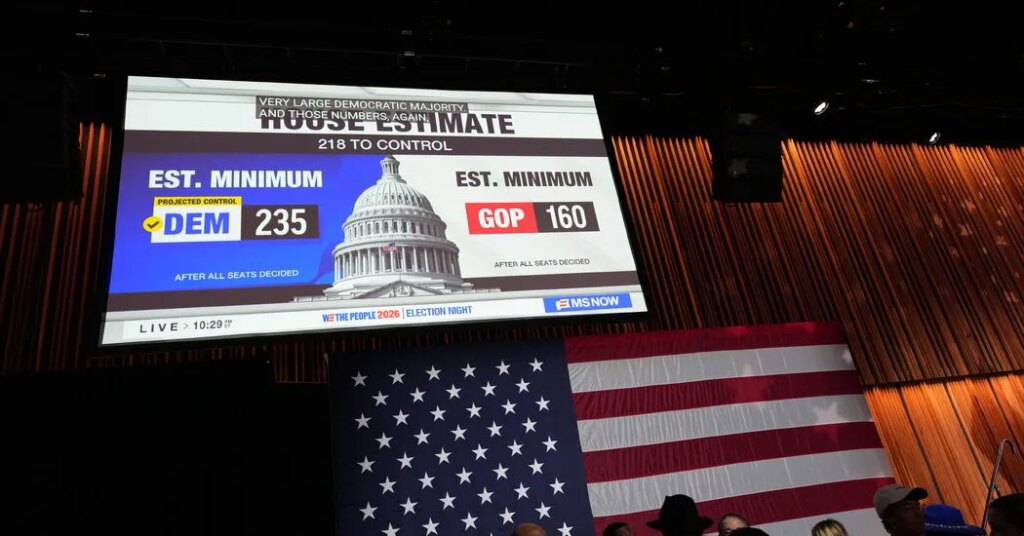
The Democrats’ rout of the Republican Party, with some House and Senate members increasingly critical of Israel in the run-up to the vote, has only added to Israel’s growing sense of international isolation after years of war.
The results come at a sensitive time for Israel, as it grapples with its inconclusive election and faces another possible round of conflict with Iran.
Now, its future relationship with the United States, its most important ally, is also on the line, as are billions of dollars in annual U.S. military assistance, in a sign of how far traditional support for Israel has fallen among both Democrats and Republicans.
Mr. Netanyahu’s critics and political rivals seized on the results as proof of his mishandling of Israel’s national security interests.
“The results we see today are precisely the reason Israel always tried to maintain a bipartisan policy toward America,” said Jeremy Issacharoff, a former Israeli ambassador to Germany. He dealt with many aspects of Israel’s strategic relations with the United States during his long diplomatic career, which included two stints at the Israeli Embassy in Washington.
Mr. Netanyahu, a conservative, largely abandoned that approach about a decade ago, Mr. Issacharoff said, becoming “the most dependent Israeli prime minister on an American president.”
Early this year, Mr. Netanyahu declared that Israel had “come of age” and that he intended to do away with the financial aspect of America’s military assistance to Israel within a decade. He said he wanted to see Israel fund weapons purchases itself, build up its own defense industry and move “from aid to partnership,” possibly articulating a position that he thought Mr. Trump would like to hear.
But on Election Day in America, Mr. Trump surprised Israelis by declaring that he was cutting off the nearly $4 billion in annual aid to the country “at the end of the year,” even though Israel’s current aid agreement with the United States expires in 2028.
Mr. Trump said, during an interview with Fox News, that the move was a political step to take “a bad talking point” away from the left wing of the Democratic Party, after aid to Israel became a divisive issue during the midterms. He suggested that Mr. Netanyahu was on board with the decision, though the prime minister has not yet commented.
As Mr. Netanyahu battles for his political future, after an election that afforded neither his bloc nor his opponents a clear path to forming a government, the opposition was quick to reap political capital out of the situation.
Mr. Netanyahu’s main challenger, Gadi Eisenkot, a former military chief and centrist leader, said the fact that Israel’s defense establishment had learned about such a drastic change in the strategic relationship through the news media “illustrates just how much Benjamin Netanyahu’s conduct is a real danger.”
“He can’t be trusted anymore,” Mr. Eisenkot added in his statement, “and he must be replaced.”
The leader of Israel’s left-wing Democrats party, Yair Golan, a former deputy military chief, said, “An end to American aid is very damaging to Israel’s security and to the quality of life in the country.”
And Avigdor Liberman, another Netanyahu rival from the right, said, “The cost of Trump’s support for Netanyahu — $3.8 billion annually,” an apparent reference to Mr. Trump’s effusive endorsement of Mr. Netanyahu ahead of Israel’s election last month.
Mr. Netanyahu’s office did not immediately respond to a request for comment.
The change in the aid relationship set the stage for even deeper concern as the midterm results emerged.
Tzipi Livni, a former minister in a Netanyahu-led government, wrote in a social media post that “Netanyahu gambled on the Republicans, broke the alliance that we maintained throughout all the years with both parties and has no way of defending the legitimacy of the existence of the Jewish people’s state and our right to defend ourselves,” citing the election of some candidates who are vehement critics of Israel.
The website of Channel 14, an Israeli news outlet that is widely regarded as supportive of Mr. Netanyahu, minimized coverage of the midterms on Wednesday. But it did run a news item highlighting a social media post from the White House after the results with a photograph of the president and the caption: “Trump is still your president.”
Israel had long had bipartisan support in the United States, which it viewed as a strategic asset. But as American public opinion has shifted, political support for Israel has eroded on both sides of the aisle, particularly since the Oct. 7, 2023, Hamas-led attack on Israel that ignited the war in Gaza.
The large civilian death toll in Gaza, where tens of thousands of Palestinians were killed, along with a humanitarian crisis and the lack of an Israeli exit strategy, stoked tensions with the Biden administration.
Amid this deterioration of relations, Mr. Netanyahu prided himself on his close ties with Mr. Trump, culminating in a joint campaign against Iran this year. But as that conflict ground on and Israel became embroiled in a war against Hezbollah in Lebanon, tensions arose with the Trump administration as Israeli and American interests diverged.
In April, Mr. Trump said Israel was “prohibited” from further bombing in Lebanon, saying, “Enough is enough!!!” And after the American leader reached a preliminary cease-fire deal with Iran in June, which many Israelis felt would not address their security needs, relations between Mr. Trump and Mr. Netanyahu and his supporters devolved into mutual insults.
Support among Americans for Israel fell to new lows this year, worsened by the actions of Mr. Netanyahu’s hard-right government in the occupied West Bank, including a huge expansion of Jewish settlements, and its minimization of surging extremist settler violence against Palestinians.
The Israeli election offered the possibility of a reset, and once a new government takes shape, analysts say, one of its most urgent tasks should be to try to repair the bipartisan relationship.
“For Israel, there is an important distinction between its relationship with the U.S. and its relationship with the Trump administration,” said Gedaliah Afterman of the Abba Eban Institute for Diplomacy and International Relations at Reichman University in Herzliya, north of Tel Aviv.
“The U.S. will remain Israel’s most important strategic partner,” he said. But the strong showing for the Democrats in the midterms “should be a wake-up call to invest more seriously in relationships across the American political spectrum,” he added.
Mr. Issacharoff, the former diplomat, said the future of the U.S.-Israeli relationship now largely depended on Israel’s actions.
Being a reliable strategic ally, he said, meant “being willing to take America’s interests into account in the region and Israel doing what it can to move the peace process forward in various arenas.”
“It’s pretty obvious,” he added.
Damien Cave contributed reporting.
The post For Israelis, U.S. Midterms Show How Far Their Star Has Fallen in America appeared first on New York Times.