President Trump spent much of the past two years promising to bring down energy prices.
Instead, his war with Iran, as well as other policies, drove up the cost of gasoline, diesel and electricity. At the same time his administration worked to thwart efforts to fight climate change, blocking renewable energy investments that could have reduced the country’s reliance on fossil fuels or brought down costs.
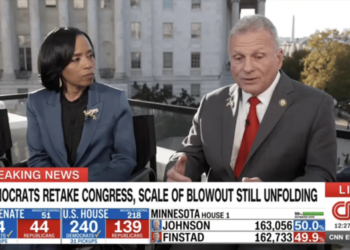
On Tuesday, voters’ frustration with soaring energy prices helped propel Democratics to a blowout, with Republicans losing control of the House and the Senate, as well as the governorships of many historically conservative states.
“It’s quite clear that energy and energy affordability in particular played a big role in the electorate’s decision-making last night,” said Hasan Nazar, head of policy at Crux, a clean energy finance company.
Many Americans said concerns about the cost of gas and electricity informed their voting choices, according to polling from The Associated Press. Gasoline prices across the country were at a record high for an Election Day, according to AAA.
No single action had a bigger effect on energy costs than Mr. Trump’s decision to go to war with Iran. With the Strait of Hormuz closed and global flows of oil disrupted, gasoline prices in the United States have jumped more than 40 percent since the war began. Diesel prices are up nearly 70 percent.
Catherine Wolfram, a professor of energy economics at the Massachusetts Institute of Technology’s Sloan School of Management, said that launching the war was among the worst decisions Mr. Trump could have made if he was trying to bring down energy costs. “It’s Econ 101 that invading Iran when they control the Strait of Hormuz is going to impact gas prices,” she said.
Daniel Raimi, a fellow at Resources for the Future, a nonprofit research institute, noted that “usually presidents have very little sway over global oil prices, but that was not the case this time.” The Iran war, he said, not only increased fuel prices but also costs for fertilizer “and a whole host of commodities.”
Beyond the war in Iran, the Trump administration has taken a sweeping approach to reshaping the nation’s energy policy, including actions that may have increased costs for consumers.
At a time when electricity demand and prices are soaring because of the data center boom, the administration has blocked the construction of offshore wind farms, despite pleas from governors to allow the projects to get built. It also mandated that coal-burning power plans stay online, even though utilities said that doing so would raise prices for their customers.
Chuck Schumer, the Senate minority leader, said on Wednesday that higher energy costs were a factor with voters. “Some of the time he talked about extraneous things that were ridiculous, but much of the time he implemented things that raised their costs: on electricity, on health care, on goods,” he said, referring to Mr. Trump.
If there was one energy-related issue beyond Iran that broke through, Mr. Raimi said, it was likely higher electricity prices, which many Americans blame on the proliferation of data centers. “Voters are certainly unhappy about higher electricity bills, but the larger driver for those higher prices is increased demand,” he said.
While data centers have become deeply unpopular with voters, Mr. Trump and his administration have offered stalwart support for the industry and dismissed voters’ concerns about them.
Other issues, like keeping coal plants open or blocking wind farms, he said, were less important in the voting booth because their effect on prices would be marginal.
Some of the Democrats who won seized on energy affordability as part of their campaigns. Roy Cooper, who flipped a Republican senate seat in North Carolina, said at a campaign stop that the war in Iran was “driving the cost of gas through the roof.”
James Talarico, who became the first Democrat to win a senate race in Texas in decades, has called for suspending the federal gas tax and diesel tax.
And Abdul El-Sayed, who won a senate seat in Michigan, touted the need to adopt clean energy. “We have all the technology we need to drop the price of electricity via renewable energy,” he said at a recent event. “And all of those renewable energy investments, guess what? They create really great jobs.”
While Democrats will soon be in control of Congress, bringing down energy prices is unlikely to be swift or easy.
Mr. Trump has two years left in office. In recent weeks, he has indicated that he might intensify attacks in Iran following the midterm election, which could lead to further spikes in oil prices.
But with voters signaling their frustration with the high cost of gas, diesel and electricity, some clean-energy supporters said they believed even Mr. Trump might be open to revising his stance on some issues that have driven up prices.
“The election was a compete repudiation of his energy agenda,” said Lori Lodes, president of Climate Power, an environmental group. “The question is what comes next, and one thing he could do is stop blocking clean power that could help meet demand and lower costs.”
The post How Trump’s Energy Policies Helped Trigger Tuesday’s Election Rout appeared first on New York Times.