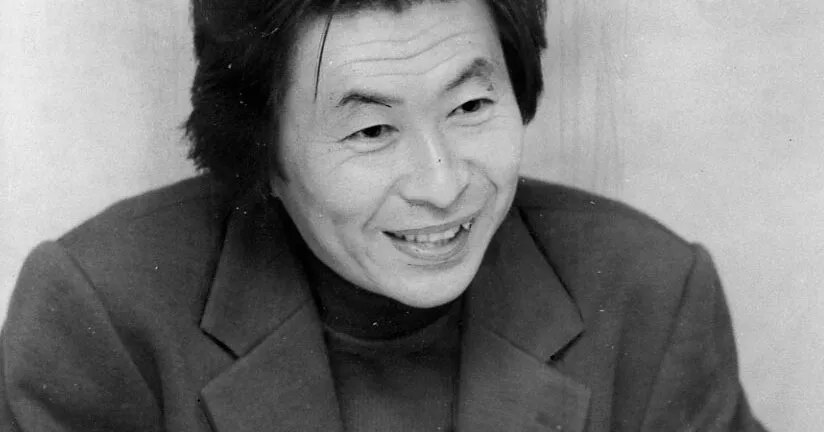
Senji Kuroi, the Japanese novelist and essayist who chronicled the anxieties of postwar corporate life and the muted emotional landscapes of ordinary, white-collar employees navigating a rapidly modernizing Japan, died on Oct. 12 at 94.
His death, from pneumonia, was widely reported in the Japanese media.
A writer of quiet restraint rather than sweeping flourish, Mr. Kuroi built his reputation on stories that often unfolded in offices, commuter trains and modest homes — spaces where ambition, conformity and private yearning collided in ways that rarely produced dramatic explosions but left deep emotional aftershocks.
Critics frequently described him as an interpreter of “the salaried soul,” capturing the unease that simmered beneath Japan’s economic miracle and the quiet disillusionment that followed it.
Over a career spanning more than half a century, he published dozens of novels, short-story collections and essays, earning major Japanese literary prizes and a devoted readership among those who saw their own anxieties reflected in his characters’ small hesitations and moral compromises.
His prose, spare and attentive, resisted grand pronouncements. Instead, he favored the accumulation of small details — a pause in conversation, the hum of fluorescent lights, a gesture left unfinished — through which entire emotional worlds were revealed.
Though less internationally known than contemporaries like Kenzaburo Oe and Haruki Murakami, Mr. Kuroi was widely regarded in Japan as one of the most perceptive observers of everyday life in the late 20th century.
His work bridged generations. Shaped by the austerity of the postwar years yet skeptical of the corporate conformity that defined the high-growth era, he portrayed individuals who felt quietly estranged from the very prosperity they had helped build.
In a seminal, two-volume survey of Japanese literature, “Dawn to the West” (1984), the literary historian Donald Keene remarked of Mr. Kuroi and the other writers known as the Introspective Generation that their novels and short stories often concerned “the minute observation of everyday existence.”
Critics often noted that Mr. Kuroi’s narratives seemed to revolve around almost nothing — a chance encounter, a memory resurfacing, a minor workplace dispute — yet his fiction revealed how such moments could destabilize a life.
The effect was quietly radical. While Japanese literature was becoming increasingly globalized and experimental, Mr. Kuroi insisted on the value of ordinary experience. He wrote about people who might never appear in headlines: middle managers, aging parents, couples struggling to communicate after decades together.
Literary scholars sometimes placed Mr. Kuroi within the tradition of the shishosetsu, or “I-novel,” a distinctly Japanese form that blurs autobiography and fiction. Yet his work was less confessional than observational. Even when drawing on his own corporate experiences, he maintained a careful distance, allowing readers to project their own uncertainties onto his characters.
Mr. Kuroi’s early novel “Time” (1969) clearly illustrated this approach. The protagonist, not strongly individualized, is a midlevel employee navigating routine office life at a company. The narrative follows his internal reflections as he participates in meetings and commutes between home and the office.
His novel “Life in the Cul-De-Sac” (1984) also demonstrated this technique. The story focuses on neighbors in a suburban housing development. The characters are defined by subtle gestures and fragments of thought rather than dramatic personal histories. The result is a narrative in which the author rarely intrudes, characters remain somewhat opaque and readers supply the emotional interpretation.
“By picking up small things and observing them, something begins to come into view,” Mr. Kuroi explained in a 2017 interview in Sarai magazine.
Senji Kuroi was the pen name for Shunjiro Osabe. He was born on May 28, 1932, in Tokyo. His father, Kingo Osabe, was a prosecutor who became a Supreme Court judge.
The future author came of age during Japan’s postwar reconstruction, when discipline and collective effort were prized above individual expression, even more than it traditionally had been. These experiences would later inform his writing, which often examined the tension between social obligation and personal identity.
As a high school student, Mr. Kuroi engaged in correspondence with the popular postwar novelist Noma Hiroshi about how he, too, could pursue a career in literature. The writer advised Mr. Kuroi to study economics and work in business. “Japanese literature’s hopes are so small,” Mr. Hiroshi reportedly told him, “because there are almost no writers who understand society.”
After graduating in 1955 with an economics degree from the University of Tokyo, Mr. Kuroi joined Fuji Heavy Industries, a major manufacturing company. The routines of office life — endless meetings, carefully calibrated hierarchies, the quiet erosion of personal aspiration — became the raw material for his early fiction.
As a junior executive, or “salary man,” Mr. Kuroi took his pen name in the 1950s when he began publishing short stories and novels while still employed at Fuji, to avoid possible conflicts with his bosses. In 1970, he resigned from Fuji to devote himself full time to writing.
His literary breakthrough came in the late 1960s and early 1970s, when a new generation of Japanese writers turned away from overt political themes toward the psychological consequences of rapid economic growth. Mr. Kuroi’s stories stood out for their precise realism and emotional subtlety.
He was prolific, churning out 25 novels and novellas, dozens of short stories and numerous essay collections. Japanese bibliographies count more than 50 separate volumes of his writing.
Like many Japanese authors, Mr. Kuroi often published fiction first as serialized installments in literary magazines before issuing them as books. That was the case most prominently with “Life in the Cul-De-Sac,” which won the Tanizaki Prize, one of Japan’s most coveted literary awards. Its English translation by Philip Gabriel in 2001 was the first substantial introduction of Mr. Kuroi’s fiction to an American audience.
Younger writers admired Mr. Kuroi’s discipline and clarity and his ability to transform the mundane into something profound. Others noted his refusal to romanticize either tradition or modernity.
Although more translations of his work appeared in English and other languages, his international reputation remained modest. Some translators and critics said that the qualities that made him revered in Japan — subtle tonal shifts, cultural nuances, the weight of social expectations conveyed through small gestures — were difficult to carry across linguistic boundaries.
As Japan’s economic bubble burst in the 1990s and long-held assumptions about lifetime employment began to erode, Mr. Kuroi’s earlier themes took on new resonance. The quiet dissatisfaction he had depicted decades earlier seemed prophetic to some critics, who saw his fiction as an early warning about the emotional costs of conformity.
In later works, his focus broadened to include aging, memory and the fragility of human connections. Characters looked back on careers and relationships with a mixture of regret and acceptance, asking whether the compromises of youth had been necessary or merely habitual.
Mr. Kuroi’s novel “Curtain Call” (1994) reflected the deepening concern in his work for the quiet reckoning that accompanies the later stages of life. The book follows a middle-aged man who begins to look back on the choices and compromises that have shaped his career and personal relationships, gradually sensing the passage of time as both loss and revelation.
An intensely private man, Mr. Kuroi revealed little of his personal life over the years, even to his translators. Information about survivors was not immediately available.
In his interview with Sarai magazine, Mr. Kuroi, then 85, spoke about his determination to remain a productive author.
“Even if it isn’t fiction itself, I want to keep writing something,” he said. But he lamented that writers rarely completed everything they hoped to write. “It is natural for a life to end in the middle of things,” he added.
The post Senji Kuroi Has Died. He Interpreted ‘the Salaried Soul.’ appeared first on New York Times.