content=”https://www.washingtonpost.com/wp-apps/imrs.php?src=https%3A%2F%2Fcloudfront-us-east-1.images.arcpublishing.com%2Fwapo%2FZCS662WXIQI7DEYK4CHYBBXVVQ.jpg&w=1200″
President Donald Trump this week touted his Reflecting Pool renovations, contending that its deep-blue basin (and algae-free water) showed what his administration could accomplish. Now Democrats’ blue wave threatens to swamp Trump’s plan to keep remaking Washington.
The new Democratic-led House and Senate could file suit to block Trump’s most controversial building projects, such as his in-progress White House ballroom, arguing that they have not been authorized by Congress and are illegal. That could slow or even stop the projects after the Supreme Court in August ruled that a historic preservationist likely could not prove that she would be harmed by the ballroom, clearing the way for Trump to keep building.
The new liberal majorities may also rein in Trump’s spending, after the president diverted taxpayer money to his Washington projects with little complaint from GOP leaders.
There’s also a more immediate practical effect from Tuesday night’s rout. Two congressional Democrats will replace Republicans on a 12-person federal review panel that Trump packed with allies who have swiftly approved his construction projects.
Trump is set to get some more short-term wins, though. That panel, with its current membership, is expected to approve Trump’s planned triumphal arch as soon as Thursday.
Good morning. It’s Wednesday, Nov. 4, and voters delivered a historic rebuke to President Donald Trump in yesterday’s midterm elections. You can find all the fallout in today’s edition of The 7 briefing.
Democrats took control of the Senate and the House after pulling off a series of stunning victories. Our top items cover the national implications as well as the most eye-catching results in key states.
We also look at how Americans voted by demographic, what motivated them, and how Trump has reacted.
If you need a break from politics, the briefing includes interesting research into how ADHD presents differently in adults and children. And our final story is one I am personally beside myself with excitement about — the return of “The Legend of Zelda: Ocarina of Time.”
Find today’s edition of The 7 briefing here.
Amid outcry from educators about tech in classrooms, Google said Tuesday that artificial-intelligence tools, including the chatbot Gemini, will be disabled by default on K-12 student accounts, unless administrators choose to turn them on.
But there’s a catch: Google search also will be disabled.
Google search typically includes an AI overview that, if expanded, has a chat window for further questions. Google said Tuesday it was building educational tools into AI overviews to help students work through problems without skipping straight to answers.
Google says the move responds to feedback from parents and teachers who say that AI products have been disastrous for the ability of children to learn and to think critically.
The policy shift triggered outrage Tuesday as people argued Google was trying to force schools to opt in to AI.
“Google is trying to use its monopoly power to force AI into our public schools,” New York Mayor Zohran Mamdani (D) said on X. “No corporation should have the power to dictate how we teach our children.”
The New York Times earlier reported that schools that turned off AI access entirely would not have access to Google search.
Google did not immediately return a request for comment.
The Trump administration on Tuesday asked a federal judge to dismiss the D.C. government and the commonwealth of Virginia’s attempt to block construction of President Donald Trump’s planned triumphal arch, arguing that the jurisdictions cannot prove that they will be harmed by the project.
D.C. and Virginia sued on Saturday to halt Trump’s planned 250-foot-tall arch, which the president hopes to build on a traffic roundabout near Arlington National Cemetery. The jurisdictions say that the project would lead to traffic problems, harm emergency evacuation routes across the Arlington Memorial Bridge, and cause other regional disruptions. They also say the arch is illegal because it has not been authorized by Congress, would violate Washington’s Height Act and does not comply with other laws.
In a court filing Tuesday, Justice Department lawyers said that some alleged harms, such as traffic disruptions, were theoretical and therefore “too speculative” to prove that the jurisdictions have legal grounds to bring their case. DOJ lawyers also contended that the arch and other federal construction projects should not be subject to the Height Act, which generally limits D.C. building heights to 130 feet.
Trump administration lawyers have said that they hope to win approval for the arch from a federal review panel on Thursday and begin construction immediately afterward.
U.S. District Judge Tanya S. Chutkan was already weighing whether to halt the project after three Vietnam War veterans and a historic preservationist alleged that the towering arch would harm their experience of visiting the nearby military cemetery.
Chutkan has imposed strict requirements on the administration’s plans, including mandatory updates before beginning construction, after several federal judges questioned whether Trump is seeking to outrace the courts for his controversial construction projects.
Rachel Apa, 24, a first-time marathoner and former college athlete, died Sunday after collapsing near Mile 24 of the New York City marathon from rhabdomyolysis.
Rhabdomyolysis, or rhabdo, is a rare condition in which muscles break down, spilling toxic quantities of proteins and electrolytes into the bloodstream. It causes acute kidney injury in up to 50 percent of cases. In severe instances, kidney failure can occur.
Approximately 26,000 people get rhabdo each year in the United States. Causes include overexertion, severe muscle injury, dehydration and overheating, as well as certain medications.
A 2026 study reviewing hospital records immediately after the New York City Marathon from 2017 to 2023 found a total of 39 cases of post-marathon rhabdo; 24 of them occurred in 2022 — the hottest race year on record.
Symptoms of rhabdo warrant emergency medical attention and include muscle pain, weakness and swelling, as well as dark urine and in some cases decreased urination, nausea and fainting. Most people recover with intravenous fluids.
One study of runners with rhabdo suggested that the rare cases of acute kidney failure probably represent a “perfect storm” of factors, including high-level exertion and risk enhancers such as heat stress, or a concurrent viral or bacterial infection.
Alaska voters will choose Tuesday among Republican Sen. Dan Sullivan, Democrat Mary Peltola and other candidates in a key U.S. Senate race. But the state may not have an unofficial winner in the race until more than two weeks after Election Day.
Initial returns Tuesday night will show only voters’ first choices and will remain incomplete, as election officials count absentee and questioned ballots. Alaska has 131 hand-count precincts, which slow the count, especially in its rural areas.
If no Senate candidate wins a majority in the first round after all eligible ballots are counted, the state will run a ranked-choice tabulation. The last-place candidate is eliminated, and those ballots are transferred to each voter’s next available choice. The process repeats until two candidates remain.
That could matter because Daniel J. Sullivan Jr., a retired teacher whose name closely resembles the incumbent’s, received 2.5 percent of votes in the August primary. A voter who ranks Sullivan Jr. first and Sen. Sullivan second could still have the ballot count for the incumbent if Sullivan Jr. is eliminated. But a ballot ranking no remaining candidate becomes inactive.
Republicans accuse Democrats of recruiting Sullivan Jr. to confuse voters, which Peltola denies. Gov. Mike Dunleavy (R) has ordered an investigation and asserted that certification could be “stopped or changed” if wrongdoing is found. A federal judge Sunday dismissed a Justice Department suit to block certification if the senator loses; the department is appealing.
Alaska will accept eligible domestic mail ballots through Nov. 13 and overseas ballots through Nov. 18. Ranked-choice tabulation is scheduled for Nov. 18, with certification targeted for Nov. 25.
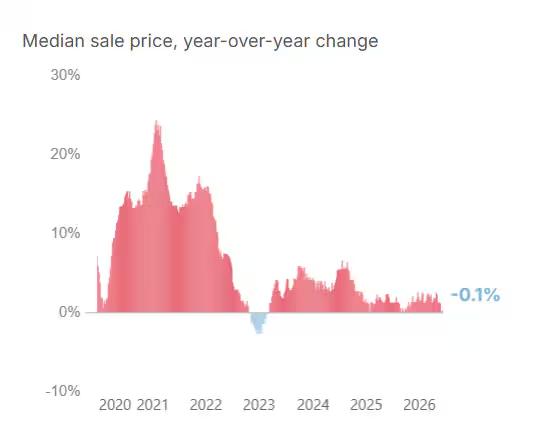
For the first time in three years, the median U.S. home price is falling.
The real estate brokerage Redfin, tracking home sales in all major markets, said prices two weeks ago fell 0.2 percent compared to one year earlier, and last week fell 0.1 percent, bringing the median price to $389,601.
Daryl Fairweather, Redfin’s chief economist, explains in two words: “Mortgage rates.”
With rates above 7 percent, renters are reluctant to become buyers, which dampens competition, and those who do choose to buy can’t afford larger payments.
During the pandemic, sale prices rose dramatically. The median home price in February 2020 was $259,000. Two years later, it was $335,000.
Prices then fell for a period in 2023, at a time of rising mortgage rates, before once again resuming their climb at a slower pace.
“Up until this point, prices had been increasing on a year-over-year basis. That’s important psychologically for homeowners,” Fairweather said.
Even when prices were rising slower than inflation, people could “look at their Redfin estimate or look at what their neighbor’s home is selling for, and they’d see it is going up in value,” she said.
The past two weeks, though, saw a small but meaningful shift.
Those weeks also saw the highest median mortgage payments ever recorded in Redfin’s data, at $2,786, more than 10 percent higher than just a year before.
In some places, prices have fallen a lot. Prices in Austin, for instance, are down more than 4 percent compared to a year before, according to Redfin.
In other places, prices have been going way up. San Francisco prices rose 15 percent in a year. Pittsburgh and Cleveland, among the country’s more affordable markets, are still attracting buyers. Prices were up 7 percent and nearly 5 percent in those cities.
The post What Democrats’ win could mean for Trump’s monument makeover projects appeared first on Washington Post.