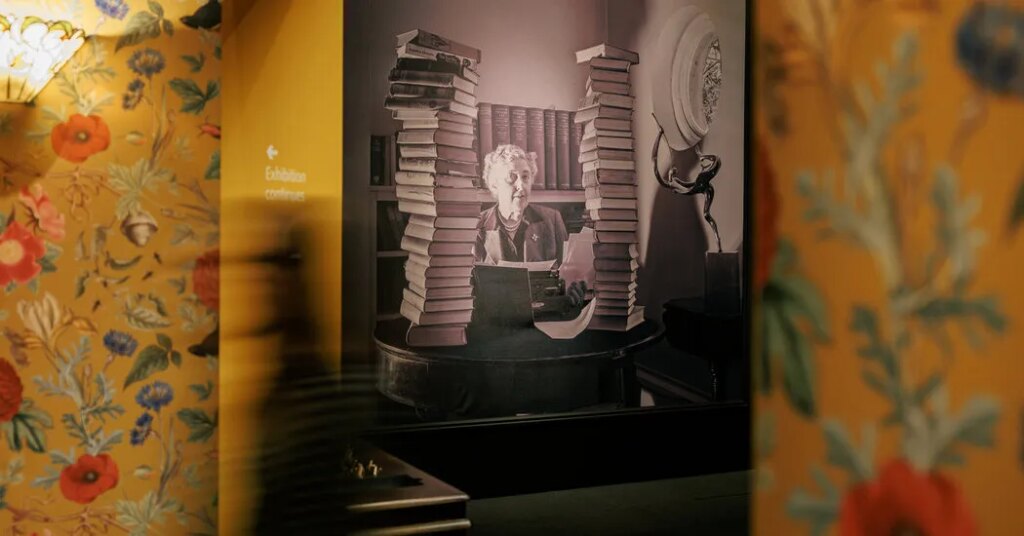
One evening in the early 1960s, the 72-year-old Agatha Christie put on a sparkly dress and went to a party at the Savoy Hotel in London. It was a celebration of the 10th anniversary of her play “The Mousetrap,” which had, at that point, been seen by 1.5 million people.
Christie was famously publicity shy, but even so, she stood in front of the assembled guests and made a speech for the cameras. She thanked everyone for coming, emphasized her surprise that the play had run for so long — she had thought it would run for only eight months — and, in general, struck a remarkably diffident pose. If this had happened in one of her books, she said, “it really wouldn’t be a person like me who had written a play that had run for years.” She smiled at her delighted audience, displaying what can only be described as a set of old-fashioned English teeth.
Footage of the speech can be seen in the final room of the British Library’s charming new show “Agatha Christie: A World of Mystery.” Watching, I was surprised at how thin and reedy her voice sounded — and how grand. She says “gretitude” and “ectors” and manages to squeeze a whole lot of extra vowel sounds into the word “old.” But I would probably have been surprised no matter what her voice sounded like.
For someone with a career as dense with superlatives as hers — author of the longest-running play of all time (“The Mousetrap” is celebrating its 75th anniversary this month), best-selling novelist of all time, most translated author of all time, a woman who has moved beyond “household name” status into something like “pillar of civilization” status — she remains an elusive and misunderstood figure.
Because she spent most of her outrageously successful career avoiding the spotlight, people have tended to fill in the blanks by conflating her with Miss Marple, one of her most beloved creations, and have projected onto her the qualities of a snuggly old village busybody who never ventured too far outside the parish.
The British Library show’s stated aim is to dismantle this false picture and reveal the real woman behind the books. From room to room, visitors move through a series of settings that will be immediately recognizable to Christie’s fans, and to people who have never read her books but have nevertheless absorbed her influence through osmosis: the country house, the dispensary, the train car, the archaeological dig.
It’s fun. Visitors are invited to treat the show as a case to be cracked, to view the material on display as clues that will not only reveal the truth about the woman who left them behind, but also, per the wall text, “uncover the secrets of her success.”
The strategy is partly effective. The idea of Christie as a matronly vicarage-fete type does not, for instance, survive contact with photographs on display in the archaeological dig section, which details her life with her second husband, Max Mallowan, an archaeologist 14 years her junior. Here, an image of an adventurous and unconventional life emerges.
For most of the 1930s and 1940s, Christie and Mallowan spent several months each year in what is now Iraq, living and working on digs together. It was an extremely productive period for Christie. It seemed she could write almost anywhere, and during that time she published an average of two books per year.
One of my favorite things in the show was a slightly out of focus photograph of Christie at work at her desk on site in Nineveh, near Mosul, in a simply furnished room with light streaming through the window onto her typewriter. It’s almost a parody of an ideal writing life.
When she wasn’t churning out novels, she was assisting Mallowan and his team. Also in the show are delicate ivory plaques from the 9th to the 7th century B.C., a sphinx and a male figure, accompanied by an explanation that Christie used her face cream to clean the ancient carvings. As she later recounted, “There was nothing left for my poor old face for a couple of weeks.”
Equally surprising are Christie’s notebooks, which she used to work out plots and characterization, grinding through possibilities before arriving at her elegant solutions. In the “Dispensary” section, which explores her work as a pharmacist’s dispenser at a hospital during World War I, there is a notebook opened to a page with the penciled heading “Poisons: Possibilities for Books,” with details of effects and fatal doses.
There is also a notebook in the section that deals a breakdown Christie suffered in 1926, which happened after her mother died and she discovered that her first husband had been unfaithful. Christie fled to a hotel and checked in under the last name of her husband’s mistress, hiding out for 11 days while a nationwide search for her went on. (A “Missing” poster on display explains that she was wearing “a small green velour hat” at the time of her disappearance.)
Christie’s explanation that she developed sudden amnesia is hard to square with what is known about the condition, but a notebook from around the time of her disappearance gives some idea of the strain she was under. It shows her laborious efforts to meet her daily word count for a book she was writing, “The Mystery of the Blue Train.” She usually seems to have found writing easy, but this notebook shows her grimly counting each chapter’s words.
Elsewhere, however, the show’s attempt to address misconceptions about Christie serves only to deepen the mystery. In a display of Christie’s passports, we see that her profession is first stated as “author” — but that later on, at the height of her writing success, she chose to describe herself as a “married woman.” In her autobiography, Christie says that being a wife was her status and her occupation, and that “as a sideline, I wrote books.” This self-effacement is as baffling, in its way, as her shock over having written a successful play.
Agatha Christie: A World of Mystery Through June 20 at the British Library in London; events.bl.uk.
The post The Mysterious Case of the Real Agatha Christie appeared first on New York Times.