Sophie Li wiped the tables and swept the floors every day at China Star, even though few customers came through the door.
For nearly 20 years, Mrs. Li’s Chinese restaurant in Edinburgh has been both her life’s work and her cross to bear. In better times, business was steady enough to support her and her two daughters and help send them to universities.
But early this year, the restaurant was almost always empty. Still, Mrs. Li, approaching 70, scrimped and toiled seven days a week to keep China Star open.
“I am a person who can endure hardship better than humiliation,” she said.
Down in London, her younger daughter, Lisa He, worried about the toll on her mother’s health. She traveled up to Scotland and posted a plea on social media.
“My mum’s Chinese restaurant is dying,” Ms. He, 29, said in a video on Instagram in April. She had decided to put aside several months to try to save it.
“Follow the journey and let’s see if I can turn this around,” she said.
Within days, the post had been viewed millions of times. Influencers and sympathetic locals suddenly flocked to China Star, overwhelming the modest 13-table restaurant.
Neither Ms. He nor her mother had been ready for internet stardom. She wondered whether she had made a mistake.
“It was absolutely awful,” Ms. He said. Going viral “doesn’t help when your restaurant’s already broken.”
An Immigrant’s Ambition
Sitting in China Star’s dining room can feel like taking a trip back in time.
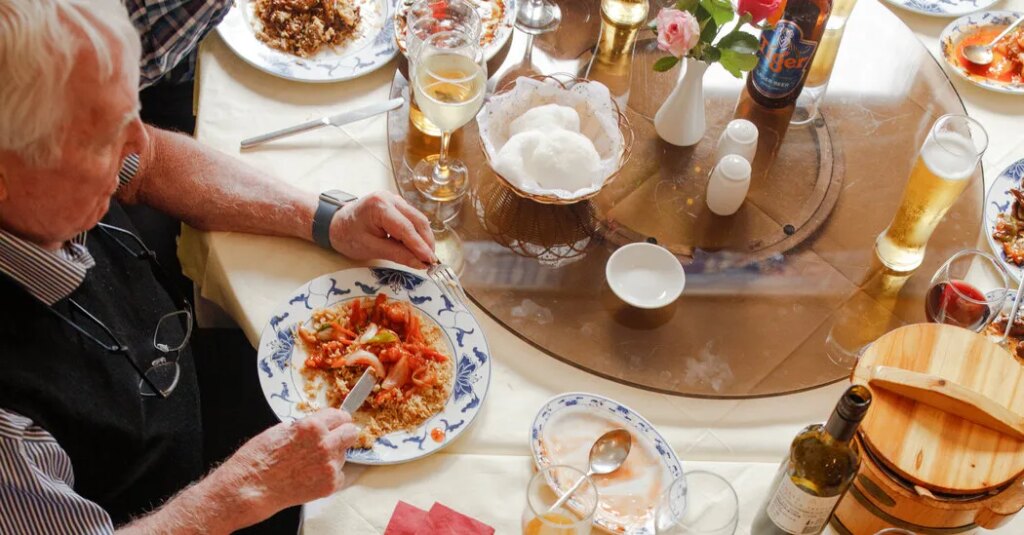
An aquarium filled with shy fish welcomes diners, and lucky cat figurines sit in the window. Decorations from a long-ago wedding still hang on the back wall. Dishes are washed by hand.
Mrs. Li was born Wei Li but took the name Sophie after emigrating to Edinburgh in 1993 from mainland China with her husband, a doctoral candidate at the University of Edinburgh. She liked the regal sound of her new name, and hoped to live up to it. To support the family, she worked as a dishwasher and waited tables.
But she didn’t feel at ease in her new home. She worried that Lisa and her older sister, Emma, would not assimilate. In 1997, with loans from relatives and friends, she opened a restaurant, then a decade later moved to her current location, on busy West Maitland Street, beneath a large red sign with “China Star” in gold letters.
“I felt like my standing wasn’t as high when I first came,” she said. She wanted her children “to hold their head high.”
Her chefs were from Hong Kong and southern China, and they cooked a version of Chinese food that had been shaped in postwar Britain into a cuisine of its own: salt-and-pepper stir-fries, sweet and sour chicken, fried noodles and curries. Mrs. Li eventually kept two menus: one for Chinese visitors and one for locals.
She worked 15-hour days, sleeping only a few hours per night. Mornings were for cleaning and ingredient prep. Then came lunch service. She waited tables and delivered takeout orders herself, keeping the restaurant open until midnight, even on Christmas.
Time passed. Her husband returned to China. Her daughters moved to London. Mrs. Li paid off the mortgage on China Star.
But as newer Chinese restaurants opened in Edinburgh and competition grew, the restaurant began to feel more like a burden. Foot traffic ebbed, and more of her business shifted to internet orders, whose commissions ate into their margins. Online ratings for the restaurant dropped.
Mrs. Li does not consider herself tech-savvy, so she didn’t see the customer reviews that complained about small portion sizes or bland fried rice. Arthritis was slowing her down. And she felt lonely.
“I didn’t think there was much hope,” she said. “But I had to keep going. There’s no other road to walk.”
Going Viral
In London, Ms. He, who was making a living as an actress and paralegal, kept tabs on China Star by logging into its CCTV camera. She saw how tired her mother looked. Early this year, she booked a trip home, hoping to give her a break.
“I came back out of a desperation to save my mom, rather than save the restaurant,” she said.
Ms. He has complicated feelings about restaurant life. When she was a baby, her mother brought her to work, putting her in a makeshift crib in a side room. After school, she felt guilty watching her work so hard.
“I often felt like I had to give up my social life to help out at the restaurant,” she said.
Before April, Ms. He’s social media account consisted mostly of images of her dancing or in film rehearsals.
But in this video, she turned the camera on her mother and China Star and gave her own, raw assessment of something many businesses may prefer to hide: what wasn’t working, from the uninviting facade to the outdated menu. And she invited people to follow her own journey as she tried to turn their fortunes around.
Perhaps it was Ms. He’s candor, or the video’s documentary style. Or perhaps it was the feeling, for watchers online, that they could still stave off the loss of yet another family-run business in a world of corporations and chains.
Ms. He’s comments lit up with offers of help, from improving the design to revamping the menu. Diners promised to visit. Restaurant owners encouraged them to rethink the business. “Don’t give up,” one said. “It isn’t over until it’s over.”
Ms. He posted the video on a Sunday. On Tuesday, she found herself back in the kitchen, trying to manage a situation for which they were entirely unprepared.
Food bloggers and new diners filled the restaurant in the days after that viral post. Mrs. Wei, who learned of her daughter’s post only after it blew up, was shocked.
Suddenly, daughter and mother were racing up and down stairs to take orders as their two cooks, used to a scattering of orders each day, suddenly had to pump out dishes.
Tensions boiled over when one frustrated chef walked out in protest during lunch as a full house waited for meals. Overwhelmed, the mother and daughter decided to shutter the restaurant temporarily.
Food and Filial Devotion
People following China Star’s struggles online replied to Ms. He with thoughts about what the restaurant needed to survive, and she decided to act on some of the advice.
She convinced her mother to slim down the menu and add Chinese wines, hired more servers and installed an electronic system for orders. They reopened after about a week with earlier hours and they closed on Mondays.
She shared updates on Instagram, where more than 200,000 accounts are now following her.
Five months after going viral, Ms. He was still working in the dining room, taking orders and mixing drinks. On a Thursday this September, the tables were filled with people who had seen her videos, drawn as much by the story of filial devotion and small-business survival as by the food.
“Usually the second generation — they don’t want to do the restaurant work,” said Wing Cheong, a visitor from Canada. “I think she is a good daughter.”
Mrs. Li, energized, could not imagine giving up China Star, and was hopeful that her daughter would take it over one day. Revenues this summer more than tripled from the year before, and the online attention has led to sponsorships.
But Ms. He wasn’t sure.
She was struggling to balance it all — the social media posts, the long days, the physical labor. There was a leak in the storeroom; a bathroom toilet seat needed fixing.
Beneath it lay a familiar generational dilemma: She had put her own career, and her ambitions to act and dance, on hold to keep her mother’s business afloat.
In one post this summer, she asked whether going viral had made their lives better, or just busier. In her mind, maybe it was time to let China Star go, for her mother to retire and for her to go back to London.
Her video had succeeded. But it had also revealed how differently mother and daughter imagined what should come next.
“If I’m tiring myself and my mom to death every day,” she said at the restaurant, in a quiet moment before lunch, “I don’t really see that as a success.”
For now, decisions on the future would have to wait. For the first time in a long time, the restaurant had large bookings for the holidays in December, and there was plenty of work to do: folding napkins, sorting prawn crackers and washing glasses. They would be back the next day to do it all again.
The post Could a Viral Video Save Her Mom’s Chinese Restaurant? appeared first on New York Times.