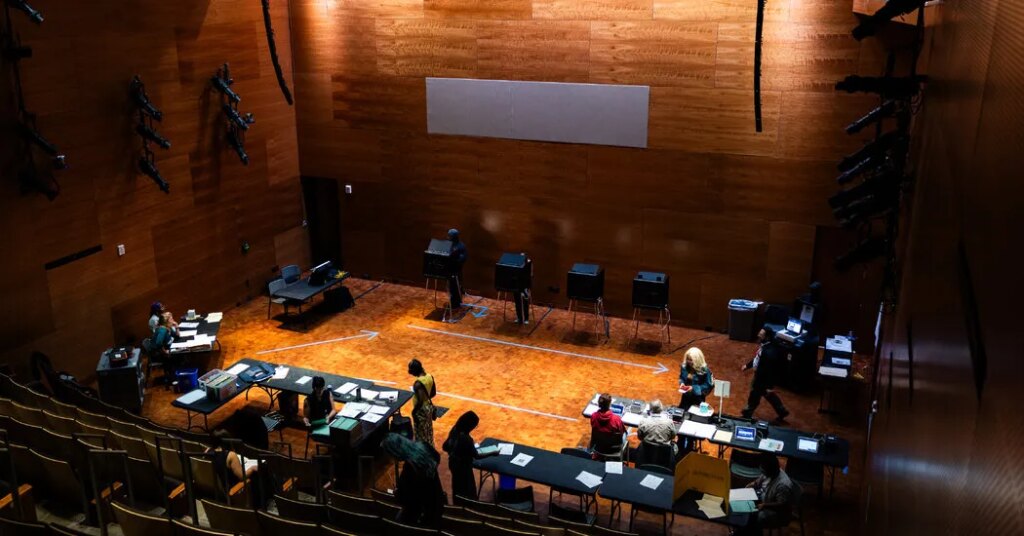
As voters chose state and local officials on Tuesday, many also weighed in on how future elections would be run and how their own votes would be counted.
In a show of disgust over the role of “dark money” in politics, Montana voters approved a ballot measure to ban corporations, nonprofits and labor unions from doing business in the state if they had made political contributions. The result appears likely to create a legal test of Citizens United, the Supreme Court decision that said independent political spending by businesses is protected free speech.
Michigan voters approved a similar measure, deciding to bar electric and gas utilities as well as many government contractors from making political donations.
In Virginia, voters backed a constitutional amendment to restore voting rights to people convicted of felonies upon their release. In Utah, they rejected a measure that would have raised the share of votes needed to approve certain changes to taxes.
Voters protected their right to propose ballot initiatives with a constitutional amendment in Montana, and raised the bar for state lawmakers to alter voter-backed initiatives in Missouri. And in South Dakota, they rebuffed an effort to require a 60 percent supermajority vote to amend their state’s constitution.
In Massachusetts, voters rejected a proposition that would have ended closed-party primaries and instead allowed all candidates to appear on the same ballot, with the top two vote-getters advancing.
Measures to ban noncitizen voting or require voters to present identification also passed in a few states — West Virginia, Arkansas, South Dakota and Ohio — with more votes still being counted into the early morning Wednesday. But voter identification initiatives were rejected in Colorado and California.
Drawing Districts
In Maryland, voters cleared a path for a new congressional map that could boost Democratic representation in 2028. In Missouri, they rejected a redrawn map that could have provided Republicans an advantage. Those moves followed a redistricting blitz that came at the urging of President Trump, with the intention of gaining more Republican seats. Ultimately, the efforts did not stave off significant Democratic victories.
“Given the blue wave it’s basically what you’d expect — voters blocking a Republican gerrymander in Missouri and greenlighting a future Democratic gerrymander in Maryland,” Nicholas Stephanopoulos, a Harvard Law School professor, said in a text message. “It’s a partisan story, not one of consistency with respect to redistricting.”
The election measures were a sizable chunk of the more than 140 statewide ballot questions that gave voters the opportunity to set policy directly on Tuesday, on issues ranging from abortion and transgender rights to taxation and affordability.
Many of the measures were handed down by state lawmakers for voter approval. Others were written by voters themselves, often with a goal of changing or creating policies that their representatives otherwise wouldn’t have taken up.
As the focus shifts to the 2028 presidential election, how the initiatives performed will help set the tone for political debate by pointing to the issues that were important to midterm voters.
Regulating Abortion
In Missouri, voters rejected an attempt by state lawmakers to repeal a constitutional right to abortion, recently approved by voters, by pairing the initiative with a ban on gender-transition care for minors.
Virginia voters enshrined abortion rights into their state’s constitution and repealed a ban on same-sex marriage, safeguarding the right should the Supreme Court overturn it in the future.
Transgender Rights
In Nebraska, voters passed restrictions on transgender students’ participation in sports. Voters’ views on transgender rights were also tested in deep-blue states on Tuesday with initiatives in Washington State and Colorado.
Patriotic Rituals
In Alabama, voters passed a measure requiring public schools to have pupils recite the Pledge of Allegiance every day and allow for student-led prayer. They also approved an initiative requiring public schools to play or arrange for a performance of the first stanza of “The Star-Spangled Banner” once every week.
Setting Rates
A Florida ballot measure to cut homeowners’ property taxes also passed. Opponents said that limiting property taxes would tighten a major source of funding for services like police and fire departments and programs for low-income residents. But supporters billed it as a way to provide relief for homeowners as the cost of living has ballooned.
The post Across the Country, Voters Give Direct Orders to State Governments appeared first on New York Times.