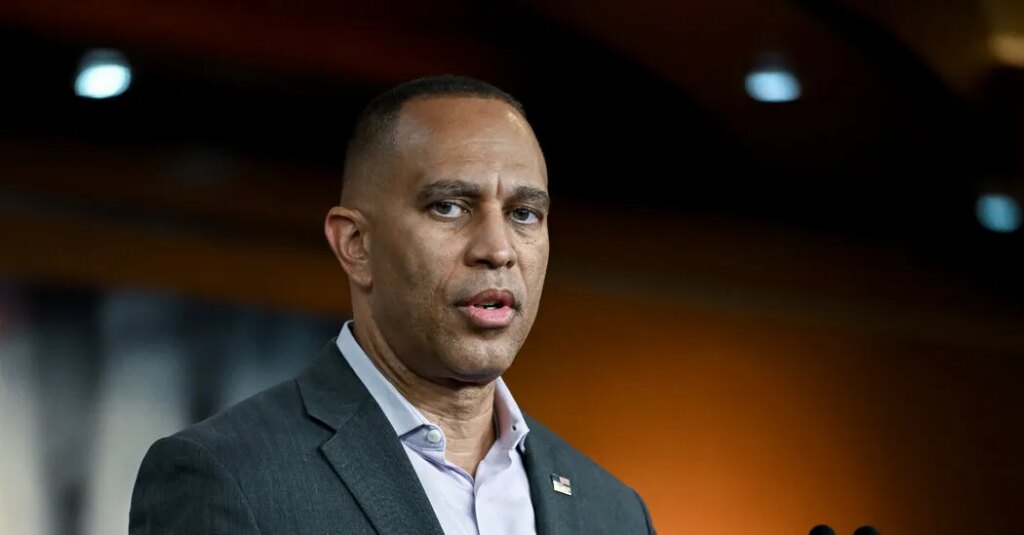
On the frigid evening of President Trump’s inauguration last year, after the vindicated president swept back into power and immediately pardoned nearly all of the Jan. 6 rioters, Representative Hakeem Jeffries, Democrat of New York, gathered his top lieutenants for a quiet dinner in Washington.
In a private back room at Osteria Morini, an Italian restaurant on the Anacostia River, Mr. Jeffries, the relatively untested Democratic leader, and his team strategized for hours about how to use their limited power in the minority to check a newly empowered president who now had control of both houses of Congress.
Mr. Jeffries, according to a person who attended the dinner, was preoccupied with a single imperative.
“We just have to win,” he said firmly. “If we don’t win in 2026, it’s over.”
On Tuesday, Democrats did just that, claiming the House majority and putting Mr. Jeffries, 56, on the precipice of making history as the first Black speaker of the House. His actions will determine how effective Democrats can be in checking Mr. Trump’s power, and help set the agenda for the 2028 presidential campaign.
Here are five things to know about Mr. Jeffries.
He has roots in Black nationalism
Mr. Jeffries grew up in a working-class home in the Crown Heights section of Brooklyn in the 1980s, when the now-gentrified neighborhood was a hotbed of Black activism, but also overrun with crime and unrest associated with the crack cocaine epidemic.
The son of a social worker and a substance abuse counselor, who became a high-powered litigator, Mr. Jeffries grew up in a house that was described by longtime associates as teeming with Black nationalist ideas. His uncle, Leonard Jeffries, a professor at the City College of New York, was associated with the Afrocentrism movement and often expressed extreme views on the subject.
Mr. Jeffries and his brother, Hasan Kwame Jeffries, a history professor at the Ohio State University, were pushed by their churchgoing parents to excel above all else.
“When Hakeem was growing up, Myrtle Avenue was known as Murder Avenue,” recalled Lupe Todd-Medina, one of his longtime political advisers. “It was not a place white people wanted to go. He grew up in this bubble of love, with lots of aunties around him. That also helped shape who he is.”
His mother and his aunt joined the Cornerstone Baptist Church, a Black house of worship, in the 1960s, and the congregation and its pastors became an important force in shaping Mr. Jeffries’s early life. Growing up, he served as an usher there. His grandmother predicted that he would one day become a pastor.
Mr. Jeffries has said that he has been motivated since entering law school by fights over racial justice. If all goes as expected and he is elected in January as the first Black speaker, he would be second in line to the presidency.
“That might be the thing that matters the most to him — breaking the glass,” Ms. Todd-Medina said.
At a victory party on Tuesday night, he ended his remarks with a note of hometown pride. “We made it, Brooklyn,” he said, “we made it.”
He was not Pelosi’s heir apparent
Former Speaker Nancy Pelosi never exactly groomed her mentees, but she had a small circle of loyal House Democrats around her whom she viewed as potential successors. For a time, the top spot in that group was occupied by Chris Van Hollen, then a representative from Maryland. When Mr. Van Hollen won a Senate seat and left the House, Ms. Pelosi looked to Representative Joe Crowley of New York as someone who operated in her mold and could lead the caucus in the future.
But Mr. Crowley was defeated in a 2018 upset by Representative Alexandria Ocasio-Cortez. After that, some of Ms. Pelosi’s closest allies included Representatives Ben Ray Luján of New Mexico and Adam B. Schiff of California, both of whom went on to serve in the Senate.
Mr. Jeffries was never one of her people. But when he was elected by Democrats in 2018 to be the chairman of their caucus, essentially their chief messaging official and No. 5 leader, he was widely seen as having the potential to be the first Black speaker.
And four years later, when Ms. Pelosi acceded to calls to relinquish her role as the top Democrat, Mr. Jeffries quickly emerged as his colleagues’ top choice to take her place. He was elected House Democratic leader by acclamation after the 2022 midterm elections.
He has a reputation as cautious and remote
Mr. Jeffries’s Democratic colleagues have always elected him to leadership posts by unanimous votes, and he is not expected to face a challenge for the job of speaker. But that does not mean that they are uniformly thrilled about his elevation to become the most powerful man in the House.
Though he is seen as a fresh face compared with the octogenarians who led Democrats in the House until recently, Mr. Jeffries is substantially more moderate than Ms. Pelosi and the progressives who are the largest bloc in the caucus. He is viewed as an establishment figure at a time when many Democratic voters are rejecting their party’s entrenched power structure.
And some Democrats regard Mr. Jeffries as overly cautious, according to interviews with a half-dozen officials who spoke on the condition of anonymity to offer an unvarnished view of his standing.
They questioned whether he had the instincts to sustain the kind of fights that Democrats will need to show voters they can wage and win, now that they have regained some power in Washington.
Some House Democrats also said they had been surprised over the years when they did not hear much directly from Mr. Jeffries, even after successes or struggles. They had grown accustomed to Ms. Pelosi, who would constantly work the phones to keep her finger on the pulse of the caucus, often congratulating or commiserating with lawmakers as she quizzed them about what they were hearing. But Ms. Pelosi effectively operated as both the speaker and the whip.
These days, the duties are more divided and it is Representative Katherine M. Clark of Massachusetts, the No. 2 who is in line to become the first female majority leader, who generally serves as whip and takes on a lot of member management.
Some of Mr. Jeffries’s allies said that they expected him to act more aggressively and decisively in his new job.
“When you’re the speaker, you become the engine of the vote,” said Representative Gregory W. Meeks, Democrat of New York and one of Mr. Jeffries’s most trusted lieutenants. “Hakeem is ready to do just that. In the minority, your role is not as commanding.”
His pro-Israel stance has alienated the left
Many democratic socialist candidates elected this year view Mr. Jeffries with particular aversion, regarding him as an establishment politician who has held back some of their progressive goals.
They also see him as too closely aligned with AIPAC, the pro-Israel lobbying group that has come to be seen by many Democrats as politically radioactive. The radio host Charlamagne Tha God has mocked him as “AIPAC Shakur.”
Mr. Jeffries bristles at the notion that he is beholden to any outside special interest group.
“Nobody can point to a single instance of me taking a vote that had anything to do with being influenced by any outside group,” he said in an interview earlier this year.
Still, Mr. Jeffries will face a major test next year from a progressive bloc of lawmakers who want Democrats to unite around ending military aid to Israel, which has bitterly divided the party. He will face competing pressure from more centrist Democrats, who have privately warned him that the party will get flattened if he goes too far in appeasing the left.
Mr. Jeffries is already cognizant of a need for Democrats to recalibrate their position on Israel. The question is how far he will be willing to go.
Earlier this year, he opposed a measure that nearly half of House Democrats backed that would have terminated U.S. aid to Israel. But in a letter announcing his position, he conceded that there were good reasons to back the measure and asserted that “a meaningful change in direction is needed” in the relationship between the United States and Israel.
A Gen X leader who loves a hip-hop reference
Mr. Jeffries, a Generation X leader in a Congress still filled with baby boomers, has made hip-hop culture a central part of his public persona, often peppering his speeches with rap lyrics.
During Mr. Trump’s 2020 impeachment trial, Mr. Jeffries ended his somber presentation with a lyric by the rapper and fellow Brooklynite Biggie Smalls: “And if you don’t know, now you know.”
At a news conference in February, he quoted the rapper Jay-Z, while railing against redistricting in Texas.
“At what point will Republican extremists come to the conclusion that your reach ain’t long enough and your peeps ain’t strong enough?” he said.
He turned again to inspiration from Jay-Z in March, at a news conference related to the government shutdown.
“But for us, difficult takes a day, impossible takes a week,” Mr. Jeffries said, quoting a Jay-Z guest verse on Kanye West’s “Diamonds from Sierra Leone.”
The post Five Things to Know About Hakeem Jeffries appeared first on New York Times.