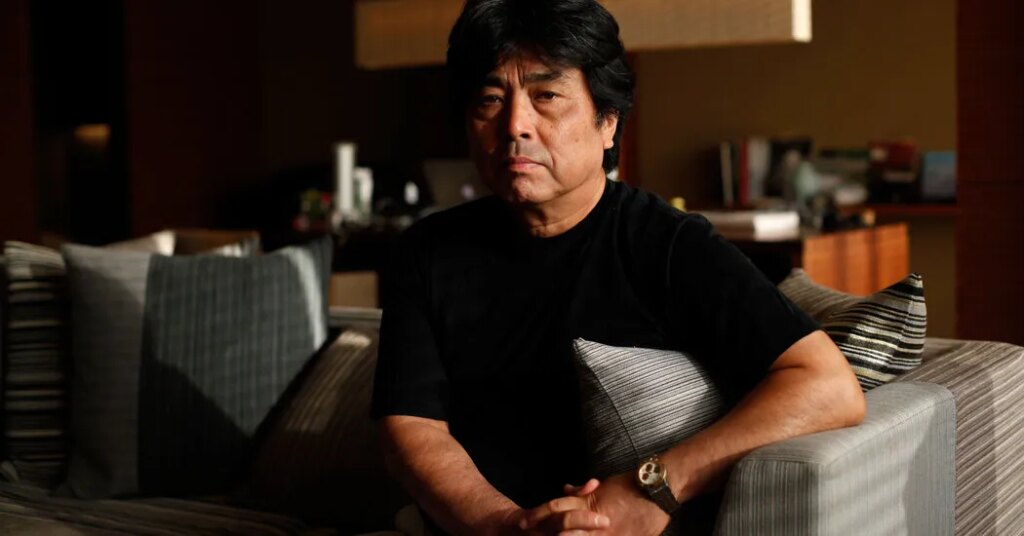
Ryu Murakami, a novelist, filmmaker and television host whose bracing psychological explorations of the underside of Japanese society made him one of his country’s most popular writers, died on Sept. 17 at his home in Tokyo. He was 74.
Gentosha, the publisher of many of his novels, announced his death, but did not provide a cause.
Mr. Murakami wrote his first novel, “Almost Transparent Blue,” while still in art school. Published in 1976, it depicted a side of Japan that ran counter to the strait-laced, socially conservative image promoted by the nation’s mainstream — one of aimless youth, orgies and copious amounts of drugs.
The book was a huge commercial and critical success, selling more than 1.2 million copies in its first six months and winning the esteemed Akutagawa literary prize. It established Mr. Murakami as a voice of Japan’s counterculture and a sharp-eyed analyst of the cultural and social costs of the country’s rapid postwar expansion.
“I have a feeling that during this chaotic postwar rush to tremendous economic growth, we Japanese may have lost or have sacrificed something very dear,” he told The New York Times in 1977. “And instead of sitting idly by and moaning, I believe novelists must provide active leadership in this quest.”
Mr. Murakami was not related to Haruki Murakami, another beloved Japanese author and a close contemporary. They were friends, but took very different approaches to writing: While Haruki Murakami’s densely psychological books lean heavily on dream fugues and magical realism, Ryu Murakami’s novels were grounded in blade-sharp criticism of Japanese culture and politics.
After the success of “Almost Transparent Blue,” Mr. Murakami wrote more than 40 additional novels, as well as countless short stories, screenplays and nonfiction essays. As a regular radio and TV host, he became a familiar voice and face to millions of Japanese.
He directed five films, including “Topaz” (1992), released in the United States as “Tokyo Decadence” — an unsubtle title for a movie centered on a prostitute named Ai and her encounters with Japan’s wealthiest and kinkiest.
His 1997 novel “Audition” was the basis for the 1999 movie of the same name that became a cornerstone of the so-called J-horror movement, alongside films like “Ringu” (1998) and “Ju-on: The Grudge” (2002).
The story revolves around Aoyama, a widowed TV producer who uses the pretense of auditioning actresses to find a girlfriend, eventually falling for a mysterious woman named Asami. As Aoyama slowly, terrifyingly learns the truth about her, Mr. Murakami unravels a story that revels in gory details and jump-scare shocks.
“The prose in these passages is elegiac and affecting, but it has the sharp, visceral feel of the butcher’s knife or surgeon’s scalpel,” the Scottish novelist Irvine Welsh wrote in a 2009 review of the English edition for The Guardian.
As Japan sank into the economic and social doldrums of the late 1990s, Mr. Murakami’s novels began to feel almost prophetic in their depiction of a population ready to burst in violent rage at suffocating social restrictions and the fading hope for a better tomorrow.
“Many Japanese are dissatisfied and frustrated,” he told The Financial Times in 2013. “But they are not good at expressing those feelings, so they tend to wall themselves off. And because they have this pent-up anger, they are very unstable.”
While keeping up a steady pace of fiction writing, Mr. Murakami turned his pen toward nonfiction as well, in essays, opinion pieces and books that assailed the government’s failure to adapt to the end of Japan’s decades-long economic expansion.
“The days when everything worked like a dream and everyone’s standard of living kept rising are over, and have been for a long time,” he wrote in a guest essay for The New York Times in 2009. “Now that there is no longer enough money, the Japanese public has to make some hard choices.”
Surprisingly for a novelist who cut his teeth on the counterculture, Mr. Murakami became a favorite of the establishment. He once gave a lecture on Japan’s cultural crisis to 100 executives from NEC, the electronics company, and he served as an unofficial adviser to top politicians and policymakers.
But as a novelist, he insisted, his responsibility was always to the reader, not to politics.
“I’m not trying to make the world a better place,” he told The Financial Times in 2013. “Unlike politicians, whose job is to work on the masses by making society fairer and more prosperous, the duty of the novelist is to target a single reader, one person reading alone.”
Ryunosuke Murakami was born on Feb. 19, 1952, in Sasebo, a port city on the southern island of Kyushu. His father, Shinichiro, taught art; his mother, Fujiko, taught math.
Sasebo is home to major U.S. Navy installations, and from childhood Ryū was both drawn to and repulsed by America’s influence on Japanese society.
He was a rebel from an early age: As a teenager, he played drums in a rock band, and he and some friends once barricaded themselves on the roof of their high school, resulting in a three-month suspension.
After graduating, he moved to Tokyo, where he enrolled in the sculpture program at Musashino Art University. He also began writing, and dropped out of school following the success of “Almost Transparent Blue.”
Mr. Murakami’s survivors include his wife, Tazuko Takahashi, and their son.
Despite his mainstream success, Mr. Murakami assured interviewers that his heart remained with the fringes. He liked to tell a story about getting a letter from a girl who had run away from home.
“While she was waiting for a bus, she was reading one of my novels and got encouraged by the idea that there were misfits like her out there in society,” he told Vice in 2013. “Reactions and episodes like that make me feel really very happy.”
The post Ryu Murakami Has Died. His Writing Explored the Dark Side of Japan. appeared first on New York Times.