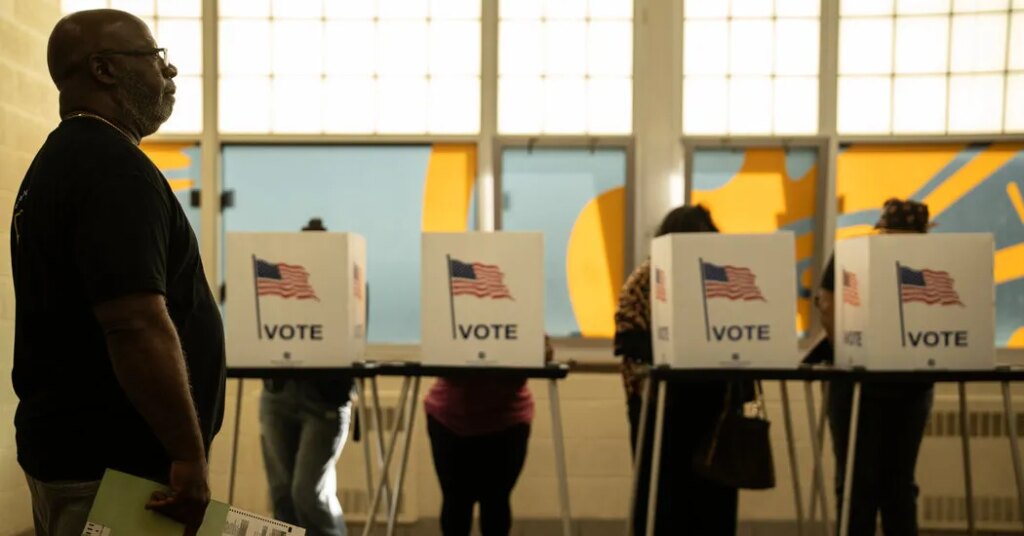
You’ve made it. Election Day is here.
Control of Congress is hanging in the balance as voters deliver their verdict on a president whose main character energy has not been dimmed by his unpopularity, nor by the fact that he isn’t on the ballot. (He has, after all, asked people to vote as if he is.)
And if I’ve done my job right, you understand how little we know right now — very little! — and how many different ways this could go.
You know there’s an unusually large battleground in the Senate, one that has pushed Republicans to play defense in states where they’re used to coasting. You also know that, because of those candidates’ structural advantages, it could be hard for Democrats to flip critical seats.
You know that political forecasters expect Republicans to lose House control, but it’s anyone’s guess by how much. (And those forecasters could be wrong!)
I can’t tell you what’s going to happen. But I can tell you how to understand what’s happening in real time. I asked several colleagues where they will be looking for early clues. Here, without further ado, is the On Politics Guide to the Next Few Hours.
First up: Watch Kentucky and Indiana
A portion of the polls have already closed in Kentucky and Indiana. Most years, there’s not a lot of insight to be gleaned about the national picture here.
But this year, Julie Davis, The Times’s congressional editor, will be watching two Republican-leaning districts in those states very closely.
Kentucky’s Sixth Congressional District and Indiana’s Fifth both backed President Trump by double digits in 2024. Now, though, the Kentucky district, which includes Lexington and its suburbs, is considered a tossup by the Cook Political Report. The Indiana district, which is held by Representative Victoria Spartz and has been in Republican hands since 1993, is considered “lean Republican.”
If Republicans hold those seats, Julie told me, it would not be a major surprise. They should in a typical year. But if they don’t — or even if those elections look close — it would be an early sign of struggle for the G.O.P.
7 p.m.: To Florida…
More polls in Indiana and Kentucky will close at 7 p.m., which will put us on track to get a fuller picture of those two red districts.
But we’ll also want to look at Florida, where, as my colleague Pati Mazzei explained, much of the state starts to report results at 7 p.m. (Yes, Florida’s slow counting in 2000 turned into a national punchline. But it has really turned things around.)
“Florida is the nation’s third most populous state, and its diverse regions sometimes act like other parts of the country,” Pati told me. “The Southeast (of Florida) is a little like the Northeast (of the U.S.), for example. The Southwest is like the Midwest, the North is like the South, and so on.”
Pati says she’ll be watching the battles for four seats that Republicans redistricted this spring: Florida’s 25th, 14th, 22nd and Ninth Districts.
-
The 25th (which hugs the Atlantic coast from Boca Raton to Miami Beach) and the 14th (a Tampa Bay-area district) have Democratic incumbents, Jared Moskowitz and Kathy Castor, who hope to hold on even though their districts have gotten redder.
-
The 22nd District race is for an open seat with two little-known candidates, so it could be a good test of a generic Democrat versus a generic Republican.
-
And the Ninth District has a Democratic incumbent, Darren Soto, but it now leans quite Republican.
Just like with the district in Indiana and Kentucky, it’s difficult to extrapolate much if Republicans perform well in these districts, Pati said, because that’s the expectation. But if Republicans underperform, it’s a sign that the party might have a rough night ahead. “That would indicate that the national mood overtook even their structural and organizational advantages,” she said.
… and Virginia
The night of the 2024 election, the first signs of Vice President Kamala Harris’s weakness came in the Virginia suburbs. Tonight, my colleague Reid Epstein, who is based in Washington, will be looking at some of those same areas.
Virginia’s First and Second Districts are classic swing districts, and this year they’ve gotten a lot of attention. In the military-heavy Second District, along the Chesapeake Bay, Representative Jen Kiggans, a Republican, has struggled to fend off former Representative Elaine Luria, who has made the war in Iran a major focus of her campaign.
Trump won Virginia’s Fifth District, a rural stretch that includes Charlottesville, by double digits in 2024. If former Representative Tom Perriello defeats Representative John McGuire, Reid said, that would be a sign of a big night for Democrats.
Another swing district to watch after 7 p.m. is the First District in South Carolina, which is represented by the outgoing Republican Nancy Mace. A Democrat picked up this district in the party’s 2018 midterm wave; Mace won it in 2020 and has held it ever since.
… and several key Senate races
7 p.m. is when the earliest polls will close in states that could offer insights into the Senate map, my colleague Nate Cohn explained:
In the Senate, there are several states on the periphery of the battleground where Democratic strength and Republican resilience will quickly be put to the test, like New Hampshire and Southern states like Florida, South Carolina, and Georgia. If it looks like a good night for the Democrats Annie Andrews in South Carolina or Angie Nixon in Florida, the Republicans are in some real trouble.
7:30 p.m.: Ohio
Let’s shift our focus away from the House for a moment. Polls close at 7:30 p.m. in Ohio, and as the counting gets underway there, we’ll get some insight into one of the ugliest contests in the country: the governor’s race between Vivek Ramaswamy, a Republican, and Dr. Amy Acton, a Democrat.
If Acton wins, my colleague Jonathan Weisman, an editor on the National desk, said that it will give us some insight into the accuracy of the polls, which showed her with a lead.
The counting will be already underway in two other revealing governor’s races. In Vermont, Gov. Phil Scott, a moderate Republican, is trying to defy the national environment in an otherwise deep blue state. And in New Hampshire, the strength of Gov. Kelly Ayotte’s re-election bid will offer further insight into how well a fairly popular incumbent Republican was able to separate herself from the president.
8 p.m.: Georgia
Georgia’s polls close at 7 p.m., but the count of early ballots is released about an hour later. The counting of Election Day ballots continues into the evening.
The state has a big governor’s race between a Democratic former mayor of Atlanta, Keisha Lance Bottoms, and the self-funding businessman Rick Jackson. If Bottoms wins, Jonathan told me, it will be a historic moment — she would be the nation’s first Black female governor. It might also offer a hint about the power of Black turnout in the South, which several other Democrats across the region are hoping will pull them across the line.
8 p.m. is also when Texas will report its early vote. That will get a lot of attention, Nate has written — but it will be a while before we know what the Election Day vote looks like.
Beware of the blue mirage
One thing to keep in mind is that the results you see first might not look much like the final picture.
That’s because many counties first release early votes, which tend to be more favorable to Democrats, and because large counties, which also tend to favor Democrats, also report earlier.
My colleague Christine Zhang, an editor on our Election Analytics team, said so-called blue mirages — in which Democrats take a deceptively strong early lead — could appear in Georgia, South Carolina, Ohio, Nebraska, Texas and Michigan. Smart returns-watching means looking out for whether you’re seeing only early-vote totals. And remember that you can keep an eye on The Times’s Needle, our live forecasting tool, which takes all of this caution into account.
Follow the results: Here are our pages tracking control of the Senate and the House tonight. All of our election coverage is free to read in the New York Times app, which you can download here.
Watching the polls
It’s been a largely smooth Election Day, according to the reports coming in from Times journalists at polling places across the country. (Here’s our live coverage.)
But there were a few notable disruptions:
-
A technical problem with voting machines in Westchester County, N.Y., just north of New York City, led officials to set aside ballots until the machines could be fixed. It’s unclear how this will affect the timing of the count, including in the closely watched 17th District, where Democrats are trying to flip Representative Mike Lawler’s seat.
-
There are storms around the country that could affect voters’ travels. In Florida, flooding forced the relocation of more than 20 polling stations across eight counties.
Markwayne Mullin, the homeland security secretary, said today that he did not send federal immigration agents to polling sites, which had been a concern for civil rights and immigrant advocacy groups. The Justice Department expanded its longtime practice of deploying election monitors and observers, sending around 1,000 monitors to cover all 50 states — more than in years past, but still accounting for just a fraction of the country’s more than 100,000 polling places.
In One Chart
Here’s one last look at the money being spent in battleground Senate races this cycle, according to the media-tracking firm AdImpact.
Republicans have spent more than Democrats in eight of the 11 Senate races shown here, the bulk of which are in states that voted heavily for Trump in 2024.
Voters’ voices
Times journalists were out talking to Americans casting ballots today. Here are a few we heard from.
“I have been agonizing. I am Jewish. This is just a tremendous dilemma.”
— Madelene Kepes, 77, of West Bloomfield Township, Mich. She voted for Democrats, but felt that the party’s Senate candidate in the state, Dr. Abdul El-Sayed, had not sufficiently denounced an outside group’s ad suggesting that U.S. aid to Israel was making life more expensive for Americans.
“Trump really frustrated me with the tariffs and some of his economic stuff.”
— Stephen Strobel, 39, of Atlanta. He split his ticket, voting for the Republican Rick Jackson for governor and Senator Jon Ossoff, a Democrat.
“We don’t need the war. It’s not benefiting anybody right now. It’s taking a big chunk of money from our incomes.”
— Godpower Babaa, 57, of Des Moines. He said the economy brought him to the polls, citing the costs of gas and food as his major concerns. He voted for Democrats down the ticket.
The post The On Politics Guide to Election Night appeared first on New York Times.