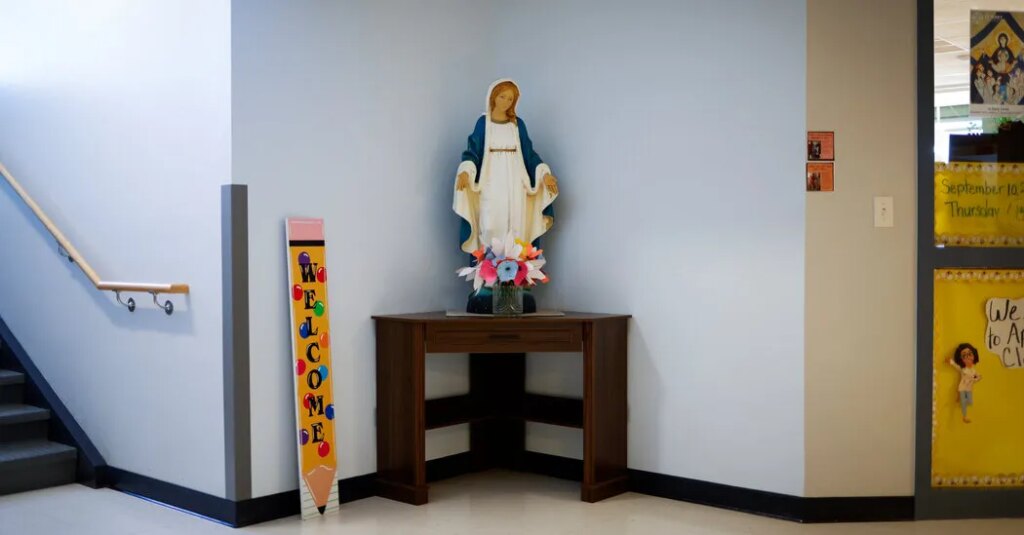
The hallways of the St. Mary Catholic Parish school are decorated with Adam-and-Eve-themed apple prints and a colorful mural depicting Jesus’ life as a child. Inside the preschool classroom is a prayer table with a rosary and puzzle pieces shaped like the symbols of Catholicism.
Parents who send their 4-year-olds to the school a few miles south of Denver feel strongly about educating their children in the Catholic faith — but they also say the state of Colorado should pay for it.
And that has led to a clash that will reach the Supreme Court on Tuesday.
A state program allows private preschools to get taxpayer funding, but those preschools are required to provide children an “equal opportunity” to enroll, including the children of gay and transgender parents. The Archdiocese of Denver argues that the requirement is at odds with its religious mission — and its members’ First Amendment rights.
The archdiocese, parish and parents have sued Colorado, setting up the latest battle at the Supreme Court testing whether religious objections can override government prohibitions against discrimination.
The conservative-dominated bench has issued a series of recent decisions expanding the role of religion in public life, continuing a signature project of the court led by Chief Justice John G. Roberts Jr.
Religious groups almost always prevail before the current Supreme Court. In 2021, the court ruled unanimously that a Catholic social services agency in Philadelphia could defy city rules and refuse to work with same-sex couples who apply to take in foster children. The next year, in a case from Maine, the court said that states that choose to subsidize private schools may not exclude or discriminate against religious ones.
In the Colorado case, however, lower courts have said the state “welcomed and actively solicited” the participation of faith-based preschools after voters approved a universal prekindergarten program in 2020. The state pays for at least 15 hours of free preschool each week at any public or private preschool, including religious ones, provided it meets the program’s requirements, including the nondiscrimination agreement.
In 2023, the archdiocese directed its preschools not to register, arguing the requirements ran counter to its views on sexuality and gender identity. Teachers, other staff members and parents at its schools sign a “statement of community beliefs” that acknowledges that the archdiocese does not recognize same-sex relationships or transgender status. Enrolling children of gay and transgender parents, according to school officials , would “likely lead to intractable conflicts.”
According to the lawsuit, Colorado is excluding hundreds of families across 34 preschools overseen by the archdiocese. As a result, the archbishop of Denver said last week that enrollment is down 20 percent and two preschools have closed, as parents have withdrawn their children and enrolled them in schools that get public funding.
One couple who joined the suit, Dan and Lisa Sheley, met as students at a Catholic college and say they now want their seven children to be steeped in their faith and values both at home and at school, where Lisa works. Because of the state’s policy, the Sheleys said, they have missed out so far on at least $18,000 in tuition assistance. They expect to lose thousands more when another child becomes eligible for the program.
In an interview, Lisa Sheley said the couple voted for the program believing it would be universal. Now, she said, they’ve discovered “it is not universal because we’re being discriminated against and not allowed to participate.”
The school is being represented by lawyers from the Becket Fund for Religious Liberty, a religious legal organization. They told the justices in court filings that the government cannot condition access to a public benefit on a recipient’s abandoning their religious beliefs.
“Catholic schools wanted to be a part of it, and Colorado wanted them to be a part of it, but when push came to shove, we couldn’t compromise what we believe,” said Nick Reaves, a lawyer representing the school, parents and archdiocese.
Jared Polis, Colorado’s Democratic governor, said in a statement that state officials intentionally included faith-based groups when they created the program. At least 79 faith-based providers participated in the last school year, serving at least 2,052 students and receiving more than $9.5 million in payments.
In court filings, Colorado’s lawyers argued that the anti-discrimination requirements do not infringe on the schools’ religious beliefs because those schools are free to teach whatever they would like about sex, marriage, gender and family. They need only refrain from excluding children from enrolling “simply because their parents are gay.”
The state also noted that the requirements apply equally to all participating preschools — public, private, secular and religious.
Scott Skinner-Thompson, a law professor at the University of Colorado who specializes in civil rights and constitutional law, said states have long had the power to impose conditions on recipients of taxpayer funds, such as committing to comply with nondiscrimination requirements.
“St. Mary’s is saying that’s not tenable with our faith position. That’s fine. It’s a simple choice not to take the money,” he said. “The state is trying to balance protecting L.G.B.T.Q. families and preserving religious liberty.”
After a three-day trial, a federal judge said in 2024 that while states may not decline to fund religious schools, states “are not obligated to subsidize discrimination using taxpayer dollars, even when that discrimination is based on religious beliefs.”
A unanimous panel of the U.S. Court of Appeals for the 10th Circuit upheld that decision last year, citing an important Supreme Court precedent limiting First Amendment protections for religious practices.
The 1990 decision, Employment Division v. Smith, said laws that apply neutrally and across the board, without singling out religion, typically do not violate the First Amendment’s protection of the free exercise of religion.
That decision is unpopular among many conservative Christians, who say it does not offer adequate protection to religion. Three justices — Clarence Thomas, Samuel A. Alito Jr. and Neil M. Gorsuch — have called for overturning that precedent, with Justice Alito writing in 2021 that it “threatens a fundamental freedom.”
Justices Brett M. Kavanaugh and Amy Coney Barrett, who are often critical votes in the majority, expressed hesitation in the same case about the implications of overruling the Smith decision and what would replace it. The court is not directly addressing the question of whether to overturn it in Tuesday’s argument.
In the court’s 2021 decision in the foster care case from Philadelphia, Chief Justice Roberts said the city’s policies had not met the requirement set out in Smith that laws must be “neutral and generally applicable” because city officials were permitted to make certain exceptions.
Lawyers for the Catholic school in Colorado, backed by the Trump administration, have relied on that line of reasoning and asserted that the state has granted exceptions to its requirement — but for secular reasons and not religious ones.
The appeals court was unpersuaded that the exceptions the state has so far allowed, which include letting some schools give preferences to low-income families or children with disabilities, are parallel to what the church has requested.
Kitty Bennett contributed research.
The post Can Catholic Schools Get Public Money if They Turn Away L.G.B.T.Q. Families? appeared first on New York Times.