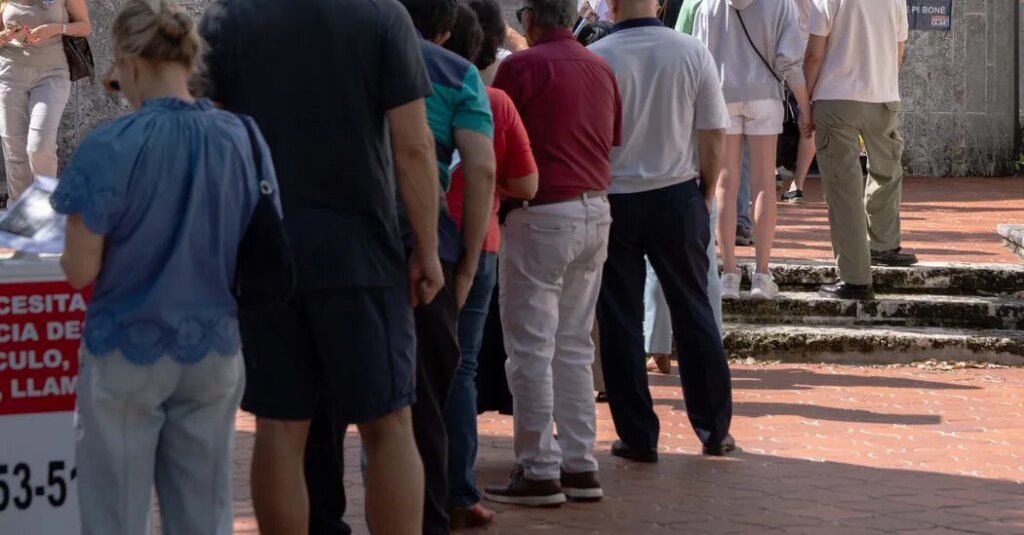
In America, it is largely up to each state to decide the laws that govern elections. That means there is a jumble of rules in place around the country on Election Day, including whether voters have to present identification to cast a ballot, and even how closely you can approach a polling place with a political sign or T-shirt.
As such, it’s important to check your state government’s website to make sure you’re within the bounds of specific regulations. But here’s a broader look at what is and isn’t allowed at polling sites across the country.
Electioneering
Every state has some kind of law about political activity near polling places. And at a federal level, actual or attempted voter intimidation or coercion are criminal offenses.
Electioneering refers to any kind of overtly political activity near a polling site while voting is taking place. Most states restrict the display of signs or the handing out of campaign literature within 100 feet of a polling site.
Some states go further, and bar voters from wearing clothing or pins that bear a candidate’s name or political messaging. A handful prohibit general loitering around polling stations, and eight states prohibit the taking of exit polls as voters leave polling sites.
Providing ID
Most states require some sort of ID to vote. In the 14 that don’t, identification is instead required at the time of voter registration, and poll workers are not allowed to ask voters for identification on voting day.
Selfies
Snapping a selfie with your completed ballot is illegal in 15 states, including New York, New Jersey, Georgia, Massachusetts and Minnesota.
Arizona, Texas, Tennessee and West Virginia allow ballot selfies, but only for absentee or mail-in ballots.
While some argue that ballot selfies are a form of protected speech, critics have claimed that it can facilitate vote buying by giving people a legal way to prove they supported a specific candidate or ballot question.
Closing times
Each state decides the hour its polls close, but they all agree on one point: If you are in line to vote when that hour arrives, you will be allowed to cast a ballot.
Stepping out of that line after the polls have closed, however, is different. If you leave a voting line after polls have closed, you most likely will not be allowed to rejoin it.
The post What You Can (and Can’t) Do at Polling Sites appeared first on New York Times.