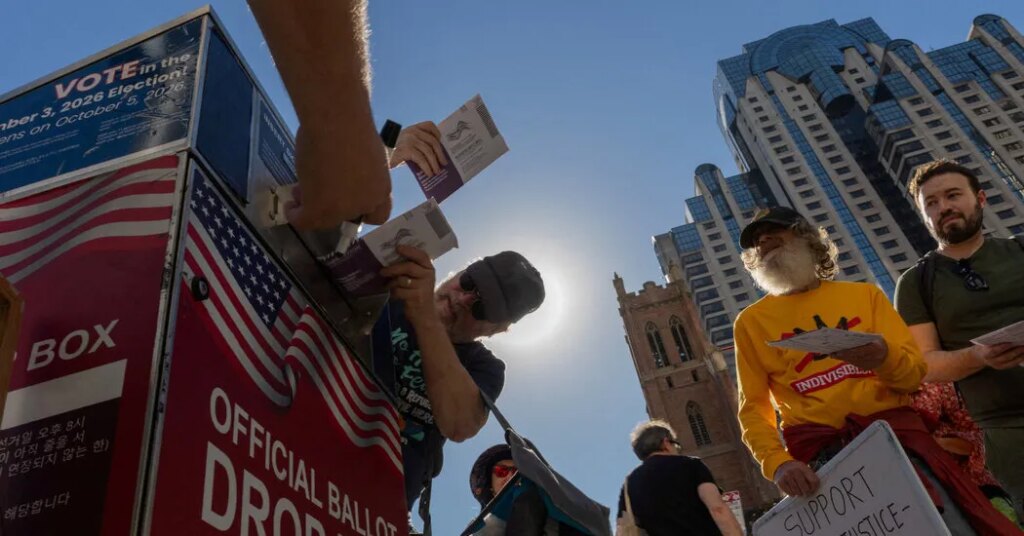
The Supreme Court on Monday evening swiftly rejected a request by the Trump administration to require that California set aside 20,000 mail-in ballots that the administration claims have been provided to noncitizens.
The order, which was unsigned and gave no reasoning, came the same day that the administration lawyers had asked the court to step in after a divided federal appeals court had rejected the administration’s arguments that California officials should impound the ballots for further scrutiny. No public dissents were noted.
The ruling appeared to be an extraordinary rebuke of the Trump administration, sending a message that the court was not interested in stepping in to assist President Trump’s efforts to interfere with how states are administering elections.
It was a highly unusual ruling because it came only hours after the administration filed its emergency request and without the court even calling for a response or briefing from the opposing parties. It is nearly unheard of for the court to rule on an application filed by the federal government without first asking for a response from the opposing parties.
Legal experts had been skeptical of the Trump administration’s arguments in the case. By filing just one day before the midterm elections, the administration may have hoped to forestall a loss in the case until after Election Day.
Instead, the court rejected the administration’s gambit nearly immediately.
The request had required the Supreme Court to consider how much power the federal government has to order states to make last-minute changes to their vote-counting procedures. Under the Constitution, states have responsibility for administering elections. The Justice Department has claimed that it is empowered by a federal law that makes it illegal for noncitizens to cast ballots.
In their emergency application, lawyers for the administration urged the justices to grant what they called a “modest remedy,” requiring California to separate ballots of “citizens and suspected noncitizens.” Solicitor General D. John Sauer wrote that such an order by the court “would not cancel any vote but would allow time to verify the eligibility of suspected noncitizens.”
The legal challenge to 20,000 California ballots is part of a broader effort by the administration to argue that the elections could be marred by illegal votes by noncitizens. The effort comes as polls show Republicans could lose control of one or both chambers of Congress and as President Trump has sought to cast doubt on the validity of the vote, despite little evidence of widespread problems with illegal voting. California officials have said the voter list provided by the Trump administration is filled with errors.
The solicitor general had appeared to distance the lawyers in his office, an elite division of the Justice Department that represents the federal government before the Supreme Court, from direct knowledge of whether the people on the list were actually noncitizens.
Mr. Sauer wrote that his office “has been informed that the United States has identified more than 20,000 individuals” who appeared to be registered to vote in California and who “in the United States’ view, are likely not U.S. citizens.”
In Los Angeles County, where more than 1.2 million of the county’s nearly 6 million voters have already cast ballots, officials welcomed the decision but worried about the case’s potential to sow confusion.
Los Angeles Mayor Karen Bass called the case “a desperate attempt to scare people into staying home” and “an effort to make Americans doubt our elections, which are safe, secure, and run by dedicated election workers.”
Dean Logan, the county’s registrar, texted that he was “in meetings and focused on the election” when the ruling was issued, “but obviously pleased.”
Governor Gavin Newsom celebrated the decision, saying in a statement that “after repeatedly losing in the lower courts, the highest court in the land firmly slapped down the Trump DOJ’s baseless attack on California’s electoral process — not even entertaining it.”
As the lawsuit has wound through the lower courts, the administration had also threatened criminal charges over claims of noncitizens voting, including charging 28 people with violating federal election laws and subpoenaing county election workers in California.
The Justice Department sent the list of 20,000 names to Los Angeles County elections officials in October, claiming that those ballots should be separated because the names had been flagged through a government process as potential noncitizens. Officials have been vague about exactly how the list was prepared, and county officials have said that the list appeared to include people with addresses throughout California. Only 7,035 names on the list sent to Los Angeles were listed with addresses in Los Angeles County. Officials confirmed others were born in the United States and were citizens.
Shortly after, the Justice Department sued to stop the counting of mail-in ballots sent to people on the list until their citizenship could be verified.
Shawn Hubler and Laurel Rosenhall contributed reporting.
The post Supreme Court Rejects Trump Administration Request to Intervene in California Ballot Case appeared first on New York Times.