In 1965, the political economist Albert Hirschman warned that the United States and Latin America were tangled in an “orgy of misinterpretation and misunderstanding” fueled by conflicting political moods and preferences. Over two decades later, looking out over a hemisphere that was just as geopolitically messy, he reflected, “I almost wonder whether I might have stumbled on some sort of law.”
Some sort of law, indeed. After a string of presidential victories by right-leaning candidates in Latin America, Washington had, up until recently, been basking in a sense of unparalleled political alignment throughout the region. Over the summer, Secretary of State Marco Rubio hailed the emergence of predominantly pro-American governments across the hemisphere as an “extraordinary achievement”; in September, President Trump boasted that he was “nine for nine” in backing winning candidates. The Donroe Doctrine — Mr. Trump’s project of hemispheric hegemony — seemed to be paying off.
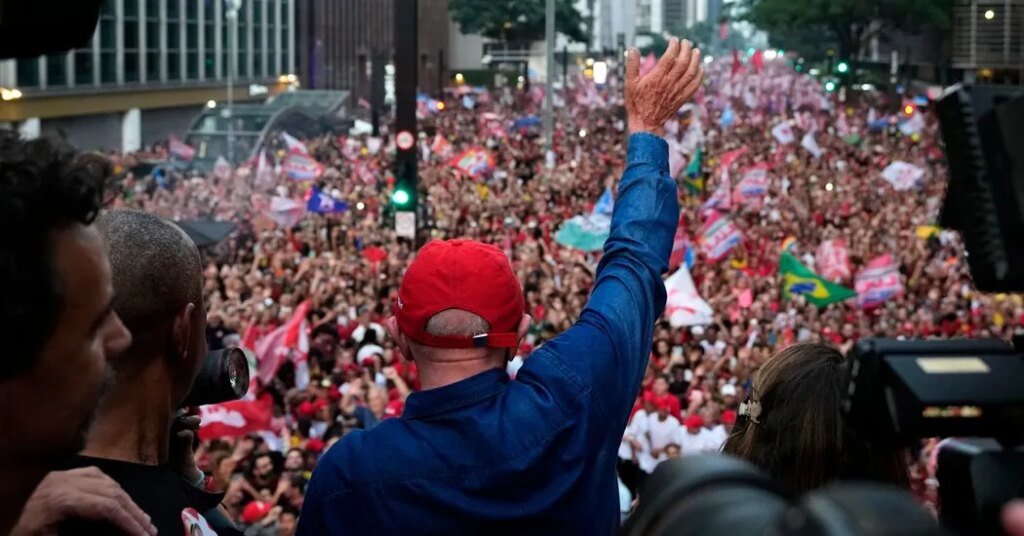
The triumph of President Luiz Inácio Lula da Silva of Brazil, an iconic octogenarian leftist, over Flávio Bolsonaro, heir to the Bolsonaro political dynasty and avatar of Latin America’s new right, upsets the narrative of a historic ideological reconfiguration — and reveals how profoundly the Trump administration has misread the region’s political winds. The swing to the right was never about Mr. Trump; it’s the serendipitous result of a wave of discontent with the status quo and could prove evanescent. Indeed, the grievances and aspirations that brought so many far-right governments to power could just as easily undermine their political fortunes and weaken their ties to Washington in years to come.
The region’s rightward shift reflects less of an ideological transformation than a widespread frustration with governments that have overpromised and underperformed for decades. Voters are angry about crime, economic stagnation, corruption and poor public services. Right-leaning candidates in places like Argentina, Colombia, Chile, Peru, Honduras and Bolivia have successfully capitalized on that discontent, promising to restore order, revive economic growth and challenge discredited political establishments.
To some extent, Brazil’s election complicates this picture. Mr. Lula is, after all, an incumbent who managed to overcome considerable dissatisfaction with his government to win October’s election. But Brazilians had already lived through four years of Jair Bolsonaro’s Trump-backed right-wing populism. In the presidential runoff, thanks to a campaign powered by digital grass-roots mobilization, they rejected a return to that political project under his son Flávio — who almost immediately absconded to the United States, apparently fleeing a web of criminal investigations at home.
Mr. Lula’s victory should not be interpreted as an emerging leftward swing in Brazil, or in the region, where conservatives remain a formidable political force. What the final verdict does suggest is that Latin America’s electoral volatility is driven less by ideology, or even the rejection of incumbents, than by voters’ judgments about competing political alternatives and their records in office.
For the new crop of right-wing leaders, whose ascent began with the election of Argentina’s Javier Milei in 2023, delivering on their promises has already proved a tall order. Crime and economic stagnation are complicated problems that defy quick solutions. Already, there are signs that some of the right’s new guard are floundering and losing popular support. Not even a year after taking office, Bolivia’s Rodrigo Paz, Chile’s José Antonio Kast and Peru’s Keiko Fujimori all face plummeting approval ratings. Mr. Milei, a close ally of Mr. Trump’s, faces mounting political difficulties as he approaches his bid for re-election next year. The same impatient electorates that propelled him and other leaders into office could just as readily turn against them.
These right-leaning leaders hardly constitute a cohesive political movement. They differ in their convictions, governing styles and policy priorities. Just as tensions have always divided Latin America’s left-wing governments, today’s right-wing bloc is quarrelsome and fragmented. Despite their ideological affinity, for example, Mr. Kast and Mr. Milei recently clashed over longstanding territorial disputes, stirring nationalist sentiments.
True, the region is largely aligned on tougher security policies in response to mounting public concern about crime. Over the past decade, driven by a booming global drug trade, criminal organizations have amassed power and territory throughout the region, expanding from illicit activities into informal economies and laying waste to vulnerable communities. Over a dozen governments in the region now participate in the United States-led Shield of the Americas, a hemispheric initiative aimed at combating drug cartels and transnational organized crime.
But governments are being forced to think through how far to accommodate Washington’s demands for a more militarized approach to law enforcement. Concerns about policy autonomy and national sovereignty extend across the political spectrum, including to right-leaning governments in Peru, Chile and Colombia, whose political affinity with Washington does not necessarily mean subordinating their national interests to U.S. priorities. Those national interests include their relationships with China: While right-leaning governments may feel considerable political kinship with the Trump administration, most also have vital economic relationships with Beijing that transcend political orientation and that they cannot or will not sacrifice.
Meanwhile, Washington is losing the confidence of people who voted Mr. Trump’s regional allies into power. The 2026 Latinobarómetro survey — conducted after Mr. Trump’s launching of the Iran war — showed that 59 percent of Latin Americans disapprove of his handling of international affairs. The share of Latin Americans who express trust in the U.S. government has fallen to 40 percent from 62 percent in 2012, according to AmericasBarometer. (Trust in China has dipped more slightly, to 51 percent from 57 percent.)
That free fall in trust has played out as the Trump administration’s policies have grown increasingly aggressive and interventionist. Tariffs, sanctions and political pressure, together with the brutal treatment of Latin American immigrants in the United States and ongoing extrajudicial boat strikes in the Caribbean and the Pacific, have reinforced longstanding suspicions of American power — and of the advantages of being in America’s spotlight. The 2026 Latinobarómetro survey revealed that while 69 percent of Latin Americans approved of the U.S. military operation in January that removed Nicolás Maduro, only 35 percent believed it had benefited Venezuela.
Those figures, and Mr. Lula’s upset in Latin America’s most populous country — as well as the enduring popularity of Mexico’s leftist leader, Claudia Sheinbaum — belie the Trump administration’s exuberant claims about the roaring success of its Latin America policy and its reassertion of an American sphere of influence in the hemisphere. Washington has been celebrating what it sees as a historic foreign policy achievement in a region where, among voters, its reputation has suffered damage that will take years to repair. What looked on the surface like a new era of hemispheric convergence could turn out to be another chapter in a long history of missed connections.
Michael Shifter is a senior fellow at the Inter-American Dialogue, a think tank focused on the Western Hemisphere, and teaches Latin American politics at Georgetown University and George Washington University.
The Times is committed to publishing a diversity of letters to the editor. We’d like to hear what you think about this or any of our articles. Here are some tips. And here’s our email: [email protected].
Follow the New York Times Opinion section on Facebook, Instagram, TikTok, Bluesky, WhatsApp and Threads.
The post This Was Never About Trump appeared first on New York Times.