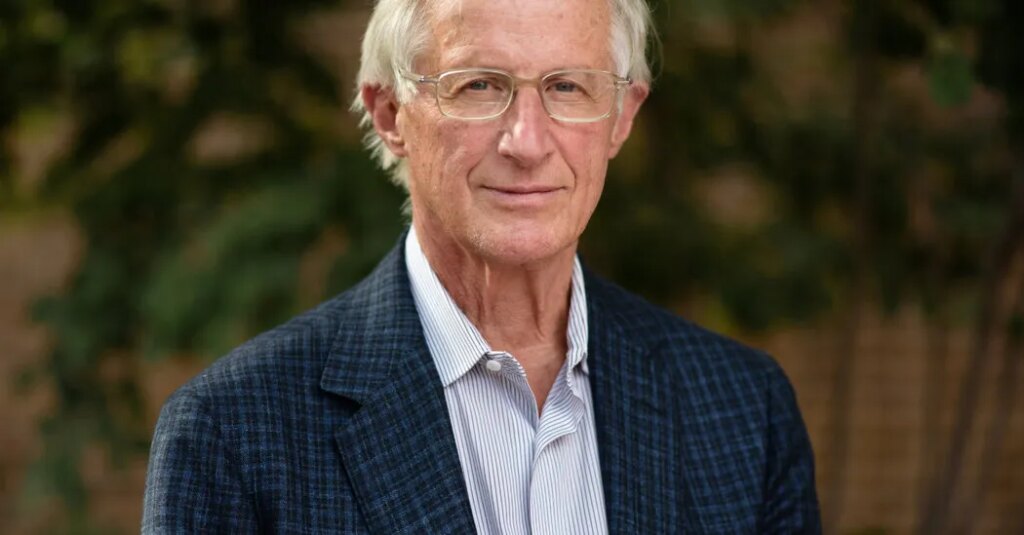
William D. Nordhaus, a Yale economist and Nobel laureate who tabulated the economic wreckage of carbon emissions and influenced climate policy across several presidential administrations, died on Friday at his home in New Haven. He was 85.
The cause was glioblastoma, a form of brain cancer, said his nephew Ted Nordhaus.
In 2018, Professor Nordhaus shared the Nobel in economic science with Paul M. Romer, an economist at New York University. The Nobel committee cited Professor Nordhaus’s work in developing a method to balance climate change’s long-term damage with the costs required to contain it.
The model, which Professor Nordhaus refined over decades, has underpinned dozens of regulations around the world aimed at limiting fossil fuels and seeded the ground for a new field of research that bridges the gap between economics and earth science.
“He played a crucial role in terms of bringing consideration of the natural environment into the mainstream of economics, whereas earlier, it was sort of a fringe area,” said Robert Stavins, director of the environmental economics program at Harvard, who wrote about Professor Nordhaus’s impact.
Professor Nordhaus saw climate change as a clear threat to humankind, but he emphasized that potential damages must be balanced with the economic cost of preventing them. “Climate stabilization would appear enormously expensive,” he concluded, in his initial paper describing the model.
To deal with the problem efficiently, Professor Nordhaus proposed a modest carbon tax that would escalate over time. The idea gained support in the 2000s among liberals like Senator Bernie Sanders, an independent from Vermont, and Republicans such as former secretaries of state James A. Baker III and George P. Shultz, who championed it as a “conservative climate solution.” Ultimately, although carbon taxes have proven politically toxic in the face of corporate opposition and have only rarely been instituted, many countries and sub-national governments like states and provinces have set up emissions-trading systems that impose carbon limits and use markets to set prices. One such proposal passed the U.S. House of Representatives in 2009 but died in the Senate.
Perhaps a more enduring outgrowth of Professor Nordhaus’s model is a metric called the “social cost of carbon,” which quantifies the benefits of combating climate change. In the Obama administration, it became a fundamental tool for regulating emissions from power plants and vehicles, until the second Trump administration banned its use in rule making last year.
The Nobel was widely seen as a rebuke to the Trump administration, which had at the time begun to dismantle the building blocks of American environmental policy; Mr. Trump often called climate change a “hoax.”
Although colleagues found Professor Nordhaus to be scrupulously apolitical, he gave an interview to the Nobel committee in 2018 in which he decried what he called Mr. Trump’s “ludicrous statements about climate change.”
Winning the prize, he said, “gives a kind of courage and heart to the people who are on the right side of history.”
William Dawbney Nordhaus, the third of four children, was born in Albuquerque on May 31, 1941. His father, Robert Nordhaus Sr., was a Yale-educated lawyer for American Indian rights; he also was an outdoorsman who started a ski resort in the nearby Sandia Mountains and helped build a popular tram to bring visitors to the tourist destination. His mother, Virginia (Riggs) Nordhaus, oversaw the home.
Professor Nordhaus graduated in 1959 from Phillips Academy in Andover, Mass., and in 1963 received a bachelor’s degree in economics from Yale University.
In 1967, he completed his doctoral studies in economics at the Massachusetts Institute of Technology, studying under future Nobelists Robert M. Solow, Kenneth Arrow and Paul A. Samuelson, with whom Professor Nordhaus continually updated and later took over primary authorship of a widely used textbook, “Economics.”
He returned to Yale in 1967 as an assistant professor just as the environmental movement was gaining steam. He became interested in accounting for planetary harms after reading an article in a Trans World Airlines in-flight magazine that criticized the traditional measure of economic output, the gross national product.
“In the words of a young radical, don’t tell me about your GNP. To me, it’s really Gross National Pollution,” Professor Nordhaus recalled that it said. “I thought, ‘Wow, that’s really cute. But is it true?’”
That question launched an effort to quantify the impact of natural resource depletion. The work to reflect the environment in national economic statistics took another step forward in a National Academies of Sciences, Engineering and Medicine report that Professor Nordhaus led in 1999 and continues today, as governments have tried to supplement official metrics that ignore many aspects of human welfare.
In the 1970s, awareness of the impact of carbon dioxide on the earth’s climate was just dawning. Professor Nordhaus hit upon the problem in 1974 during a residency at the International Institute of Applied Systems Analysis in Vienna where he shared an office with a climatologist who encouraged him to study linkages with the economy. That led to the first known paper integrating carbon emissions into an economic model that estimated what it might cost to limit the fallout for the climate.
Soon after his return to the United States, Mr. Nordhaus went to Washington, D.C., to serve as a member of President Jimmy Carter’s Council of Economic Advisers. In close communication with his brother Robert, an energy lawyer who wrote key provisions of the Clean Air Act of 1970 and later was general counsel at the Department of Energy under President Bill Clinton, he generated recommendations about how to gauge the economic costs and benefits of proposed regulations. The concept was legally mandated for federal rule-making processes in 1981, although the criteria have changed with the priorities of successive administrations.
Back at Yale, Professor Nordhaus kept working to quantify the implications of climate change for economic growth. It was a lonely project: Few others were studying the question, and when he finished a model that assessed the cost of several approaches to limiting emissions, mainstream economics journals rejected the submission.
“They didn’t see why this was important. That’s why it was published in Science,” Lint Barrage, an associate professor of energy and climate economics at ETH Zurich, a public research university, who studied under Mr. Nordhaus and worked with him on later updates to the model, said in an interview. “You don’t stick with that topic and swim against the stream if it’s not something you’re really convinced about.”
As Professor Nordhaus’ research gained mainstream acceptance, it also came under fire. One challenge arrived in the form of a 2006 report commissioned by the British government that called for a much more aggressive approach to limiting carbon emissions than Professor Nordhaus had recommended.
The core dispute was over how much policymakers should value the welfare of future generations compared with that of people now. Professor Nordhaus wrote a withering riposte, and the question remains central to debates over how much to pay for climate mitigation.
Another disagreement arose over whether conventional economic analysis could be applied when considering the potentially infinite costs of unlikely but catastrophic climate disasters. This one came from the Harvard economics professor Martin Weitzman, to whom Professor Nordhaus respectfully responded that such scenarios were limited. He would later call Professor Weitzman, who died by suicide in 2019, the “pre-eminent environmental economist of the modern era.”
Other criticisms arose over whether the harms from climate change should be balanced with conventional metrics of economic growth, which many see as the wrong yardstick.
“When he carried out that analysis, his view was, ‘Let the chips fall where they may,’” said Professor Stavins. “As a result, the policy actions and trajectories that he was recommending early on were not as ambitious as many advocates would like.”
Under the Biden administration, federal climate policy largely abandoned the idea of pricing carbon, favoring subsidies as both more politically palatable and potentially more equitable in shifting behavior. And over time, Professor Nordhaus adjusted his model to incorporate new science, pushing up his estimate of the appropriate carbon price significantly. Other economists have now constructed their own integrated models that reach different conclusions.
In 1964, he married Barbara Feise, who later became a psychoanalyst. In addition to his wife, he is survived by three children, Jeff, Monica and Rebecca; a brother, Richard; a sister, Elizabeth; and three granddaughters.
Another legacy of Professor Nordhaus’s work may only now be taking root.
As international climate diplomacy floundered in recent years, he proposed the concept of a “climate club” of willing nations that would impose trade penalties on nonparticipants. One such effort took effect this year: the European Union’s carbon border adjustment mechanism, which levies tariffs on goods from outside the bloc that correspond with their impact on the climate.
The post William Nordhaus Has Died. Nobelist Influenced Climate Policy. appeared first on New York Times.