Like a lot of Americans, I’ve grown accustomed to Supreme Court justices speaking out much more frequently and informally than they once did. Yet still there was more than one moment in a public conversation Elena Kagan had at Catholic University last month when I almost couldn’t believe what I was hearing.
The justices like to say that their opinions speak for themselves. In the old days, they nurtured the mystique of their delicate yet elevated position in government, rarely if ever revealing their own feelings about the law, American politics or life in general. Anyone who wanted to know what a justice really thought, they claimed, would do best simply to read their rulings.
That is no longer true. Today’s bench is among the most voluble in the court’s history — the justices seem constantly to be writing books, giving speeches, engaging with interviewers and, increasingly, complaining about the institution they serve and (sometimes) the colleagues they serve with.
Even by that new standard, Justice Kagan’s comments, which came during an hour-plus sit-down interview at Catholic University’s law school, broke the judicial omertà, both in what she said explicitly about her conservative counterparts’ blasé attitude toward American democracy and in what she appeared to say about the dangerously compromised state of the court in 2026.
The Catholic University law professor J. Joel Alicea, who interviewed Justice Kagan, started the conversation by asking her about rulings involving partisan gerrymandering, voting rights and money in politics, all of which were decided on party-line votes with her and the other Democratic appointees in the minority.
“The court got it wrong” in each of these cases, Justice Kagan said, because of a “lack of appropriate concern or understanding of the consequences of their decisions.” She pointed to the Republican-appointed majority’s evisceration of the Voting Rights Act in April, which was followed almost immediately by a mad scramble in states across the South to pass new, more partisan gerrymanders aimed at erasing Black lawmakers’ districts.
Protecting Black political participation and representation was precisely what the Voting Rights Act was enacted to do, she noted. By eliminating the last meaningful tool of that landmark law, she explained, “the court kind of said, ‘Oh, well.’” Whether that was meant in the sense of “we don’t care if Black political representation plummets” or in the sense of “it won’t plummet,” Justice Kagan concluded, “the court has kind of blinded itself to the very deleterious effects of their rulings on how the political system works, and has created a democracy that does not work as well as it should.”
This wasn’t the first time she has leveled such sweeping criticisms; you can find similar charges in her dissenting opinions in that and other democracy-related cases, in which she skewered her right-wing colleagues for misunderstanding the law and disregarding Americans’ democratic rights.
But Justice Kagan was offering this critique off the bench, in public — where the justices know their words carry a special significance, particularly before the midterms. Even more surprising, of all the Democratic appointees, if not all nine justices, Justice Kagan has a reputation as the most restrained and institutionalist.
At a judicial conference in July, Justice Kagan took pains to defend her conservative counterparts against accusations that they were acting as a rubber stamp for the Trump administration. So it was that much more remarkable to hear her admit, just a few months later, such wide-ranging frustrations with her fellow justices.
And she wasn’t done: “This court is deeply conservative, and in that way very different from the court I joined 16 years ago.” That court, she added, “was by no means liberal” — it still had a 5-4 conservative majority and had only months earlier decided Citizens United v. F.E.C., which transformed the role of money in politics (and in which Justice Kagan, then serving as President Obama’s solicitor general, had argued the losing side). Still, as recently as 2017, “nobody in America thought the court was in the pocket of any one group or any one party or any one anything,” she said. “The court had a kind of legitimacy. And when the court has a kind of legitimacy of that kind, it helps to create a stable country.”
Her implication, of course, is that today’s court, dominated by a right-wing supermajority that rules consistently in favor of a longstanding conservative agenda, lacks that “kind of legitimacy” — about as serious a charge as a sitting justice can make.
Justice Kagan had one more dig, which verged on the personal. Reflecting on the role of originalism in the court’s jurisprudence, she said, “I’ve never thought originalism really works,” adding that the “cartwheels” originalists perform to reach their preferred outcomes are “almost embarrassing.” In sum, she said, “the whole project is kind of misconceived, and it’s not a very good match with the Constitution we have.”
Originalism has been the coin of the conservative judicial realm for decades and is currently ascendant at the Supreme Court; as Justice Kagan said ruefully at her own confirmation hearings, “We are all originalists.” Calling it “misconceived” and its practitioners “embarrassing” may sound relatively mild to ears accustomed to the crude invective of the Trump era, but it suggests that the interpersonal conflicts on the bench aren’t getting resolved anytime soon.
I would go so far as to infer a deeper message in Justice Kagan’s remarks: When taken together, her critiques of her colleagues — their disregard for democratic rights, their undermining of the court’s legitimacy and their “misconceived” commitment to originalism — offer a coherent case for reforming the court.
It goes something like this: The conservative majority has been arrogating outsize power to itself over the past several years, claiming the authority to decide many of the most contested questions of American legal and political life, while Congress has stood idly by. Even when the court rules that it has no power to act, as it did in the partisan gerrymandering case, it has “deleterious effects” on democracy, as Justice Kagan pointed out. (That ruling has also disproportionately benefited Republican political interests, which goes to her point about legitimacy.)
Next, pair the court’s arrogation of political power with the fact that the right-wing justices apparently consider themselves accountable to no one. As Justice Samuel Alito wrongly claimed about Congress in 2023, “No provision in the Constitution gives them the authority to regulate the Supreme Court — period.”
Finally, consider this in the broader context of judicial life tenure, a functionally impossible-to-amend Constitution and — to Justice Kagan’s point about originalism — a majority in thrall to a theory of constitutional interpretation that privileges the supposed consensus of people living more than two centuries ago over the values and wishes of those alive today.
Put it all together, and the American people have no way to push the Constitution in a more democratic direction. No way to stop six justices from deciding that protecting democratic rights like voting — “just about the most important thing that the court does,” as Justice Kagan described it at Catholic University — is no longer necessary.
The court’s profoundly antidemocratic attitude was summed up neatly by Chief Justice John Roberts, who said in a 2009 interview: “The most important thing for the public to understand is that we are not a political branch of government. They don’t elect us. If they don’t like what we’re doing, it’s more or less just too bad.”
The chief justice offered one remedy: impeachment followed by conviction in the Senate. However, as he also noted, that has never happened in American history. Impeaching even a single justice would be an enormous lift.
There is a better and easier solution, and Justice Kagan’s critiques last month point directly to it: major court reform imposed by Congress.
Structural failures demand structural repairs. Whether these repairs take the form of term limits, an expanded bench, binding ethics rules, restrictions of the court’s jurisdiction or other measures, they are the only way for the American people, through their elected representatives, to reclaim power over a court gone rogue.
Is this what Justice Kagan was saying, implicitly, in her talk at Catholic University? I can’t be certain, but I’m comfortable speculating.
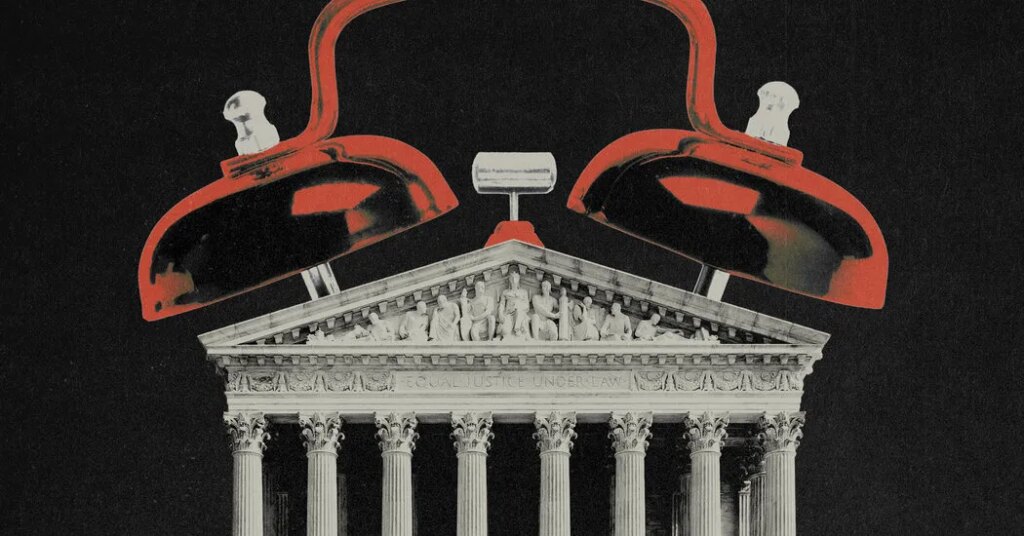
In this moment of rock-bottom public confidence in the court, Justice Kagan was not unaware that she was speaking outside of the formal boundaries of court decisions, and thus challenging the public appearance of judicial comity. Indeed this may be Kagan’s restraint showing up after all: With her comments, she is ringing alarm bells about the seriousness of problems at the court.
And while the justices may have concluded that they are the final word in interpreting the Constitution, no one gave them power over how we interpret their own words.
Source photographs by Michael Lee and PhotoPlus Magazine/Getty Images
The Times is committed to publishing a diversity of letters to the editor. We’d like to hear what you think about this or any of our articles. Here are some tips. And here’s our email: [email protected].
Follow the New York Times Opinion section on Facebook, Instagram, TikTok, Bluesky, WhatsApp and Threads.
The post Justice Kagan Confronts a Broken Court appeared first on New York Times.