In mid-October, Vice President JD Vance came face to face with a young woman who told him that he got her vote when she cast her first ballot as a U.S. citizen. At a town hall in Michigan, she asked why he was scapegoating immigrants for the issues he had vowed to solve as vice president.
Mr. Vance responded that his goal was not to “dehumanize” immigrants.
“To the extent that my rhetoric has been imperfect here, that’s on me,” Mr. Vance said.
But days later, when a heckler interrupted his speech with shouts of “Release the Epstein files” and “God bless our children,” Mr. Vance claimed without evidence that the man was an illegal immigrant.
And last week, at a rally in Michigan, Mr. Vance suggested that Dr. Abdul El-Sayed, a Muslim American and Democrat who is running in a tight race for the Senate, would lead an uprising similar to the unrest taking place in France.
“We have to understand what happens when our nation gives in to these kinds of people, to young men with zero attachment to its land or to its history,” Mr. Vance said of Dr. El-Sayed, who was born in the United States.
“Because what we saw in France,” he added, “the hatred, the ingratitude, the desire to destroy rather than the desire to build, that exact same cancer is what has corrupted Abdul El-Sayed writ large.”
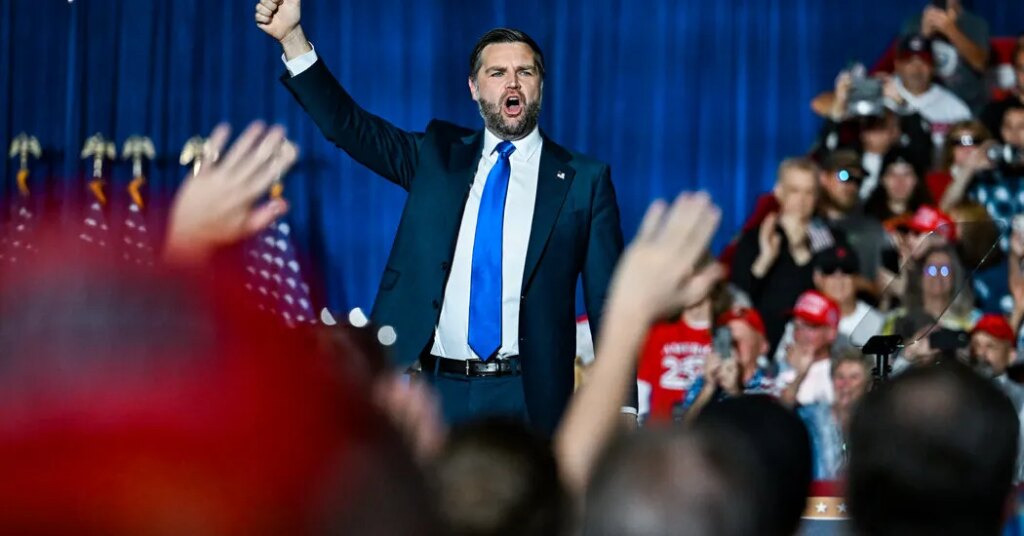
As he has sought to rally support for G.O.P. candidates before the midterm elections, Mr. Vance has repeatedly reverted to deeply personal attacks and inflammatory rhetoric, playing a leading role in a campaign in which Republicans in tightening races have adopted xenophobic, anti-immigrant and anti-Muslim rhetoric.
He fat-shamed critics, and suggested that the Democratic Senate candidate in Texas was gay and had inappropriate relationships with children. He asserted that a Black Democratic candidate in Florida did not belong in the United States because of her socialist views. He questioned the Christianity of a Kansas pastor running for Senate. And he defended a widely criticized ad featuring the estranged mother of the Democrat running for governor in Ohio, Dr. Amy Acton. Dr. Acton has not spoken to her since her mother’s husband was charged with raping Dr. Acton when she was 12.
Vice presidents have historically been called on to be rhetorical attack dogs, particularly during campaign seasons, and Mr. Vance is second-in-command to a president whose go-to defense is often aggression and insults.
But Mr. Vance’s sharp-edged rhetoric is revealing of his political instincts on the eve of the next major campaign, as attention shifts to the 2028 race for the White House and his potential candidacy to succeed President Trump.
“His political juice is still very much open to question, and Vance has put a lot of his credibility on the line in the places he visited,” said Matthew Dallek, a political historian at George Washington University. “He’s looking for ways to say to his base voters that ‘I should be the one to inherit the Trump mantle. I can go where Trump also goes, and go to depths that Trump hasn’t even visited yet.’”
In response to a request for comment, Luke Schroeder, a spokesman for Mr. Vance, said in a statement that The New York Times was “cherry-picking his comments to manufacture a politically convenient caricature.”
“The vice president’s message is simple: America belongs to those of all colors and creeds who love it, not to those who hate it,” he added. “The vice president has rightly held radical Democrats accountable for their apparent contempt for the American way of life.”
Mr. Vance has demurred when asked whether he plans to run in 2028. “My wife will tell you this: I’m a procrastinator. I hate thinking about it,” he said at a recent CBS News town hall, adding, “Anything could happen, man.”
The president has so far declined to name Mr. Vance as his heir apparent. In the closing stretch of the midterm elections, he has privately questioned why Mr. Vance has not drawn bigger crowds at the rallies he has headlined.
“He’s a very talented person and he’s a very good person, but we’ve — I don’t think we’ve ever talked about,” Mr. Trump said recently when asked whether he would endorse Mr. Vance, adding: “It’s early, very early right now. We have to get through the midterms.”
Mr. Vance is often the most disciplined messenger for the Trump administration, arguing in careful talking points that Republicans are improving the lives of everyday Americans. At several recent rallies, he promoted economic policies like tax cuts and efforts to lower health care costs, as well as the administration’s fight against fraud, which he said would help steer more jobs and resources to Americans.
At a rally in Kansas, Mr. Vance leaned into his personal story, comparing the state to his hometown in Ohio, sticking largely to an economic populist message. He acknowledged that many Americans felt squeezed by rising costs, a concern that Mr. Trump has repeatedly dismissed.
“I want to speak mostly to the undecided voters,” Mr. Vance told the crowd. “You’ll hear a lot of people say that gas prices are too high. And I understand that. It is true.”
Throughout the campaign, Mr. Vance also presented himself as open to bipartisanship. He has lamented that the Democratic Party had changed since the 1980s and ’90s, saying in one rally that he would “frankly love to be dealing with some reasonable Democrats in Washington, D.C.”
But he also frequently veers back toward swipes at immigrants and multiculturalism.
During a recent Fox News town hall, Mr. Vance recalled a conversation with his wife,Usha, who is the daughter of Indian immigrants, about growing frustrated when he took his son to the emergency room and observed “nine different translators for nine different languages.”
“And I’m just thinking to myself, How about if everybody spoke English, and we could hire more doctors and less translators in our country?” he said.
When asked how young Americans were expected to buy homes and start families with the high cost of living, Mr. Vance placed blame for housing prices, in part, on unauthorized immigrants.
“We allowed 20 million illegal aliens into our country to buy homes that ought, by right, go to American citizens,” he said.
Economists and real estate experts have long debunked this claim, finding that while illegal immigration has contributed to population growth, a lack of supply is the primary culprit of the housing affordability crisis.
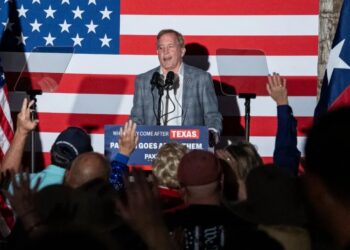
During a swing through Texas, Mr. Vance assailed one of his favorite targets, James Talarico, the Democratic Senate nominee, implying in a fiery speech that Mr. Talarico had an inappropriate focus on children. The vice president has repeatedly suggested that Mr. Talarico’s past statements supporting transgender children were inappropriate.
“I need you to send a message on November the 3rd that America belongs to those who love it, not those who hate it,” Mr. Vance said. “I need you to tell James Talarico that his weird obsession with trans kids is not good for the state of Texas, and I need you to send a message to every far-left activist, to everybody who expects Texas to surrender, that in five days, Texas is not surrendering a damn thing.”
He has been particularly pointed when discussing Dr. El-Sayed, who earlier this year suggested that Mr. Vance’s white grandfather would not accept his wife, Usha. The vice president has falsely accused Dr. El-Sayed of supporting Shariah law and described him as someone who “defends literal terrorism.” Mr. Vance has also seized on claims that Dr. El-Sayed made about holding dual citizenship in Egypt, which his campaign later said was an error, to argue that he is not loyal to America.
On other occasions, Mr. Vance has said that he supports a country that does not judge people by the color of their skin. At the town hall in Michigan, where he addressed antisemitism, he said he condemned “anybody who would judge another human being based on who their mother or father were, what their ethnicity was, what their religion is.”
Political observers said that the midterm campaign had showcased how Mr. Vance appears to tailor his political persona to different audiences.
“I feel like this was his opportunity to really try out and see what sticks and what doesn’t,” said Alexandra Middlewood, a professor of political science at Wichita State University.
A Republican strategist close to Mr. Vance, who spoke on the condition of anonymity to discuss his private comments, said the vice president had grown more comfortable showing his personality by leaning into humor, profanity and riffing.
Mr. Vance has credited his boisterous political style to his upbringing, largely shaped by a grandmother who passed on her love of God and colorful expletives.
In a recent interview with the vice president, the political podcaster Mark Halperin pressed him on why he had so many feuds.
“I’m probably a little pugnacious,” Mr. Vance answered, laughing. “I like to have fun with it. I also like to be honest and direct.”
The post A ‘Pugnacious’ Vance Leans Into Personal Attacks on the Campaign Trail appeared first on New York Times.