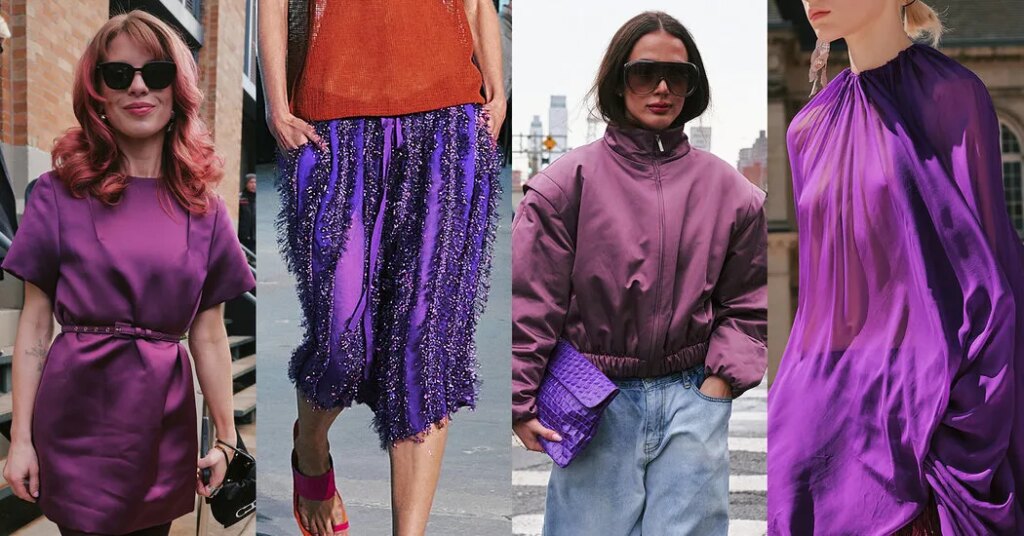
Do brands and designers get together and make a decision about what the predominate color of any fashion season will be? Brown seems to be in the lead this autumn with pops of purple and red. It’s so prevalent that it’s hard to imagine it’s a coincidence. Is there an explanation? — Linda, Los Angeles
You are not the only person who wonders this — and it’s a mystery not limited to shoppers. Even fashion insiders sometimes scratch their heads.
Henry Zankov, founder of a namesake line and the artistic director of the reinvented Diane von Furstenberg label, told me that when he was in design school, he wondered the same thing. And Joseph Altuzarra, the founder of a namesake brand, said that sometimes he looked at his peers’ collections during fashion week and thought, “Oh damn, they’re doing the same color or same type of print as me.”
What everyone is essentially wondering is whether there is a real-life equivalent of the famous “cerulean blue” speech Miranda Priestly gives in the original “The Devil Wears Prada.” You know, the one in which “Oscar de la Renta did a collection of cerulean gowns, and then I think it was Yves Saint Laurent — wasn’t it? — who showed cerulean military jackets. And then cerulean quickly showed up in the collections of eight different designers. Then it filtered down through the department stores —”
And the answer is sort of.
There is absolutely no official collusion, no late-night cabals a month before the fashion season where designers get together and, sotto voce, identify a shade they haven’t used for a while and agree to bring it back so that everyone will feel a need to buy new stuff.
But two things are going on that could activate the spidey senses of conspiracy-minded fashion watchers among us. One is quite straightforward, and one is a little more systemic.
First, the obvious factor. As Altuzarra explained it: “We’re all seeing the same shows, the same movies. We’re all steeped in similar culture.”
In other words, if there’s a big Yves Klein show at the Met or the Louvre, designers, who are deeply enmeshed in the art and entertainment worlds, would probably see it. A number of them might come away with a sudden interest in Yves Klein blue.
Similarly, if the biggest film talker is a thriller that takes place in the former Soviet Union, the snowy gray shades of a concrete gulag might capture their imagination. It’s why, to go back to “The Devil Wears Prada,” “florals for spring,” groundbreaking though it is not, does, in fact, happen every year.
I know this may be disappointing (aren’t designers supposed to be super-inventive and original?!), but that doesn’t make it any less true — particularly these days, when creativity is forced to take place on such a fast schedule. It’s little wonder designers have to latch on to the first source of inspiration they see.
The second factor is more behind the scenes.
About a year before they start on a collection, most designers — or their teams — attend the major fabric fairs, like Paris Première Vision and Pitti Immagine Filati in Florence, Italy. Mills and manufacturers take booths at these enormous trade fairs to show brands their latest developments: new tweeds, a fresh shade of purple and so on.
“You go and the Chanel team is there and the Dior team and the Chloé team,” Altuzarra said.
That means, said Kim Jones, the former men’s wear designer for Louis Vuitton and Dior, and former women’s wear designer for Fendi, who is starting his own line, “Everyone uses the same fabric mills, and a lot of the same fabric developers work across a few companies.”
Then, because “clients gravitate toward certain things, the mills think, ‘Oh, everyone loves these tweed developments,’ and suddenly we see a lot more tweed,” Altuzarra said. Or russet, or grape.
It becomes a vicious, or virtuous, cycle: Mills show something new or exciting, designer teams seem interested, mills make more variations of that fabric, which makes it seem even more au courant, a slew of designers decide to use it in their next collections, Pantone, a designator of the color of the year, takes note and … voilà!
Suddenly you see [fill in the blank] color or sequined yarn in stores everywhere.
Your Style Questions, Answered
Every week Vanessa will answer a reader’s fashion-related question, which you can send to her anytime via email or X. Questions are edited and condensed.
The post Purple Is Everywhere. Is It a Coincidence or a Conspiracy? appeared first on New York Times.