This week, Israeli party leaders will trickle into the residence of President Isaac Herzog to officially recommend their pick for Israel’s next prime minister following the inconclusive election on Tuesday.
In live-streamed meetings to begin on Wednesday, politicians from 11 parties, including those representing secular liberals, ultra-Orthodox Jews and Arab voters, will make a pitch to Mr. Herzog. He will then bestow the mandate to build a governing coalition on whomever he deems the most viable.
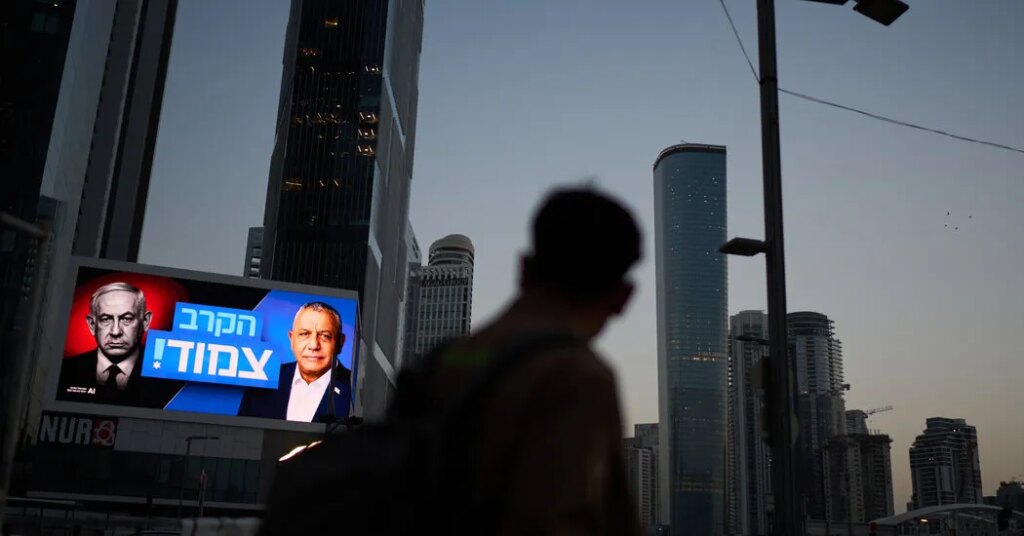
Most party leaders are expected to back either Prime Minister Benjamin Netanyahu, the longtime right-wing leader, or his main center-right rival, Gadi Eisenkot. Neither man won a clear majority in balloting for the 120-member Parliament, most likely meaning that weeks or months of negotiations among the parties and elected lawmakers lie ahead.
Behind the scenes, politicians are already weighing the different potential paths to power and wrangling with one another to that end, seeking leverage over opponents and allies alike. “It’s a game of chicken,” said Nevo Cohen, a political strategist who ran the 2022 election campaign for the far-right national security minister, Itamar Ben-Gvir.
Each possible way of attaining a parliamentary majority of 61 seats would involve making painful compromises and potentially breaking promises made to voters during the election.
“They are also checking their internal situation, to see how much room they have to maneuver,” said Lior Chorev, a political strategist who worked on former Prime Minister Naftali Bennett’s campaign, which picked up 12 seats in Parliament last week. “They want to know how far they can go.”
An Israeli opposition official, who spoke on the condition of anonymity to discuss private negotiations, said that party leaders were feeling out one another’s red lines. These leaders were also drawing up legislative plans for when Israel’s Parliament, the Knesset, is sworn in this week, the official said.
The coalition talks will be extraordinarily sensitive because they could easily collapse, sending Israel back to another round of elections, said Izhar Shay, a former centrist lawmaker. So in making deals or concessions, politicians need to be cognizant of how that might play with their voters, should they find themselves back at polling stations quicker than expected.
“Because elections might be just around the corner, the sides can’t be open,” Mr. Shai said. “Anything they say can and will be used against them, so everyone is being very cautious, although a moment must come when the cards are placed on the table.”
After the last election in 2022, Mr. Netanyahu swept into power with a 64-seat majority, allowing him to establish the most far-right government in Israel’s history. This time, the calculations are considerably more complex.
Mr. Netanyahu and his allies dropped to 53 seats, while Mr. Eisenkot’s bloc garnered 48. Surging turnout among Israel’s Arab citizens helped deliver a historic 19 seats to the two main Arab parties.
Mr. Netanyahu could try to secure another term as prime minister by peeling away at least eight lawmakers from Mr. Eisenkot’s alliance, a daunting task because so many of them have vowed not to enter a Netanyahu government.
Mr. Eisenkot has three paths to power. He could try to pick off some of Mr. Netanyahu’s allies; he could form a unity government with the prime minister he swore to oust; or he could lean on the Arab bloc — and risk splitting his base.
Some of Mr. Eisenkot’s supporters say that joining with Mr. Netanyahu — despite their candidate’s description of the prime minister as unfit for office — might make the most sense, since it would keep ultra-Orthodox and Arab parties out of power. But Mr. Netanyahu is a famously slippery partner, and he has walked away from political agreements before when they no longer served him.
In 2020, a unity government between Mr. Netanyahu and Benny Gantz, a centrist opposition leader, collapsed after less than a year of power sharing. Under their coalition agreement, Mr. Netanyahu was supposed to yield the prime minister’s seat to Mr. Gantz, but he instead dissolved the Knesset and called new elections.
“We thought we were doing the right thing, and in the end Netanyahu cheated us,” said Mr. Shay, a lawmaker in Mr. Gantz’s party at the time.
To form a government without Mr. Netanyahu, Mr. Eisenkot would most likely have to lean on the Arab parties, in particular the relatively pragmatic Raam party, which got eight seats. The Joint List, which netted 11 seats, is unlikely to join his governing coalition, but it could block a no-confidence vote against it in the Knesset, allowing him to form a “minority government” with fewer than 61 seats.
Israeli political analysts say a decision to depend on the Arab parties could easily split Mr. Eisenkot’s base, so he has been tiptoeing, at least for now, around the possibility. Avigdor Lieberman, one of Mr. Netanyahu’s main opponents, has repeatedly vowed not to join any government that relied on the Arab factions.
Since last week, Mr. Netanyahu has claimed that Arab citizens were “stealing the election.” His Likud party has alleged, without providing proof, that the results were subject to widespread tampering. Election officials have repeatedly said there was no evidence of systematic interference in the vote.
Analysts say Mr. Netanyahu’s racially charged campaign aims at further discrediting any attempt by Mr. Eisenkot to engage Arab parties as partners.
“That’s the only scenario that Netanyahu is afraid of, so he’s trying to do things that will make a minority government impossible,” said Michael Koplow, an expert at the Israel Policy Forum, a research group.
An incident that surfaced Thursday gave Mr. Netanyahu an opening to cast doubt on the legitimacy of the high Arab vote.
Noam Sohlberg, the Supreme Court justice overseeing the country’s elections committee, said in a letter that he had seen intelligence indicating potential “improper influence through foreign funding” in the elections. He did not elaborate or provide evidence and said he “could not attest to the veracity of the suspicions.” He nevertheless sent a letter authorizing the head of Shin Bet, Israel’s domestic security agency, to investigate.
The Likud party quickly issued a statement saying that the Arab parties had “stolen the elections in Israel.” The party incorrectly cited Mr. Sohlberg’s letter to Shin Bet, falsely saying it had reported that “foreign officials have bribed voters on behalf of the Arab parties.”
Three days later, Mr. Sohlberg issued a clarification, saying that there was no reason to “doubt the votes cast by Arab citizens.” But the claim that Arab parties had tainted the elections had already become a right-wing talking point.
On Sunday, the Likud party again denounced the results of the vote, saying that a “black cloud” was hovering over the election.
The post Israel Turns to Next Big Question: Who Gets a Shot at Being Prime Minister? appeared first on New York Times.