In today’s edition … How are you feeling on Election Eve? … Michigan’s Senate race is pure chaos … but first …
It’s now or never for two Democrats in Pennsylvania
Republican incumbents nationwide are worried about their futures, well aware that tomorrow’s midterm elections could see several long-tenured Republicans swept out of Congress.
But as anxious as those members may be, the Democrats facing them are filled with an intense mix of hope and dread, knowing that if they don’t defeat some of these entrenched lawmakers in these midterm years, they may never be able to do it.
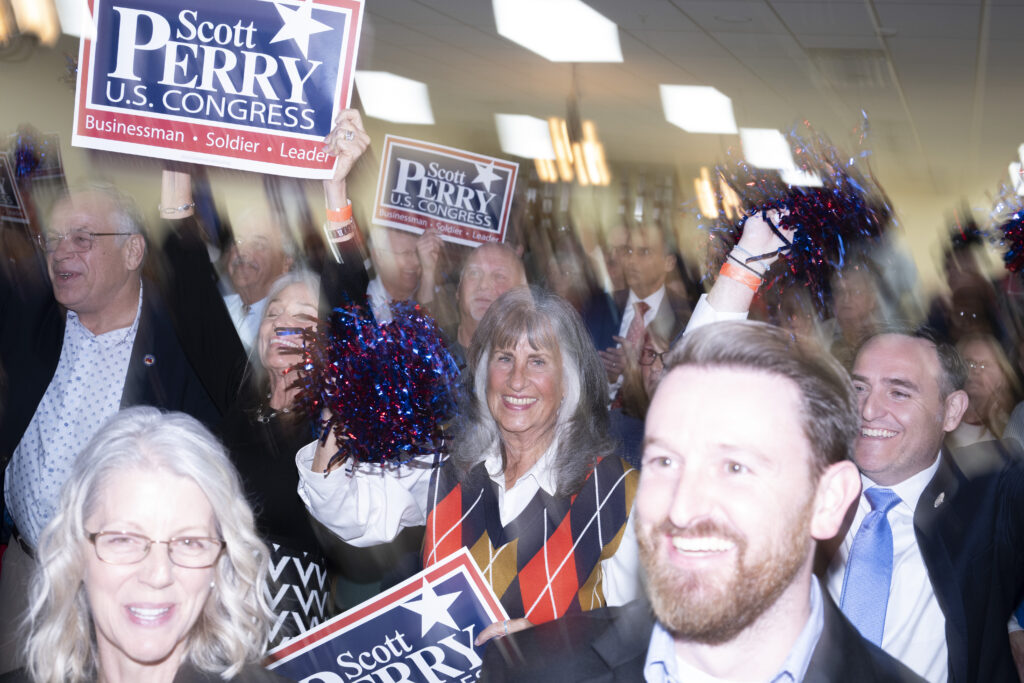
There are few areas where that is truer than in Pennsylvania, where two longtime Republican lawmakers — Brian Fitzpatrick in the Philadelphia suburbs, and Scott Perry in a district around Harrisburg — are in the fights of their political lives, facing off against well-positioned Democrats in a year that could be notably bad for their party.
Neither Perry nor Fitzpatrick would speak with The Washington Post in the days leading up to Election Day, but conversations with their Democratic opponents — former newscaster Janelle Stelson, who is running against Perry, and Bucks County Commissioner Bob Harvie, who is challenging Fitzpatrick — tell the story of how Democrats feel good about this political moment, but won’t believe it until they see the results on Tuesday.
“He wins all the time,” Stelson told me, invoking her Republican opponent and recalling how when her campaign manager gives her good news, her first reaction is not to believe it. “I probably believe worse than anybody else because I’ve seen him win and win and win.”
Stelson’s race against Perry is a rematch. The Democrat came within 5,000 votes of defeating the incumbent, making the race a unique test of just how different this national environment is from two years ago.
“What’s different is the story of Scott Perry just keeps getting worse,” Stelson said. “I feel like he’s not living in the reality of the people I talk to every day, who talk about how they’re struggling.”
Stelson says she can feel that the environment is different this cycle. There is anger at President Donald Trump over what she calls an “economic crisis,” and she believes Republicans have been in denial over it, pointing to how Perry, while campaigning alongside House Speaker Mike Johnson (R-Louisiana), told voters that while the country faces “some problems,” the economy is “rocking and rolling.”
Over in Bucks County, Harvie is prosecuting a similar case against Fitzpatrick.
“It’s hard for people just to do the basic things, you know, have health care, buy a new home, you know, fill the grocery cart when you need to. And we’re just going to keep on that message because clearly it’s working,” he told me.
Perry and Fitzpatrick are a study in contrasts.
Perry has long been a close Trump ally, and played a central role in his effort to overturn the 2020 election. He is combative and direct, similar to the president. And when I spoke with him earlier in the year, he acknowledged gas prices were affecting his constituents but blamed the mainstream media for how it was covered.
“Look, I don’t like the high gas prices,” said Perry, noting that he often drives to and from his district and Washington. “I am not at all immune to high prices and being frustrated by them.”
Fitzpatrick, by comparison, has broken with the president multiple times, criticizing his tone, telling CNBC that he hasn’t “done a sufficient job” as president. He also voted to restrain the president’s power over the Iran war.
The two men represent starkly different districts. Fitzpatrick’s is one of three in this cycle that Kamala Harris won in 2024 but is represented by a Republican. Perry’s is a darker shade of red, with Trump winning the area by 5 percentage points two years ago.
Both, however, have proven difficult to beat, especially Fitzpatrick, long a Democratic target.
“He clearly has changed the past 10 years. He’s not the guy that people have sent there,” Harvie said. “The votes that he’s cast are really causing pain in this district. We talk about whether it’s health care or the war in Iran or tariffs, all of those things are hitting home for people, and he can’t defend himself.”
The two races are among four competitive House contests in Pennsylvania. But they stand out because the Republicans in the other competitive contests were elected just two years ago and are far less entrenched.
The real difference maker this year may be Gov. Josh Shapiro, who is on the ballot this year, but — as we have documented — has run up the score on his Republican opponent. Even longtime Republican operatives in the state told me that they think he is a shoo-in to win reelection.
Shapiro took a hands-on role in these House races, telling me that he recruited the four candidates on the ballot tomorrow.
“These are people who are common sense, who are running on platforms and are actually bringing Democrats and Republicans and independents together,” he said after headlining an event with Stelson. “I’ve worked hard to get through their primaries, and I’m working hard right now. I hope they come across the finish line. And I think if they do, if they win, it will send a very clear message that these are the types of common-sense candidates who can win in the toughest districts in the toughest swing state in the entire country.”
Voters at the Shapiro-Stelson event were fully bought in, with many having already cast their ballots. But it was clear throughout the crowd that while the names they backed matter, hopes of stopping Trump and Republicans were the driving force behind their votes.
“The blue wave is coming. Janelle Stelson is going to get swept up like a surfer at Rehoboth and sent to the House,” said David Ellis, a 71-year-old retired teacher who lives in Harrisburg.
Ellis said Stelson hadn’t “suddenly become more magnificent” since running against Perry two years ago and that he isn’t really inspired by her. But he added that he “hardly cares” who is running against Perry as long as they have a D next to their name.
“Let’s put you in the House,” he said, pulling a random woman standing in line into the conversation. “I am voting for you over Scott Perry. Anybody, anybody here, I’m voting for them over Scott Perry.”
Want this in your inbox?
Start your day with The Washington Post’s flagship political newsletter. Sign up here.
From across the newsroom
- JD Vance may announce a 2028 run. First, he has to get through the midterms, from Natalie Allison.
- The final House battleground map looks great for Democrats. Watch these races, from Mariana Alfaro, Anna Liss-Roy and Eric Lau.
- Ken Paxton’s last stand, from Jack Herrera.
- Sen. Chris Murphy hospitalized for stroke, his office says, from Teo Armus, Sammy Westfall and Theodoric Meyer.
- We talked to voters in six battleground states about the rising cost of living, from Joanna Slater, Brady Dennis, Alex DeLuca, Julie Z. Weil, Dan Simmons and Molly Hennessy-Fiske.
- Big Tech vowed to lead on climate. Now it’s driving a fossil fuel boom, from Evan Halper and Kevin Schaul.
- The corruption election: Democrats link Trump’s wealth to voters’ economic pain, from Cat Zakrzewski.
- Republicans mount ‘most aggressive play’ for Black voters in Michigan Senate race, from Erin Cox.
What I’m watching
The cake — as I wrote earlier this year — is largely baked on this election. And that is certainly true on Election Eve.
But one state — Michigan — was pure chaos in the final hours to Election Day.
I worked on a deeply reported piece with Karen Tumulty, Liz Goodwin and Erin Cox about how the Michigan Senate race descended into pure chaos, with Rep. Haley Stevens choosing to endorse Republican Senate nominee Mike Rogers over Democratic Senate nominee Abdul El-Sayed.
You can read about that background here — including how Stevens was telling people as late as Saturday night that she would be at church with El-Sayed and Rep. James E. Clyburn (D-South Carolina) on Sunday, only to show up at another church with Rogers.
The heart of the long-simmering, sometimes boiling-over acrimony between Stevens and El-Sayed is their contentious primary. The two Democrats plainly don’t like each other, but their main policy disagreement is over U.S. policy toward the Israeli government and the war in Gaza, which El-Sayed has called a genocide.
But Democrats made clear that Stevens’s decision to endorse Rogers was a a bridge, too. The response was swift and brutal.
“This is a despicable betrayal from Rep. Stevens,” Senate Minority Leader Chuck Schumer wrote on X. The powerful Senate Democrat from New York had supported her in the primary against El-Sayed.
“Anyone who makes an election this important about themselves, and not Michiganders and our democracy, should think hard about whether they are serving the greater good,” wrote Sen. Elissa Slotkin, a Michigan Democrat.
The question is whether this kind of infighting is reaching average Michigan voters. If it is, is it changing their mind about whether to vote for El-Sayed? Some may shift their vote, but it feels unlikely that most Michiganders are paying close enough attention to this drama to flip their vote, especially amid high prices and broader political concerns.
State Sen. Mallory McMorrow, flanked by dozens of United Auto Workers at a unity event in downtown Detroit on Sunday, said national reporters want to make this race a Real Housewives episode, but “this is not about people trying to get their last five minutes before they no longer have a title.”
(FWIW: McMorrow a few days ago put out a statement obliquely telling Stevens to “cut the shit” — very Real Housewives.)
“Are we divided?” she asked. “No!” The crowd yelled back. “If anything I think it’s going to backfire,” she said. “I’ve heard from a lot of people who texted me or slid into my DMs today that said how much this pissed them off.”
In your local paper
Kansas Reflector: Payments between Sen. Roger Marshall’s leadership PAC and a top aide violated federal laws, a new ethics complaint alleges. Marshall is locked in an unexpectedly tight Senate race in Kansas.
New Jersey Monitor: When was the last truly bipartisan moment in national politics? It’s an interesting question from this New Jersey outlet, which posits, citing former New Jersey Gov. Chris Christie, that it may be when the governor and President Barack Obama worked to respond to Superstorm Sandy.
Texas Tribune: The problems Ken Paxton has with some Republicans are embodied in Erik Gomez, one of the youngest mayors in Texas. The mayor modeled his rise in Republican politics after Sen. John Cornyn, but isn’t convinced on Paxton.
Send a reply
How are you feeling going into Election Day? I have talked with a bunch of voters over the last few weeks, and I would say the overarching feeling is dread, both at what could happen and, from the perspective of Democrats, whether to believe the polls. So what are you feeling a day out? Let me and your fellow Early Brief readers know at [email protected].
Thanks for reading. You can follow me on X at @merica.
The post It’s now or never for two Democrats in key Pennsylvania battlegrounds appeared first on Washington Post.