A classic work of political science, “The Presidential Character” by James David Barber, offers a crystalline summation of what the presidency requires. Presidents must be protectors of “the respectability — even religiosity — of the office,” providing citizens a sense of “reassurance,” “progress” and “idealism.” To meet this test, a subhead of Barber’s first chapter offers a maxim: “Personality shapes performance.”
Barber’s book, published in 1972, is a sweeping study of the importance of character, image, ethics, political dexterity and performative talent, from Woodrow Wilson through the collapse of Richard M. Nixon. His system of classifying presidential performance was vastly influential among my generation of national political correspondents. I am among the hundreds of journalists who had a ringside seat at 1600 Pennsylvania Avenue. That doesn’t allow for personal intimacy, but regular exposure to a president’s public acts, and interviews with his chosen courtiers, does allow one to take the measure of a chief executive. Presidents operate in plain sight, and they can’t hide their core traits over time.
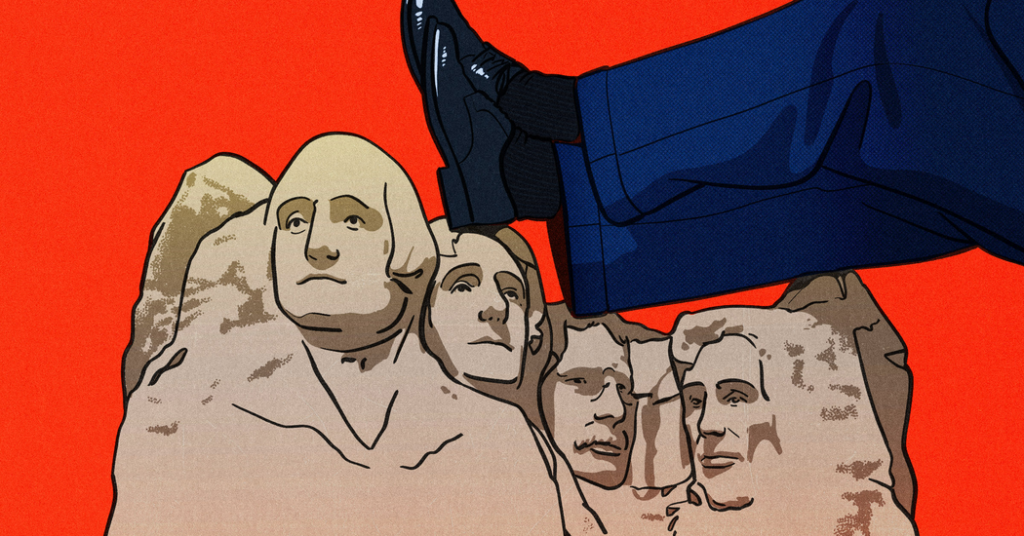
President Trump is dwarfed by his predecessors. I can attest that even in disgrace, the private Nixon had an aura of ravaged dignity that remained presidential in scale. When I watch the current president and his toadies wreck our patriotic landmarks and essential tools of governance, I recall the lament of Riddley Walker, the eponymous hero of the 1980 Russell Hoban novel. It was a best seller among intellectuals who thought a supposedly dimwitted and warlike Ronald Reagan would usher in a dystopian future. Riddley, deprived of education and speaking a degenerated dialect, is nonetheless an acute observer of the radioactive ruins of a once great technological society. He glimpses the majesty of what has been lost, saying, “O what we ben! And what we come to!”
By ending the Cold War, Reagan taught us the limits of prediction and the indispensable asset of a calm, balanced personality and, dare one say it in this environment, a kindly nature — something sorely lacking in Mr. Trump’s offenses against good taste and common-sense management. Barber’s work can seem demonstrably dated — he died in 2004 — since the MAGA faithful, in two watershed elections, chose vengeance over idealism, retribution over healing. Yet in one respect, Barber seems morbidly prescient in defining the playbook by which three presidents of benign intent — Woodrow Wilson, Herbert Hoover and Lyndon B. Johnson — drove down their approval ratings by a “narrow insistence on a failing course of action despite abundant evidence of the failure.” How better to describe Mr. Trump’s decision to launch a so far winless conflict in Iran under the guidance of a madcap secretary of war?
The historical record will show that Mr. Trump fails to measure up, even allowing for the grandiose private failings of a Nixon or Bill Clinton. The videotaped highlights of Mr. Trump’s cabinet meetings could be marketed for reality television as “Spoiled Trust Fund Brats of New York.” What we are witnessing on the ravaged White House grounds is a kind of low-rent yard sale devoted to racecars, wrestling and housebroken rockers. Even his presumptive heirs have demeaned themselves: JD Vance by cheapening the word “hillbilly” in a book about his ersatz Appalachian upbringing, and Marco Rubio, the intellectual star of the cabinet, by defending nutty policies on Iran, Cuba and Venezuela.
Taken as a group, Mr. Trump’s management team has defeated the political journalism rulebook. As Richard Reeves observed in New York magazine in 1974, political “journalism has its limits” in describing ineptitude. Recounting President Gerald Ford’s bumbling speech to a Republican rally in Colorado, he reported, “President Ford had nothing to say and said it badly to a friendly and respectful but slightly stunned crowd of 5,000.” He added, “It is not a question of saying the emperor has no clothes — there is a question of whether there is an emperor.”
The midterm elections will test Barber’s central maxim that character matters. The public expected commanders in chief “to personify our betterness in an inspiring way,” he wrote, to exhibit “a moral idealism” that is “the very opposite of ‘politics.’” Was this era of role model presidents ended by Mr. Trump’s monetization of the White House, and the unregulated machinations of billionaires? Barber would have argued that Mr. Trump’s excesses must surely trigger the self-correcting pendulum of the old democracy. The elections of 2026 and 2028 will tell us whether the digital tide has swept that mechanism away, along with the Washington etiquette book.
Press relations is a good place to start with Jimmy Carter, whom I covered during his Georgia governorship for The Atlanta Constitution and during his presidential campaigns for The St. Petersburg Times and The New York Times. Contrary to his soft manners, Carter had a steely core shaped at Annapolis and was calculating about using the press. He first tried seduction, as when he volunteered a scathing assessment of the corruption of Georgia’s highway director. Carter and his wife, Rosalynn, and I were in a state plane on a trip to the director’s Georgia hometown, and he spoke with such vehemence that his wife tried to hush him. He reminded her, a little snappishly, that he and I had already agreed we were off the record. He was testing my honesty and also providing useful evidence to her role as a key political adviser. From his point of view, the worst that could happen was that a harshly true assessment of a political enemy would show up in the state’s paper of record. He wanted to show that he had the steel spine required at Annapolis.
I kept my word about this off-the-record rant but soon got my own snapping-at for an article that angered him. Carter had spoken at a medical meeting outside the state, touching on health care reforms that were not popular in Georgia. I made that the news of my account, and the next day I encountered Carter at the western entrance to the Capitol. He angrily said I had ignored his main points. I responded that I was exercising my right to selectivity in what I chose to report. “Next time, be less selective,” he snorted, marching away across the rotunda.
The experiences contrast with Mr. Trump in several ways. No previous Georgia governor held such frequent news conferences for the useful civic purpose of informing voters about a feckless legislature. Looking back, I realized Carter was rehearsing for his then-secret presidential aspirations. He was schooling himself in the rhetorical precision that seems to have eroded for Mr. Trump. In the Oval Office, stately address has yielded to the stream-of-consciousness rant, often with sexist targeting. And compassion, a quality glaringly missing in Mr. Trump, came naturally to Carter. There was clearly no political gain in his decisions to focus on cervical cancer screenings and day care for special needs children, both transformative in the poor counties of rural Georgia.
Highly empathetic, Carter could sometimes seem ill at ease in casual social settings. President George H.W. Bush and President George W. Bush were his opposites in that regard. The elder Bush talked a good game of “kinder and gentler,” but he was myopic about the impact of his tightfisted social policies. I had breakfast with him and Barbara Bush in their private quarters one frigid winter morning. Bush had invited me to go fishing with him and a local anchorman on the Potomac. In clear view along Pennsylvania Avenue were homeless people, bundled against the cold. How, I wondered, could they observe this every morning at breakfast and not be moved to a programmatic response to the plight of the unhoused?
Yet a few hours later, when the fast Coast Guard cutter carrying us hit an underwater object and bent its shaft, Bush displayed a more sensitive side of his personality. As the wounded boat limped along, he went forward and reassured the enlisted helmsman that he was not to blame. Like other politicians raised in privilege, he had a relaxed social manner. When he hosted his last White House Christmas party after losing the 1992 election, he told me in the receiving line that he had read about my recent promotion at The Times from chief of the Washington bureau to editorial page editor. “Your career is going like this,” he said, raising his hand in an upward slant. “And mine is going like this,” he added, reversing the gesture to indicate a steep decline.
Such grace notes did not surface frequently with his son, who invited a joking camaraderie with reporters, saddling them with nicknames like “Pancho” that had the effect of putting them in their lesser places. When reportedly drunk, he started an argument in a Dallas restaurant with Al Hunt, The Wall Street Journal’s Washington bureau chief, over Mr. Hunt’s coverage of his father. When I was editing the editorial page, he asked me how I felt about moving from Washington to New York. “I can’t stand that place,” he said with startling candor.
My takeaway was that the elder Bush’s homespun affectations — like his preference for pork rinds and country music — were politically calculated, while W.’s preference for the crude charms of Texas was unfeigned and real. His main advisers, Karl Rove and Karen Hughes, were Lone Star enforcers who made clear to me that they detested the Northeast. They assured me their client had no interest in coming to The New York Times for the editorial board meeting that was traditional for nominees of both parties. I lobbied hard through G.O.P. intermediaries and succeeded in getting their decision reversed. Mr. Bush bounced into the meeting room full of good cheer and small talk as he shook every hand. As he grasped mine, he leaned over and said, “Thank you for setting this up,” in a tone that was somewhere between sincerity and an inside joke. At the least, the younger Bush could banter without throwing bomb-like insults.
Mr. Trump would seem to share with Barber, the political scientist, a high regard for showmanship in presidential role-playing. But Mr. Trump seems not to have studied the timing and flourishes of the master of White House theatricality. Contrast Reagan’s bravura moments with the endless filibuster of a Trumpian weave. Reagan was confident that his “Evil Empire” speech and his challenge to the Soviet leader Mikhail Gorbachev would scorch their way into the history books. His ease and language have nothing in common with Mr. Trump’s mechanical dance steps and depth-charge insults about the stupidity and ugliness of his enemies. One difference is that Reagan had an agile sense of humor and an actor’s feel for staging.
I think of the summer of 1980, when Ronald and Nancy Reagan leased Wexford, the Blue Ridge farm that John and Jackie Kennedy established as their weekend retreat. One evening, they hosted a garden party for the traveling press corps and the crew, including flight attendants, of their campaign plane. Mrs. Reagan, in a summery dress, moved through the crowd on the muscled arm of a T-shirted network cameraman who was a California bodybuilder. Reagan was encircled by reporters who asked how he felt about the jokes about approaching his 70th birthday. Well, he said, I enjoy everything that a younger man enjoys. The winking response was an amusing parry of a question that Mr. Trump most likely would have greeted with vulgarity.
In his relaxed way, Reagan never let his ideology become a MAGA-like straitjacket. When he and Tip O’Neill were at swords’ points over Social Security in 1983, Reagan’s chief of staff, James A. Baker, arranged for secret nighttime meetings at his home, where the two sides made a deal that allowed both men to save face. Reagan, for all his conservative fervor, never feared compromise or tried to humiliate his opponents.
For decades, Hugh Sidey, Time’s veteran commentator, closely monitored the appearance of the Oval Office. He regarded its understated décor and buttery light as enduring emblems of presidential character. His book “Portraits of the President” was subtitled “Power and Personality in the Oval Office.” The chapter “Home Sweet White House” tracks the subtle adjustments in paint color, drapes and rugs that took place when the elder Bush moved out for Bill Clinton. Historic art pieces were displayed on clean, uncluttered walls. Thanks to criticism on Fox News and the book “Regime Change,” we have the image of Mr. Trump gluing clutter to those walls. He claims it is real gold, but the visual statement says Hobby Lobby.
When presidents I observed deployed humor, it was seldom a weapon of ridicule. Carter told of announcing in an Iowa barbershop that he was running for president. He recalled the barber saying, “Yeah, the boys and I were just laughing about that.” I once heard Nixon jest to a small group of reporters about his failure to burn the Watergate tapes. He, like Clinton and the sometimes befuddled Reagan, was a figure of flawed majesty. For the next two years, thoughtful citizens will have no choice but to beat on against the current of a presidency that is all flaws and no majesty.
Howell Raines is a former executive editor of The New York Times. His most recent book is “Silent Cavalry,” a Civil War history.
The Times is committed to publishing a diversity of letters to the editor. We’d like to hear what you think about this or any of our articles. Here are some tips. And here’s our email: [email protected].
Follow the New York Times Opinion section on Facebook, Instagram, TikTok, Bluesky, WhatsApp and Threads.
The post This Presidency Is All Flaws and No Majesty appeared first on New York Times.