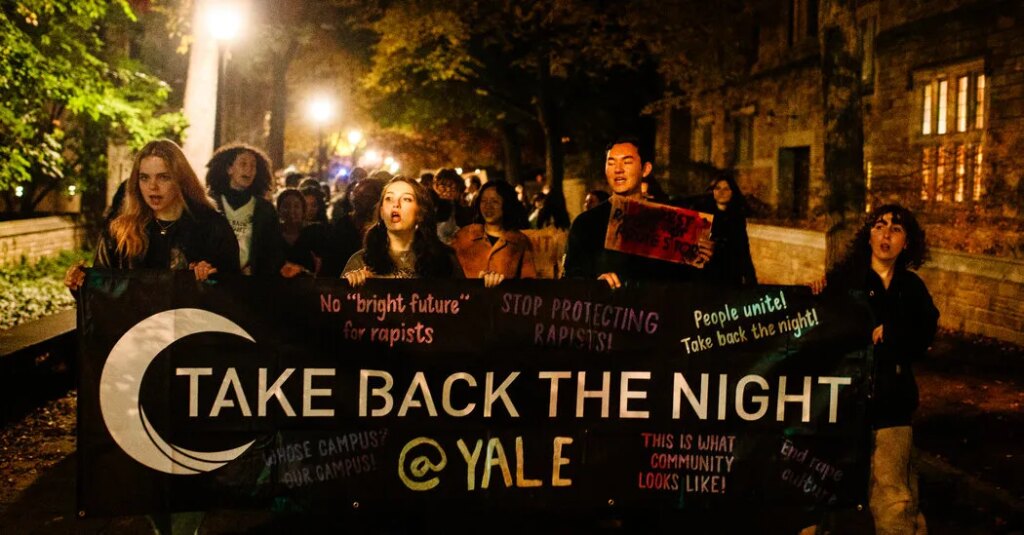
Students gathered on college campuses on Sunday night for a joint event organized by the group Take Back the Night to protest sexual violence on campus in the wake of allegations of rape at Cornell University.
At Yale University, about 100 students stood outside Sterling Memorial Library, holding signs that read, “I Refuse to Watch My Friend Become Jane Doe,” and “We Shouldn’t Still Be Here.” Jane Doe is the pseudonym used by the woman in the Cornell case in legal filings to protect her identity.
At the University of California, Berkeley, the gathering was closer to 50 people. They walked from Sproul Plaza to California Hall, the campus’s main administrative building.
“I was, like, really, really angry,” Angie Mendoza, 21, a U.C. Berkeley senior, said of the Cornell case. She said she came to support a friend who was speaking at the rally.
For decades, Take Back the Night rallies have been a feature on college campuses, often as grass-roots events organized by students angry at the pervasiveness of sexual assault.
Starting in the 1990s, Katie Koestner, then a student at The College of William and Mary who had been raped and found her university’s response lacking, began to organize local chapters nationwide. In 1999 she founded a nonprofit, Take Back the Night Foundation, to carry the work forward. Ms. Koestner, now 54 and the group’s executive director, organized the event on Sunday.
She said in an interview that it was intended to raise awareness about rape on campus and show that, while public attention has been on the case at Cornell, the problem is much broader.
Tessa Stewart, a senior at Yale, said that while she had heard of Take Back the Night before, she didn’t know what it meant until this fall. “It’s really inspiring to know that in doing this, we are reviving this legacy of organizing,” she said.
Ms. Koestner said students from dozens of colleges had signed up to take part, but it was not clear on Sunday night how many people had actually attended.
Of the handful of people who went to the gathering at the University of Colorado, Boulder, half of them were university faculty or staff members. They sat in a mostly empty conference room watching a livestream that Ms. Koestner hosted. The video stream featured a Broadway actor, an Olympic swimmer and an N.F.L. player, all with personal stories of sexual abuse they had suffered as children or young adults.
As of 8:30 p.m. Eastern time, half an hour after the event began, 53 people were watching the livestream.
At Cornell University, just six people showed up to view the livestream in the basement of St. Luke’s Lutheran Church near campus.
Student organizers at Cornell said they were unable to get a place on campus because they could not find a sponsoring club in time. They also said that they had had little time to get the word out because the rally was put together quickly.
Take Back the Night began in the 1970s, at a time when the common understanding of sexual violence was “this idea of strangers jumping out of bushes,” said Lisa Wade, a sociology professor at Tulane University and author of “American Hookup.”
“It was a response to this idea that women could not walk alone at night,” she said. The early rallies, she said, “were fueled by rage that it wasn’t fair.”
In the 1980s, feminists turned to the term date rape, she said, and the idea of the danger coming from someone you know. Today the term date rape “has really fallen out of use,” she said, and the danger now is seen as coming from parties and networks of people, as in the case at Cornell.
She argued that the #MeToo era showed how hard it was to get accountability for sexual violence, despite the successes of the feminist movement of the 1970s. She said that the Cornell case was another example of the difficulty of holding men accountable, and that the rallies on Sunday might reflect frustration over that.
At least one rally was held last week. On Wednesday night, around 100 students gathered at the University of Chicago to call for changes to the school’s safety and disciplinary policies following two reports of sexual assault at separate fraternity houses in October.
Shay Castle, Zoya Haq, Benjamin Leynse, Kim Bellware and Heather McCabe contributed reporting.
The post Campuses Join Take Back the Night Gathering to Protest Sexual Violence appeared first on New York Times.