Just over half of young men voted for President Trump in the last election, prompting a political debate about what propelled their move to the right.
Now, seven in 10 men ages 18 to 29 disapprove of Mr. Trump’s job performance, according to an analysis of the final three New York Times/Siena University national polls.
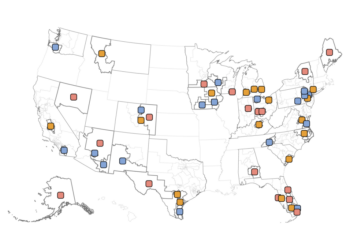
Two years ago, before and after the election, The Upshot interviewed a number of young men who supported Mr. Trump. To learn what changed, we called some of them back.
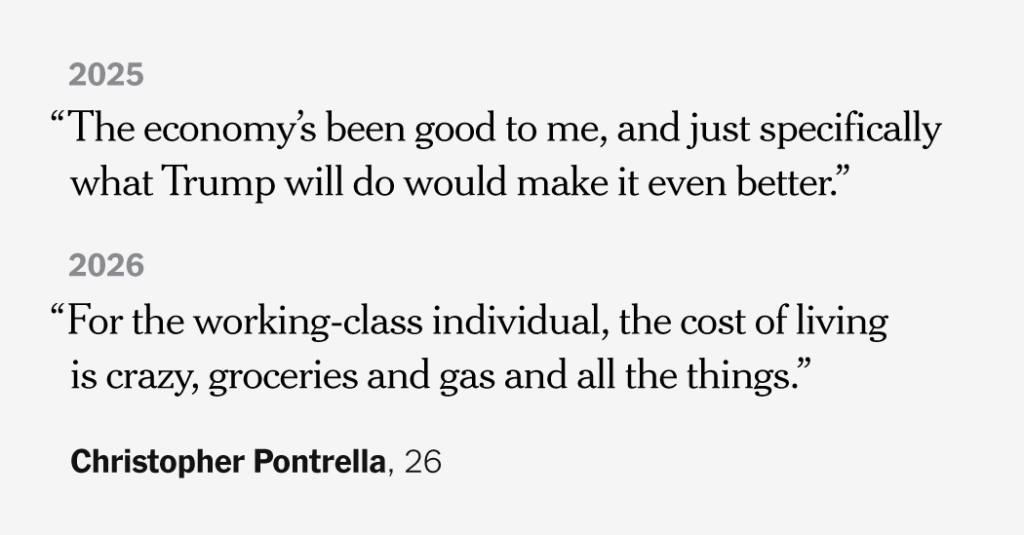
All of them had complaints about Mr. Trump’s presidency, particularly about prices and the war in Iran. But while some said they’d take back their vote if they could, they weren’t necessarily supporting Democrats in the midterms.
Several said they backed their state’s Republican candidates — they didn’t blame them for Mr. Trump’s decisions, and they hadn’t been persuaded by Democrats’ pitches. Others weren’t planning to vote or hadn’t given it much thought yet.
Matthew Michels, 26, an engineer in Grand Rapids, Mich., is not planning to vote, in protest against the Trump administration, and because “I haven’t seen enough pushback against some of the stuff Trump’s been doing from establishment Republicans.”
He credited the immigration crackdown for opening more jobs in his field. But he is upset by the “careless swagger” with which he said Mr. Trump conducts foreign policy. He is “deeply disappointed” by the war in Iran. He’s worried about rising gas prices.
“If I could go back, I would not cast a vote for him again,” he said.
Ranger Irwin, 22, who works at a tire store in North Las Vegas, Nev., said he felt Mr. Trump broke his promises.
“He really said he was going to be antiwar, and we’re in war in the Middle East again,” Mr. Irwin said. “The price of everything’s gone up; gas is getting ridiculous again.”
Still, he said he’d cast the same vote again, and plans to vote for the Republican candidates for Congress and governor in Nevada: “It’s not their decisions, it’s his decisions.”
More young men, though, have extended their disapproval of Mr. Trump to the party. They favor the Democratic candidate for Congress in their district by 13 percentage points, Times/Siena polls show. Forty-eight percent identify as Democrats or lean that way, compared with 42 percent who lean Republican.
The analysis, which included nearly 500 men ages 18 to 29, is broadly consistent with other polls showing young men moving away from Mr. Trump. Still, it doesn’t mean they’ll turn out to vote, said Charlie Sabgir, director of the left-leaning Young Men Research Project: “Midterms favor the highest propensity voters, and young men are the opposite of that.”
Much was made of whether young men’s support for Mr. Trump’s macho campaign marked a cultural turning point — a generation of men under the sway of the manosphere, rejecting broadening gender roles.
But a vote for Mr. Trump was not necessarily an embrace of male dominance or a desire to turn back women’s rights, a variety of research has shown. Rather, this was a group that felt undervalued and unmoored. Young men have been telling us and researchers that the path to adulthood they were counting on — get a good job, buy a home, support a family — was no longer available to them, and Mr. Trump promised to help.
“I think a lot of people misread the results of 2024, viewing it as young men are suddenly becoming more conservative, that they’re sick of woke politics,” said Melissa Deckman, a political scientist who is chief executive of the nonpartisan Public Religion Research Institute. “But a fundamental issue was the economy.”
In the Times/Siena polls, 90 percent of young men said the economy was poor or only fair.
In a new survey from Third Way and the American Institute for Boys and Men, a majority of men ages 18 to 29 said long-term economic goals were out of reach — including finding a good-paying job, supporting a family, affording medical care, paying down debt, owning a home and saving for retirement.
Logan Fischer, 23, got a new job as an engineering technician in Kansas City, Mo., since we last talked with him, and he credited the Trump administration for improving job opportunities. But he still feels his “lifelong goal,” buying a house to raise a family, is unattainable.
“A lot of older people will say, ‘Go to college, get a degree, then you can find a wife, build or buy a house and live happily ever after,’” Mr. Fischer said. “It’s like, I’m making good money now, but it’s not build-a-house money, when 10 years ago it would have been.”
Malachi Bohlmann, 25, a high school teacher in Phoenix, voted for Mr. Trump in part because of the strength he thought he’d show in border control and foreign policy.
But he is unhappy with Immigration and Customs Enforcement’s tactics, and with the war with Iran.
“When I was in the service, we talked about being able to be ready to strike at any given time to defend our people at any cost,” said Mr. Bohlmann, an Air Force veteran. “I don’t like America attacking first.”
He said he would vote on Tuesday but had yet to make a final decision on the candidates.
Even as some young men move away from Mr. Trump, they still don’t necessarily see a place for them in the Democratic Party.
Although young people as a whole are moving to the left this election, young women remain much more Democratic than young men. Three-quarters of them identify as Democrats or lean that way, according to the three Times/Siena polls, 27 percentage points more than young men.
While young men “might be drawn to an economic agenda that’s more Democratic, they have questions about whether they would be welcomed and wanted in the Democratic coalition,” said Daniel Cox, a senior fellow at the American Enterprise Institute, a right-leaning think tank, and author of “Generation Uncoupled: America’s New Gender Divide and the Crisis of Human Connection.”
“I think there’s still this lingering hesitancy on the left to forcefully advocate for the interests of young men,” he said.
Mr. Fischer, the engineering technician in Kansas City, echoed that idea.
“I feel like one of the Democrats’ main topics in every election is for minorities, for immigrants,” he said. “I feel like their thing is to hit this niche group and get all their votes.”
Though he’s mad about the Iran war, he still thinks voting for Mr. Trump was the right choice, in part because the alternative was Kamala Harris, and “every time I saw her she was talking about abortions.” He said he’s unlikely to vote this week.
As the two parties prepare for 2028, young men swinging right and left should not be interpreted as a desire for a centrist candidate, said Mr. Sabgir of the Young Men Research Project.
Rather, he said, what resonates with many of them is a distrust of institutions and career politicians, and a belief that the system needs to be torn down and rebuilt.
In the interviews with Trump-voting young men, many said they wanted a candidate like Bernie Sanders — who also blames the establishment for disadvantaging ordinary people.
“It’s something more like the Joe Rogan approach of being pretty economically populist and thinking free health care is cool,” Mr. Sabgir said, “but also having an aversion to the excesses of wokeness that young men often associate with the Democratic Party.”
Nate Cohn contributed reporting. Production by Rachel Buigas-Lopez.
The post We Called Back Young Men Who Voted for Trump. He’s Losing Them. appeared first on New York Times.