No one thought Curtis Malone would be back, not even Curtis Malone. Not the way things ended. The scandal, the media circus, the prison sentence. He’d said he would start a business or something when he got out — just nothing to do with basketball.
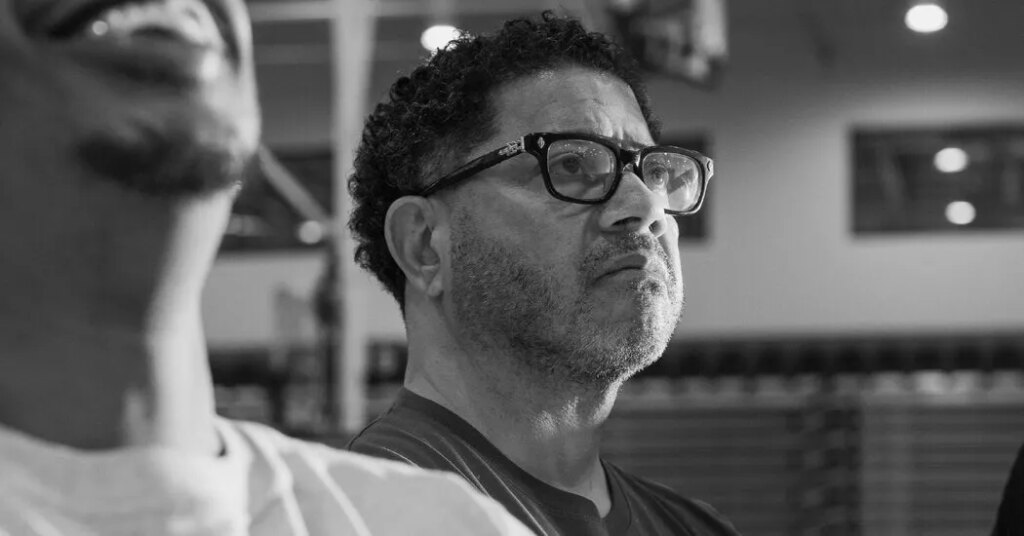
And yet there he was, courtside on a Saturday afternoon in March, watching a gym full of high school boys with N.B.A. aspirations compete for a spot on one of his teams. Well, partly watching; he had people for that. Mostly he was on the move, conferring with coaches, sweet-talking parents, taking call after call from scouts and business partners and guys he’d never even heard of — an unending succession of calls from people who all, in one way or another, needed him. Can you find this kid a school? Can you put in a word with the Wizards? Can you get us into the Georgetown game? His phone rang every five minutes or so. “It’s nonstop,” he told me. “Every day.”
But, god, he’d missed it — the handshaking, the backslapping, the maaan, how you been? of it all. For 20 years, from the 1990s to the 2010s, he was the godfather of the basketball scene in Washington, D.C. His American Athletic Union program, DC Assault, basically the basketball equivalent of a travel soccer team, was not just the undisputed No. 1 program in the area but one of the best in the country. His teams won national championships and sent players to the McDonald’s All-American Games, top colleges and the N.B.A.
Malone, who co-founded Assault in his mid-20s, was the top decision maker, the recruiter in chief and the public face, but he was also more than that. To many of his players, he was a surrogate father. And in the broader basketball world, he was a major power broker. College coaches knew that if they wanted to recruit in the area, one of the country’s richest veins of basketball talent, they had to go through Curtis Malone. One day, he aimed to parlay his ever-expanding network of influence into a career as an N.B.A. agent.
Then the whole thing collapsed. In 2013, federal agents raided Malone’s home and arrested him on drug-trafficking charges. At the same time that he was running DC Assault, it turned out, he was also presiding over a sprawling cocaine and heroin operation, moving millions of dollars’ worth of product each year. His alias, he said, was Whitey.
Through his drug business, Malone had undermined the community that raised him. At the same time, he funneled part of the proceeds into DC Assault to help kids escape the community he was himself destroying. “He’s helping young men,” a D.E.A. agent on the case told Sports Illustrated in 2014, “but at the same time he could be poisoning their parents or relatives.” Malone’s stepdaughter called it “the most dysfunctional Robin Hood story ever.” He was sentenced to 100 months in prison.
In May 2020, Malone came home. Despite having renounced his career in basketball, he started hanging around gyms, and before long, coaches came seeking his counsel. Parents asked when he was bringing DC Assault back. He began to feel “the itch” again. And when he got the opportunity to join a league sponsored by New Balance, he couldn’t resist. In late 2025, after 13 years away, Malone announced that he was restarting DC Assault, with the goal of rebuilding it into a national powerhouse, only clean this time — no drugs, no drug money, no double life.
At the Saturday tryout in March, players were vying for spots on one of the program’s three squads made up mostly of high schoolers — the under-15s, the under-16s and the under-17s. They would start their season in April and compete through midsummer. As the day wound down and the gym emptied out, Malone made a final pitch to one of his top recruiting targets for the under-17s, a sharpshooting 6-foot-4 combo guard named Sean Nix who drove six hours from Charlotte, N.C., to be there. “It’s like choosing Duke and North Carolina when it comes to A.A.U.,” Malone told him. “This is one of the all-time great programs in A.A.U. history.” Nix nodded.
After tryouts, Malone and his coaches treated a group of out-of-towners to lunch at a nearby sports bar. He’d already outfitted them with DC Assault gear and New Balance shoes, and when one boy said goodbye, Malone slipped him a thin stack of $20s — for gas, he said. Nix had skipped lunch to get some extra shots up, but that afternoon his father texted Malone: “We’re IN. Let’s make DC Assault great again.”
“Congratulations, man!” one of the coaches said, clapping Malone on the shoulder. “This [expletive] is back!”
“It ain’t back yet,” Malone answered. To him, back meant more than just … existing. Back meant being the best, and for the moment, still a month out from its first official games, DC Assault was nowhere near that. The world of youth basketball had transformed since Malone went to prison. Shoe companies had consolidated control, so that virtually every major team now played on one of their circuits. Dozens of current and former N.B.A. stars now sponsored their own teams. In the D.C. area, rival programs had supplanted Assault, and the New Balance league wasn’t providing anywhere near the funding that Adidas and Under Armour once had. Nor could Malone supplement the budget anymore with, shall we say, alternative income streams.
That Malone could restore Assault to anything like its former glory was far from certain. How he would react if he couldn’t was an open question. But he wasn’t worried. He would figure things out. He was Curtis Malone! With a little time and a little money, he would re-establish his dominance. “When I get that backing,” he said, “nobody gonna beat me.”
Everybody knows Curtis Malone. He’s the kind of guy who can walk into a restaurant with a 45-minute wait and be seated five minutes later. He never feels self-doubt, he told me, and he has a tendency to speak about himself in the third person, as when he chats up a waiter at his favorite seafood place (“You know you’re talking to Curtis, right?”) or when he utters one of his catchphrases (“Curtis is gonna be fine”). When Malone was a teenager, his father used to refer to his friends as his “associates,” because one boy couldn’t possibly have so many friends, but Malone never saw it that way. At a high school basketball showcase early this year, I watched him greet more than 50 people like family. He shook hands, dispensed hugs, came up behind one man and play-acted like he was dunking on him. How could you not want to be friends with Curtis Malone? When, on occasion, he forgot someone’s name, he flashed his signature mischievous-child grin, and all was forgiven. He calls that “the Malone smile,” and it works just as well now, at 58, as it did when he was a kid shoplifting candy bars from convenience stores.
There is no other private Curtis Malone. He never turns off and hardly ever spends time alone. His ex-wife, Monica Smith, told me that during their nearly 10 years of marriage, they “saw each other in passing,” to the point that she started calling him “the married bachelor.” His current wife, Gail, told me she sometimes feels as though she is raising her husband. “This man thinks life is a party,” she laughed. “He a roadrunner,” his mother said — always has been.
Malone’s earliest role models were drug dealers. Ronald Byrd. Irvin Wallace. Twin Jones. Growing up in Palmer Park, Md., he thought of these men as his godfathers.
Malone’s real father, he told me, was a straight-shooting Alabama disciplinarian. Served four years in the Air Force and worked the rest of his life at a bus terminal in downtown D.C. Out of the house in his pale-blue uniform at 5 a.m. everyday. Plus night shifts a few days a week at a 24-hour store that they all called “the fruit stand.” And what did he have to show for it? A World War II-era starter home and some meager savings.
Malone’s father commanded respect, but his godfathers made life look glamorous, easy. “Byrd, he was just so smooth,” Malone reminisced, and the way he said it, it was as though he could see the man rolling up in his sky-blue Lincoln Mark V. When Malone hung out with these guys, he felt smooth, too. They slipped him cash, kept him well-dressed and handled anyone who threatened him. When they got Chinese food, they ordered the whole menu. They showed him respect, taught him a code: Never steal, never lie, never use.
Of the many children who roamed the neighborhood’s alleyways, Malone was known as one of the first out to play in the morning and one of the last home at night. He spent much of that time playing basketball at the local rec center and over time developed a reputation as a talented point guard. His godfathers took notice, even paying for him to attend basketball camps that his parents couldn’t afford. Byrd and Wallace had been serious athletes before becoming dealers, and Malone thinks that they might have seen something of themselves in him — that they wanted him to succeed where they knew, at some level, they had failed.
And yet Malone couldn’t help thinking: Could dealing really be so bad if these men were doing it? To this day, he maintains that they were “some of the best mentors I could’ve had.”
For a while, Malone took their advice. He went to play basketball at Hampton University, a historically Black research college on the shores of the Chesapeake Bay. He tried to be a regular college kid. But he didn’t get along with the coach and never saw any court time, and he was always short on cash. At a party during his second semester, he met a dealer who went by the name New York C. Being around the hustle, he said, “just always gave me the itch,” and with his basketball career foundering, he finally gave in to it. At first, he sold powder a little cocaine and PCP, but before long he dropped out and scaled up to a full-on crack operation. His street crew back in Prince George’s County hustled on corners. His enforcers stepped in when it became necessary to “tough up the competition or shoot one of your customers.” New York C was his main supplier. Malone learned how to cook the product himself. Before long, he had turned the road he grew up on into a crack strip.
Malone is cleareyed, to a point, about the damage he did. “Crack destroyed Palmer Park and my city,” he writes in his memoir, “Duplicity: Basketball, Drugs and My Double Life,” published last year. (The cover depicts a hand tossing a bag of cocaine into a basketball hoop.) “I’ve known people who’ve stolen from their mother — their children — to get high.” Some of his closest friends were addicts. His sister Beverly drifted in and out of rehab. When he urged her to get help, she told him a dealer was no better than a user. “It hit a nerve,” he told me, “because she was right.” Still, he dealt.
In 1990, Malone was arrested in his father’s front yard and did three months in jail after pleading guilty to drug charges. A few years later, he started DC Assault at a Maryland rec center with a few buddies, among them his best friend Troy Weaver, now a top executive with the N.B.A.’s New Orleans Pelicans. The program started as a single team, mostly neighborhood kids, but things took off fast. Malone had an eye for talent, plus a pre-existing network of relationships. “My recruiting tactic,” he once explained, “was, I’m going to find out what neighborhood the kid is from, and I’m going to see who’s the biggest drug dealer in that area — who got influence. And that’s who I’m going to see.”
Within three years, the team’s starting five included four future McDonald’s All-Americans. College coaches came calling. John Thompson, the head coach at Georgetown, helped land DC Assault a sponsorship offer from Nike, but Sonny Vaccaro of Adidas swooped in with an even better one. They had made it. Serious people wanted things from them. Major corporations jockeyed for the privilege of paying them. And Malone was running the show. “Leadership is everything to me,” he told me. “I just can’t see myself being second or third in charge. If I’m going to go rob a bank, I don’t need nobody to drive the car. I’m going to drive the car too. I’ve got to be my own getaway driver.”
Of Assault’s four future All-Americans, DerMarr Johnson was the best. Malone met him one afternoon in 1995, when a friend called him from a D.C. playground and told him to drop whatever he was doing and come see this kid: 14 years old, 6-foot-7, throwing down dunks and raining in 3s. Johnson joined DC Assault and before long moved in with Malone. As a high school junior, he was the top-ranked underclassman in the country, and in his lone year at the University of Cincinnati, N.B.A. scouts salivated over his “limitless” offensive potential. The Atlanta Hawks picked him sixth in the 2000 N.B.A. draft.
Malone had already established DC Assault as one of the nation’s premier A.A.U. teams, but not until Johnson did he internalize that a top player could be his ticket to the big time, his path to legitimacy. He was the one navigating his players through high school. He was the one driving them to practices, feeding them, sometimes even paying their parents’ rent. Then agents swooped in at the last minute to profit off their success. “If we’re doing all the work,” he thought, “why wouldn’t we reap the benefits?” The same skills that made him a successful drug dealer made him successful with DC Assault, he thought, and they would make him a successful agent too. “It’s all the same thing,” a dealer friend once told him, “crack, PCP or car parts” — or basketball prospects.
DC Assault’s second true superstar was Michael Beasley. When Malone met him in 2002 at age 13, Beasley’s father was in prison, and the son already had his own troubles with the law. Beasley also moved in with Malone — who was living with his wife at the time, Monica Smith — and developed into a top prospect. After a phenomenal freshman year at Kansas State University, he was a lock to be selected in the top three picks in the draft. Malone had lined up an agent, whose firm he planned to join as a partner after draft night. Beasley would provide instant credibility for signing other stars.
After the draft, though, Beasley cut off Malone and the agent and eventually replaced them with an industry veteran. Malone still doesn’t know why. “It was a very, very hurtful time,” he told me, “because we had put so much time into building this kid up, into helping him grow up so his life could change.” (Asked for comment, Beasley said he feels “no malice” toward Malone and regrets losing touch with Smith.)
Malone had shifted his focus away from dealing as he worked to start an agency, but as his dream of legitimacy collapsed, he turned back to drugs. If he couldn’t make it big as an agent, then he would make it big as a dealer. He would still be a leader, just a different kind. He hit up his old contacts, and soon he was moving more and more kilos. He told himself that dealing was only temporary — one more good run, and he would quit. He never did.
In 2012, a heroin dealer who bought from him sold drugs to a confidential informant. The D.E.A. tapped the dealer’s phone, which led them to Malone. For more than a year, officers conducted in-person surveillance, listened in on his calls and watched him from a secret camera installed on a telephone pole outside his house. In August 2013, they arrested him at home, where they found an estimated $150,000 worth of cocaine and heroin.
Malone doesn’t speak much about his prison time, but when he does, he talks about it as though it were a long retreat — “a big weight off my shoulders.” He started playing basketball again and ran every day. He sipped moonshine and studied in the law library. “I tell you what, it wasn’t hard for me,” he said, “and I done seen it be hard for people.” I asked if there were any difficult moments. He said there were not.
Despite all this, despite his history as a dealer and his multiple prison stints and his years of deception, parents still trust him. They call people they respect in the youth basketball community, and those people tell them that Curtis Malone is the real deal. He goes to watch their kids play — travels great distances on winter nights when he surely has a million better places to be — and says all the right things. They believe, above all, that he will deliver for their children. And why shouldn’t they? Look at his résumé! He’ll make sure their baby lands a scholarship, maybe even a lucrative name-image-likeness deal. And that, in the end, is what it’s really all about.
The 2026 season got off to a rickety start. At a Richmond showcase in early April, the DC Assault under-17s went down 19 points in the first half to an Adidas-sponsored team that has produced a handful of N.B.A. players over the past decade, then rallied back and took the lead — only to lose it again in the final seconds. Two weeks later, facing a local rival in D.C., the under-17s coughed up another last-minute lead at the end of regulation, then lost on an overtime buzzer-beater.
Some parents were already beginning to grumble. In the old days, Malone dealt mostly with absentee parents who were grateful for him to keep the kids out of trouble. “We used to pick kids up in the ’hood,” he told me. “The kids used to be hard.” Once, at a tournament in Las Vegas, he intercepted a sex worker on her way to his players’ hotel room. “Now,” he said, “mothers and fathers be carrying these [expletive] shoes and bags.” The parents are never satisfied, never think their child is getting enough minutes, enough shots, enough spotlight.
And the stakes have never been higher. Recent legal developments making it possible for colleges to pay athletes mean even high school recruits who may never go pro are now just a step away from potential multimillion-dollar payouts. A series of noteworthy performances can alter a kid’s life. But the competition has also intensified: The N.C.A.A. has made it easier for college athletes to transfer schools multiple times without losing playing time, which means that high school recruits now compete not just against one another but also against college players.
Although it can feel uncomfortable to acknowledge, elite youth basketball players are both children and commodities. When scouts and analysts speak of “talent pipelines,” the phrase is less than literal but more than metaphoric. Top players really are a sort of natural resource. That, in large part, is why global brands like Nike and Adidas invest millions of dollars in their youth-basketball circuits. A fraction of the kids on those circuits will play for top colleges, and a fraction of those college players will make it to the N.B.A., and a fraction of those N.B.A. players will become N.B.A. stars, and a fraction of those N.B.A. stars will become the kind of high-wattage megastars whose endorsements sell market-moving quantities of sneakers.
DerMarr Johnson had sneaker potential. So did Michael Beasley. And in Beasley’s case, it was the complications arising from that potential — and the blurring of the lines between child and commodity — that in large part caused the collapse of his relationship with Malone.
When Malone went to prison, Beasley spoke affectionately of him despite the falling out. “He’s my father,” Beasley said in a 2014 interview. “All the stuff that I have been through, he’s been there for me.” But more recently, Beasley has struck a different tone. “Curt played a major part in my life,” he said on a podcast last year. “But I paid for that.” He suggested that Malone might have used him — that he demanded payment, once Beasley had made it to the N.B.A., for the support he had given him growing up. If he really was a son to Malone, why should he have to pay? (Malone acknowledges receiving a monthly $5,000 stipend from Beasley from January to September 2009, but he insists he never asked for money.) On another podcast the year before, Beasley was even harsher.
“He really took a liking to y’all,” the host said of Malone. “Loved on y’all like y’all was his.”
“Nah, nah,” Beasley interjected. “We ain’t going to go that far.”
“You don’t think so?” the host asked.
“You got kids?” Beasley asked back.
“Yeah.”
“How old?”
“Fifteen, 10 and 5.”
“When they get older, when they grow up, how much money they going to have to pay you?”
Johnson sees things differently. When a near-fatal car crash derailed his N.B.A. career in 2002, Malone flew to see him in the hospital hours after hearing the news. And in the years that followed, as it became clear that Johnson would never make it big, Malone stuck with him. He might have thought of Johnson as his “ticket,” but Johnson never felt that way. He thought of Malone as a father figure and still does. “I don’t know where I would have been,” Johnson told me. “My whole family sold drugs. The N.B.A. was just something that was on TV.” If Malone could make some money off his talent, all the better. “Use me all you want,” Johnson said.
If Beasley stands for the idea that Malone used his players, then Johnson stands for the idea that he loved them. In reality, both are true. Malone himself has said as much. They were his tickets — whether or not Malone ever asked Beasley for money, he hoped Beasley’s success would advance his own ambitions — and they were his sons. If that seems to verge on contradiction, well, that’s Curtis Malone.
The only time I ever saw Malone get emotional was when I asked him about Beasley’s podcast comments. Eight months had passed since the most recent ones, but they still seemed fresh in Malone’s mind. He leaned in, elbows on the table, and looked me in the eyes, speaking as though directly to Beasley.
“Would you have made it without Curtis?” he asked. “When I got you, you were a troubled kid, ankle monitor at 13 years old. I sent you to four, five different schools. I did. Your mother didn’t. Monica took you to every dentist appointment, every [expletive] doctor’s appointment when your tooth hurt, when you needed stitches.”
“I’ve never done anything to you,” he went on. “I’ve never done anything but love you — unconditionally. I loved you unconditionally.”
The Henrico Sports & Events Center in Glen Allen, Va., delivers basketball at industrial scale, basketball farther than the eye can see, an Amazon fulfillment center’s worth of basketball. Twelve courts under one deific roof. Twelve games happening all at once. Twelve whistles blowing and 12 balls bouncing and 240 sneakers — New Balance, all of them — squeaking across semi-reflective hardwood on this April afternoon. The smell of soft pretzels and beer by the concessions stand. The smell of adolescent sweat everywhere else. Parental sanity at a premium. During one game, police officers intervened to prevent a fully grown man from coming to blows with a gaggle of prepubescent boys who threatened to shoot him. This is an undiluted dose of high-level youth basketball, straight to the veins. This is where the comeback began in earnest.
The team’s goal in Glen Allen was, in a sense, rhetorical: to persuade the A.A.U. world that DC Assault was — or at least would soon be — every bit the juggernaut it once was. Eventually that would mean winning the New Balance circuit championship in July and beating top teams on the vaunted Nike and Adidas circuits. But if Assault couldn’t take care of business at a regional New Balance event, it had no chance of achieving those loftier ambitions.
“The man, the myth, the legend,” an opposing coach said as he dapped up Malone courtside. He was one of the coaches of Showtime Ballers, a team based in Orlando, Fla., that spent a few years in the late 2000s as the Florida outpost of DC Assault but pivoted after Malone “resigned,” as he sometimes euphemistically puts it. “He didn’t know me from a can of pork and beans,” Diana Gillion, one of Showtime’s founders told me about Malone. “He stepped in and just helped us out when we really needed it.” All these years later, Showtime was the DC Assault under-17 team’s first opponent.
The game did not start well. Showtime played fast-paced, hard-nosed basketball, and the Assault players seemed rattled. Stagnant on offense, disengaged on defense. Malone stood on the base line, arms-crossed, impassive. He almost always watches games this way, with an expression like he’s reviewing tax documents. Dunks that unleash delirium on a gym hardly register. Not much excites him, he said, because he has seen it all: “A dunk? OK. Block 10 shots and get 10 rebounds.”
Midway through the second quarter, Assault fired up air balls on back-to-back possessions. At halftime, the team trailed by 9 points, and that deficit was flattering. “Look at this [expletive], man,” an older guy said to Malone. “Go-lly.” He didn’t answer.
But Assault came out for the second half more organized, more energetic. Three minutes in, Showtime’s 9-point lead had evaporated. Malone started to get into it. “It’s a dogfight, baby,” he jawed at a referee. “We need some calls too!”
With the game tied at 61 in the final minute, Showtime stole a careless inbound pass and pulled ahead by 2. Timeout, Assault.
Anxiety emanated. The specter of the recent heartbreakers in Richmond and D.C. loomed. With Assault down 2 and only a few seconds to play, the feeling courtside was: Not again.
The referee blew his whistle. The teams took the court. The inbounder arced a pass to a forward in the far corner. “Shoot it!” someone yelled, but that wasn’t the play. Sean Nix came racing around a screen at the top of the key, caught a pass from the forward just behind the three-point line and, in one fluid motion, rose up for a fade-away jumper. The shot hit the net just as the buzzer sounded. Assault 64, Showtime 63.
The bench stormed the court. Malone — who has seen it all — shook his head and smiled. For a moment, at least, the comeback felt complete.
But only for a moment. There is always more to do.
Malone is still angling to make the jump from A.A.U. impresario to N.B.A. agent. He and his stepdaughter, Sydney Smith, have started an agency, and they’re currently courting investors. If the whole agent thing doesn’t work out, Malone knows he would make a good N.B.A. scout, and he hopes one of his old friends in the N.B.A. could help him land a job. If none of that comes together, Malone and Smith have also started a production company. They have a writer at work adapting “Duplicity” into a movie, and by the end of the year, Malone intends to start writing a second volume, this one focused on “the redemption side.”
But DC Assault, he says, is still his “true calling.” In July, after an impressive season, the under-17s were knocked out in the quarterfinals of the New Balance circuit championship tournament. The under-15s won the whole thing. All in all, a strong showing for a program that was never expected to play again — but not the old dominance. DC Assault still can’t compare to the best team in the area. But just give him another recruiting cycle, Malone says. He has even got former Assault players from France and the Republic of Congo scouting overseas. He showed me a photo of a 7-foot French 10th grader. “They say he’s very, very skilled,” Malone said. “They say he’s like a little Wemby.”
If the under-17 team fell short, that was in part because not long after the tournament in Glen Allen, two starters left to join a rival A.A.U. program, one of them arguably Assault’s most talented player. Malone had done everything he could to keep the kid — reassured the mother, even had the tournament organizers hang a banner with his photo. So much for that. On top of the two departures, another D.C.-area team had tried to poach two of his best under-16 players. And a rival coach had sent one of Malone’s players the video of Beasley criticizing him, along with the message, “Are you sure y’all did your research?”
None of this surprises Malone. He expected other coaches in the area to use his past against him. “They really don’t want me back,” he told me. “They smile at you, shake your hand, stab you in the back.”
In the old days, his opponents would never have gotten away with this. But that, he said, “is the different side of me.” He’s not like that anymore. He regrets what he did — or some of it anyway. He admits that he could have struck “a better balance,” but to have left the hustle behind entirely would have felt, on some level, like renouncing his upbringing. “Duplicity” is dedicated, with intentional ambiguity, “to the game.”
From the beginning, Malone modeled himself on his idols: “I watched Twin or Irvin dole out wads of cash and knew I wanted to be just like them when I grew up,” he writes. “And wasn’t I?” He too handed out cash, but he also helped kids secure scholarships. “I not only emulated my childhood idols,” he continues, “I surpassed them.” For better and for worse, DC Assault was built in their image.
It still is. But Malone is going legitimate. So when his rivals disparage him or poach his players, he simply tries not to worry too much about it. “What I’ve learned is if a kid with me leaves me and goes to another team, and that kid done been on three or four teams already, what you think he going to do again?” he asked rhetorically. “The pattern is what it is, man.”
He could, of course, just as easily be talking about himself. When college basketball didn’t pan out, he turned to dealing. When his agent plans fell apart, he turned to dealing again. If things didn’t work out this time, I asked, would he turn to dealing a third time?
“There’s nothing that I’m doing that’s not going to work out,” he said. “That’s not going to happen. ‘Not work out’ is not even in my vocabulary.”
And the way he said it, how could you not believe him?
Jacob Stern is a writer from Washington, D.C. He has written about lightning-strike survivors, anti-government ranchers and a boxer who killed his opponent in the ring.
The post He Ran a Youth Basketball Empire. He Also Had a Massive Drug Operation. appeared first on New York Times.